





Wall Street’s smart money is decisively bullish on data center infrastructure, with TD Cowen’s latest supply chain checks describing record hyperscaler leasing led by Meta Platforms (NASDAQ:META | META Price Prediction), Microsoft (NASDAQ:MSFT), and Alphabet‘s (NASDAQ:GOOGL) Google, while Morgan Stanley has warned clients that the memory shortage will intensify into 2027 and 2028. That view lands after weeks of selling in data center names, creating a contrarian setup. The gap between institutional conviction and current tape is the story.
What the Checks Actually Show
TD Cowen serves up a slew of data this week:
Our checks indicate a record ~9.6GW of 2Q26 DC leasing led by META, MSFT, and GOOG, with a record ~12.5GW leasing pipeline as 1) OpenAI upsizes its roadmap to 30GW by 2030, 2) Anthropic ramps +1GW intl. requirements, and 3) Meta leasing continues unabated.
Moreover, the Wall Street Journal reports that OpenAI now plans to spend $750 billion on data centers through 2030, up from a prior plan of $600 billion.
Morgan Stanley, in a note relayed by commentator Tae Kim on X, also conducted their due diligence:
But we spent last week talking to several of our purchasing contacts in the data center space, and the intensity of the shortages in that part of the business show no signs of abating. We see prices up at least 25% on a like-for-like basis from 2q to 3q, above our estimates and above 3rd-party estimates. As importantly, the longer-term concerns that the memory shortage will intensify in 2027 and again in 2028 are still as strong as ever.
That undercuts the AI-bear thesis that hyperscaler spend is peaking.
Analyst price targets reinforce the bullish framing. Vertiv (NYSE:VRT) stock carries a mean target of $379.20 against 22 buy or strong-buy ratings. Micron Technology (NASDAQ:MU) stock shows a consensus price target of $1,491.95 across 40 buy or strong-buy ratings. Equinix (NASDAQ:EQIX) stock shows a mean price target of $1,199.66, with Morgan Stanley recently raising its own target to $1,075.
The Gap Between Targets and Tape
Every name on this list has recently pulled back. Vertiv stock is down 9% over the past month, Equinix stock is off 6%, and Digital Realty Trust (NYSE:DLR) stock has fallen 5%. Micron stock sold off 14% on the month before rebounding this week.
In any case, the fundamentals have held up. Vertiv reported Q1 2026 revenue of $2.649 billion, up 30% year over year (YoY), with a $15 billion backlog and organic orders up 252%. Digital Realty booked a 200-megawatt AI inference lease, the largest hyperscale deal in its history. Micron delivered Q3 FY2026 revenue of $41.456 billion, up 346% YoY, with gross margins of 85% and guided Q4 revenue of $50 billion.
Moreover, Equinix logged record annualized gross bookings of $474 million, with 60% of its largest deals AI-driven. For a retail investor deciding today, the setup is a compression of price against improving fundamentals and hardening analyst conviction.
Names That Could Be Interesting
Vertiv is the picks-and-shovels play on power and cooling. The Global X Data Center & Digital Infrastructure ETF (NASDAQ:DTCR) bundles Equinix and Digital Realty with chip names for diversified exposure, with Equinix at 14% and Digital Realty at 13% of the fund; single-sector concentration is the tradeoff.
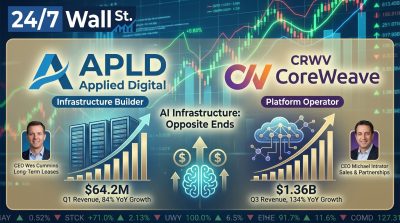
Equinix and Digital Realty are the landlords capturing leasing demand directly, with Digital Realty running roughly 3.0 gigawatts in place and about 6.3 gigawatts buildable. Micron is the sharpest expression of Morgan Stanley’s memory-shortage call. CoreWeave (NASDAQ:CRWV) rents AI compute against a $99.4 billion revenue backlog, though a widening net loss, $7.7 billion in Q1 CapEx, and a securities fraud class action make it the highest-risk name here; CoreWeave stock has slid 26% in a month.
The evidence behind TD Cowen’s leasing figures and Morgan Stanley’s memory checks is quantitative, current, and consistent with what these companies are reporting themselves. The bear case is that these remain analyst projections that might not fully play out, valuations are stretched, and these names remain volatile. No matter how you slice it, investors should consider keeping their position sizes modest and treating this sector as ideas worth researching rather than sure things.
Contact [email protected] for any questions or corrections.

















 Top Gaining Stocks
 Top Losing Stocks