





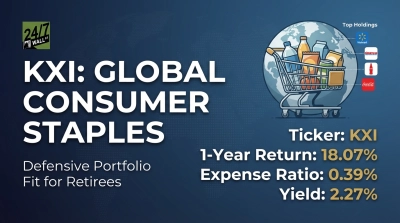
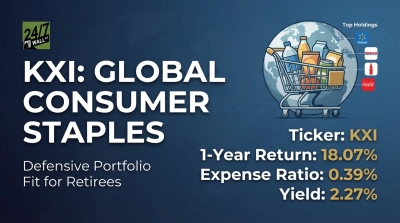
KXI pays a 2.2% dividend yield by owning shares in the world’s most recognizable consumer staples companies, passing that income through to investors each quarter. With nearly 20 years of operating history and a portfolio built around household names, it has earned a reputation as a conservative income vehicle for retirees. But a 2.2% yield sits below the current 3.75% federal funds rate, which means retirees need the total return story to justify holding it over cash alternatives.
What’s Actually Holding Up That Yield
Walmart (NASDAQ:WMT | WMT Price Prediction) and Costco (NASDAQ:COST) together represent nearly 19% of the portfolio but contribute almost nothing to income. Walmart yields roughly 0.8% and Costco under 1%. Their value to KXI is stability and capital appreciation, not dividends.
The real income engine sits in the next tier. Philip Morris International (NYSE:PM) carries a 3.1% yield and has raised its dividend every year since its 2008 spinoff, growing the payout 8.9% in 2025 alone. With 2026 adjusted EPS guidance of $8.38 to $8.53 and smoke-free products generating 41.5% of revenue, the dividend looks well-supported.
Coca-Cola (NYSE:KO) is a 63-consecutive-year dividend grower, yielding about 2.6% with a 67% payout ratio. Its 2026 free cash flow guidance of approximately $12.2 billion comfortably covers its annual dividend obligation. Procter & Gamble (NYSE:PG) is a Dividend King with over 60 consecutive years of increases and a 61.7% earnings payout ratio, leaving room to keep growing even as organic sales growth stays modest.
PepsiCo (NASDAQ:PEP) has raised its dividend for 50-plus consecutive years and just increased the payout 5.0% to $5.69 annualized, a sign of management’s continued commitment to income investors. However, the balance sheet carries meaningful leverage, which is worth monitoring. Elevated debt levels can constrain future dividend growth if earnings come under pressure, making PepsiCo the one holding in KXI’s income tier where retirees should pay attention to cash flow trends.
Total Return Puts the Yield in Context
KXI has returned 18.1% over the past year and is up 13.6% year-to-date as of February 24, 2026. That price appreciation layered on top of the 2.27% yield gives retirees a more compelling total return than the headline income figure suggests. Global diversification introduces some foreign exchange drag but also reduces concentration risk in any single economy.
The Verdict
The overwhelming majority of KXI’s income comes from companies with decades of uninterrupted dividend growth and strong free cash flow, providing a well-supported income foundation. The 2.27% yield, combined with the 18.1% one-year price return, reflects a total return profile anchored by Dividend Kings and Aristocrats. Investors evaluating the ETF may wish to consult a financial advisor to determine whether its yield and growth characteristics align with their individual income needs.
Contact [email protected] for any questions or corrections.












 Top Gaining Stocks
 Top Losing Stocks