




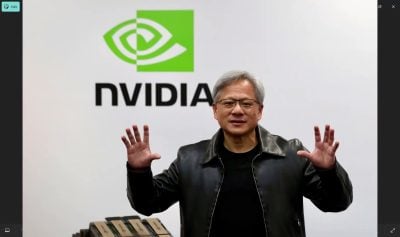
My portfolio has benefited from the hyperscaler capex race for the better part of two years now, and even I did a double-take when Dylan Patel, CEO of semiconductor and AI research firm Semianalysis, dropped this on live television:
Google’s free cash flow will be basically zero next year. I don’t think the market is ready for this revelation.
Dylan Patel, Semianalysis CEO
Patel isn’t sounding an alarm. He’s making a bullish argument. His view is that Google and Amazon are the best capital allocators in history, running the best returning businesses humanity has ever produced, and that their conviction on AI infrastructure should be trusted over Wall Street’s skepticism. The FCF-zero outcome is, in his framing, proof of commitment.
The Math Behind the Claim
Alphabet (NASDAQ:GOOGL | GOOGL Price Prediction) generated $73.266 billion in free cash flow in FY2025, which sounds enormous until you look at what’s coming. CEO Sundar Pichai has guided for 2026 capital expenditures in the range of $175 to $185 billion. For context, Alphabet’s FY2025 operating cash flow was $164.713 billion. If capex hits the midpoint of that guidance range, it consumes essentially all operating cash the business generates. Patel’s math checks out.
The trajectory has been accelerating hard. In 2023, Alphabet spent $32.3 billion on capex. In 2024, that rose to $52.5 billion. In 2025, it hit $91.4 billion, a 74% year-over-year increase. The proposed jump to $175-185 billion in 2026 would be another near-doubling. Q4 2025 alone saw capex grow 95% year-over-year to $27.9 billion.
This dynamic is playing out across the peer group. Amazon (NASDAQ:AMZN) already lived this story in 2025: FY2025 free cash flow collapsed 65.95% year-over-year to $11.194 billion as capex hit $131.8 billion. CEO Andy Jassy has guided for approximately $200 billion in capital expenditures across Amazon in 2026.
Meta (NASDAQ:META) and Microsoft (NASDAQ:MSFT) are spending aggressively too. Meta’s FY2025 free cash flow declined 19.39% year-over-year to $43.6 billion against 2026 capex guidance of $115 to $135 billion. Microsoft’s Q2 FY2026 capex alone was $29.9 billion, up 89% year-over-year.
Patel’s broader point is that tech insiders understand the technology better than financial markets, and that returns on AI infrastructure will ultimately justify the spend. The businesses backing these bets are not struggling — Alphabet posted Google Cloud revenue of $17.7 billion in Q4 2025, up 48% year-over-year, with a 31.6% operating margin at the Alphabet level. Full detail is in Alphabet’s SEC filing.
Whether it’s applied enough is exactly what Patel is questioning. If you believe AI infrastructure is a winner-take-most game and Alphabet and Amazon are positioned to win it, the FCF compression looks like the price of admission. If you think the returns won’t materialize at the scale management expects, zero free cash flow at a $1.7 trillion market cap is a very different conversation.
Contact [email protected] for any questions or corrections.





 Top Gaining Stocks
 Top Losing Stocks