Buy, Sell or Hold Credo Technology After the Selloff to $150?
Credo (NASDAQ:CRDO | CRDO Price Prediction) slid from $210.97 on May 11 to below $160 in five trading days, and the only question that matters at this price is whether hyperscaler capex still justifies n 87x trailing earnings multiple. The…

This post may contain links from our sponsors and affiliates, and Flywheel Publishing may receive compensation for actions taken through them.

Credo (NASDAQ:CRDO | CRDO Price Prediction) slid from $210.97 on May 11 to below $160 in five trading days, and the only question that matters at this price is whether hyperscaler capex still justifies n 87x trailing earnings multiple. The argument for and against this stock is unusually balanced.
Credo designs high-speed plumbing inside AI data centers. Active electrical cables, retimers, optical DSPs, and SerDes chiplets move bits between GPUs, switches, and racks at speeds up to 1.6 terabits per second. That narrow product set sits directly in the path of every dollar Amazon (NASDAQ:AMZN), Microsoft (NASDAQ:MSFT), and others spend on AI infrastructure. The selloff reflects a stock that ran 282% in a year. At that level, even good news struggles to clear the bar.
The bull case
Fiscal Q3 revenue was $407.01 million, up 201.5% year over year, beating consensus by 5%. Non-GAAP EPS came in at $1.07 against a $0.94 consensus. Operating income jumped 471.2% on the same revenue base. That is genuine operating leverage at scale.
Management opened three new addressable markets on the call. ZeroFlap optics, Active Line Cards, and OmniConnect memory solutions, each described as a multi-billion-dollar opportunity.
The balance sheet carries $1.3 billion in cash + equivalents with essentially no debt, and institutions have been buying, with Swedbank lifting its stake 47.1% to roughly $296.8 million. Of the analysts covering the stock, 4 rate it Strong Buy, 12 Buy, and 1 Hold, with a consensus target of $209.09.
The bear case
The valuation here demands flawless execution, and if management fails to do that, I’d expect more selloffs. The forward multiple of 32x only narrows the gap if growth holds.
Q4 guidance pointed to gross margin compression from 68.6% to 64.0%-66.0%, and inventory increased to $207.9 million. Insiders sold roughly $50.4 million in shares over recent months.
But despite all that, the bear case is still weak and rests mostly on the valuation side. As long as the data center buildout continues, there’s no solid argument for being bearish here. You’re going to see orders continuing to pour in as long as hyperscalers spend on data centers.
The top three customers were 35%, 33%, and 20% of revenue last year. A fourth hyperscaler is ramping, a fifth is in qualification, but until that diversification arrives, any single hyperscaler trimming capex would do more damage than another TAM expansion announcement could repair. But will a hyperscaler trim capex in this environment? Very unlikely.
What the data says for CRDO and what you should do
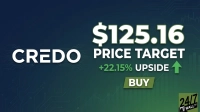
There’s upside if the consensus analyst upside target holds. Most targets were set when the stock traded closer to $188.

Even after the selloff, the stock is up 151% over the past year, well above the S&P 500’s mid-single-digit advance over the same window.
Right now, Credo is a Hold. The bull case on hyperscaler demand is correct. On a long enough horizon the current multiple may even look cheap against the revenue Credo can capture from ZeroFlap, ALCs, and OmniConnect. Hyperscaler spending looks durable, and Credo’s position inside the rack is harder to dislodge than the multiple suggests.
You need to watch the inventory, the guided margin compression, and the insider selling. I’d argue this correction has more to run before the next leg up begins. Buying here means accepting that the trend is still pointed down. On the other hand, selling here means giving up on a structural growth story for a sentiment reset that may already be mostly complete.
CRDO does not pay a dividend, and the AI infrastructure thesis will not resolve in three weeks. Watching the next earnings report, the gross margin landing zone, and any new hyperscaler disclosed at 10% of revenue is worth more than a basis point of entry. I’ll let the next earnings call decide whether the answer is Buy or Sell.
Contact [email protected] for any questions or corrections.
Omor Ibne Ehsan is a writer at 24/7 Wall St. He is a self-taught investor with a focus on growth, cyclical, and dividend equities that have strong fundamentals, value, and long-term potential. He also has an interest in high-risk, high-reward investments such as penny stocks.