Jensen Huang’s $40 Trillion Robot Call Echoes the 1913 Moving Assembly Line. The Pattern Says Buy the Picks and Shovels
Although NVIDIA (NASDAQ:NVDA | NVDA Price Prediction) CEO Jensen Huang rarely lacks for big numbers, his latest one stopped Wall Street cold. Huang has been telling audiences that humanoid robots represent a $40 trillion total addressable market for labor automation,…

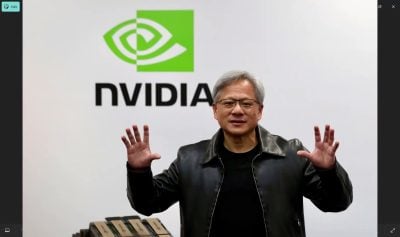
Although NVIDIA (NASDAQ:NVDA | NVDA Price Prediction) CEO Jensen Huang rarely lacks for big numbers, his latest one stopped Wall Street cold. Huang has been telling audiences that humanoid robots represent a $40 trillion total addressable market for labor automation, a figure so vast it dwarfs every consumer technology category that came before it. On the Animal Spirits podcast episode Talk Your Book: Investing in the Rise of the Robots, Derek Yan made the case that physical AI is “potentially bigger” than electric vehicles or smartphones, pointing to Waymo’s autonomous driving as proof the underlying stack actually works.
But the history of transformative production technology suggests the headline operators rarely capture the wealth they create. The durable fortunes tend to migrate one layer down the supply chain, to the unglamorous suppliers every operator is forced to buy from.
I’ve been studying industrial transitions for the better part of two decades, and the pattern repeats with uncomfortable consistency. The picks-and-shovels metaphor itself traces back to the 1849 California Gold Rush, where suppliers to miners often built more durable wealth than the miners themselves. The same logic applied seventy years later, when the modern industrial economy was born on a factory floor outside Detroit.
The 1913 Anchor: Highland Park
In late 1913, Henry Ford introduced the moving assembly line at his Highland Park plant. The mechanical innovation was modest. The economic consequence was seismic. Model T chassis assembly time collapsed from roughly 12 hours to roughly 90 minutes, a step-change in productivity that pulled the automobile from a curiosity for the wealthy into a mass-market necessity within a decade.
The investor’s instinct in that moment was the same as it is today. Buy the operator. Buy the visionary. Buy Ford, or Olds, or Hudson, or any of the hundreds of automakers that crowded American showrooms in the 1910s. The instinct was wrong. Only a handful survived the consolidation that followed. The carnage among auto operators in the two decades after Highland Park is one of the great cautionary tales in industrial finance.
The wealth simply relocated. Suppliers of steel, rubber, glass, and machine tools experienced enormous demand growth as the auto industry expanded. Every carmaker, winner or loser, had to buy sheet steel. Every Model T needed four tires plus a spare. Every windshield needed glass. Every engine needed precision tooling. The supplier sold to all of them, winner or loser.
Why the Pattern Holds
The economics behind this pattern are not mysterious. New end-market operators face brutal competition, high failure rates, capital-intensive scale problems, and the kind of demand uncertainty that destroys balance sheets. Suppliers face a different structure entirely. When dozens of operators are racing to scale the same novel product, the supplier sees aggregated demand from the entire industry rather than concentrated risk from one bet.
The benchmark S&P 500 is filled with descendants of this pattern. The companies that compounded for a century after 1913 were rarely the carmakers. They were the materials, components, and machine-tool firms whose names rarely made the front page.
The Modern Translation
Apply the same lens to physical AI and the categories almost write themselves. The 1913 supply chain was steel, rubber, glass, and machine tools. The 2026 supply chain is compute, sensors, actuators, vision systems, and batteries. Trillion-dollar CEOs are already validating the demand side. Huang is personally directing capital into the space, including $150 billion in annual spending in Taiwan, which he described as “epicenter of the AI revolution”. Elon Musk is doing the same at Tesla (NASDAQ:TSLA).
On the AI Investor Podcast, the hosts framed the scale in similar terms, noting that Elon Musk and Jensen Huang have both suggested physical AI could be a $50 trillion opportunity, a number so big it is hard to falsify. Whether it’s $40 or $50 trillion… it’s safe to say, it’s a very large number!
Arbe Robotics CEO Ram Machness, speaking from inside the sensing layer, observed that “The rise of physical AI is increasing the strategic value of high-quality sensing”. Machness is the modern equivalent of the steel mill operator in 1914.
I am watching the same fingerprints across the news flow. Industrial automation incumbents are quietly capturing the data-center buildout that has to precede any humanoid wave. Semiconductor equipment names are seeing healthy inbound orders across all segments. Power and cooling specialists are accelerating on AI-driven data center demand. These companies are selling to every humanoid OEM in the race.
The Long Memory Verdict
Long term, the stock market still heads higher in the decades to come, and physical AI may well deliver on the trillion-dollar TAM that Huang and Musk are describing. The pattern from 1913 says the technology succeeds, spectacularly, and that most of the headline operators get crushed on the way to that success.
No prediction without a pattern. This pattern says buy the picks and shovels. The supplier just had to keep shipping, regardless of which OEM survived.
Contact [email protected] for any questions or corrections.
I've been writing about stocks and personal finance for 20+ years. I believe all great companies are tech companies in the long run, and I invest accordingly.