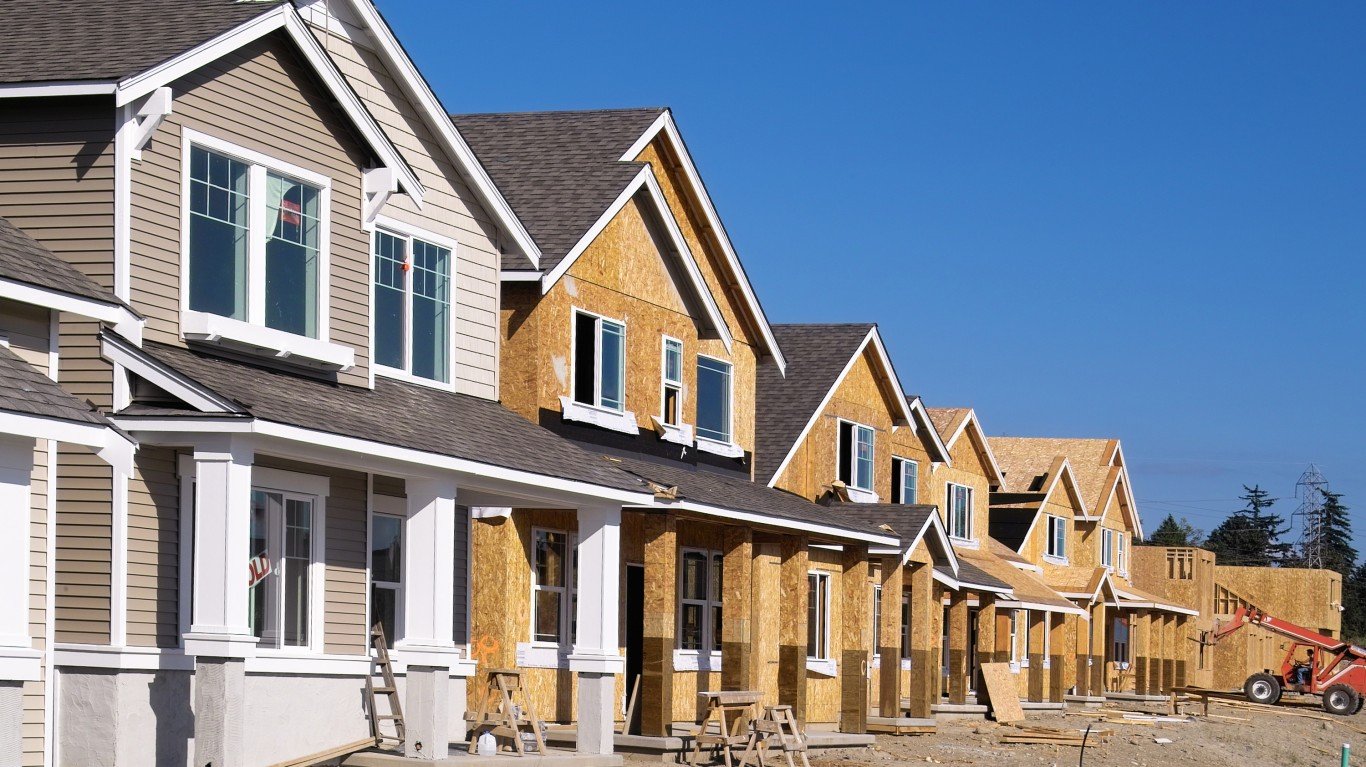
Buffett Just Bought a Homebuilder. One Stock in That Industry Crushed the S&P 500 by 34x Since 1996
Although Wall Street treats homebuilders as cyclical, Berkshire Hathaway (NYSE:BRK-B | BRK-B Price Prediction) just doubled down on the industry in a way that demands attention. On Sunday, May 31, 2026, Berkshire agreed to acquire Taylor Morrison Home for $72.50…

This post may contain links from our sponsors and affiliates, and Flywheel Publishing may receive compensation for actions taken through them.

Although Wall Street treats homebuilders as cyclical, Berkshire Hathaway (NYSE:BRK-B | BRK-B Price Prediction) just doubled down on the industry in a way that demands attention. On Sunday, May 31, 2026, Berkshire agreed to acquire Taylor Morrison Home for $72.50 per share in cash, a $6.8 billion equity deal valuing the homebuilder at roughly $8.5 billion including debt. The price represents a 24% premium to Taylor Morrison’s May 29 close, and it lands as Berkshire’s first major strategic acquisition under new CEO Greg Abel, who succeeded Warren Buffett at the start of 2026.
What’s notable is the timing. Berkshire is buying into housing while data looks weak. Taylor Morrison (NYSE:TMHC) just reported home closings down 26% year over year to 2,268 units, with adjusted home closings gross margin compressing 400 basis points to 20.6%. Housing starts have bounced between 1.273 million in October 2025 and 1.507 million in March 2026, with April’s print at 1.465 million, down 3% sequentially. Buffett, on CNBC, praised the move: “Greg did that faster than I could done it, smoother than I could have done it, and I never talked to the CEO. He has launched.”
Berkshire already owns Clayton Homes, building product subsidiaries, and Berkshire Hathaway HomeServices. Adding a top-tier production builder with roughly $400 billion in cash still on the balance sheet reads as a multi-decade conviction call on the cycle. The deal is expected to close in the second half of 2026.
So here is the question every retail investor should ask. If the smart money is willing to write an $8.5 billion check for a cyclical, commoditized industry, what does the long memory of that industry actually look like?
The one homebuilder that broke the cycle
The S&P 500 has returned roughly 1,800% since 1996. In the same window, one obscure Reston, Virginia builder has delivered approximately 62,000% in price appreciation, with shares trading around $10 in 1996 and near $6,200 today. That gain is roughly 34 times the index’s return.
The stock is NVR (NYSE:NVR), parent of Ryan Homes, NVHomes, and Heartland Homes. Shares last printed at $6,104.80 on May 29, 2026, with a market capitalization of $16.48 billion and a trailing P/E near 15x. NVR has compounded EPS at over 15% annually since 2000, a 25-year track record. From quarterly EPS of $0.24 in Q1 1996 to $121.54 in Q4 2025, the compounding is the entire thesis.

How does a homebuilder do that?
The capital-light model that ate the industry
On We Study Billionaires, episode TIP818, Kyle Grieve framed the central puzzle: “How can you reliably maintain a competitive advantage in a service that is pretty straightforward and maybe even a commoditized service?”
NVR’s answer is structural. Two mechanisms do the heavy lifting. As we’ve previously highlighted in our coverage of capital-light compounders, the model is the moat.
First, NVR does not own land. It uses lot purchase agreements, or LPAs, putting down only 10% deposits with third-party developers. The land risk that has flattened generations of homebuilders in downturns sits elsewhere.
Second, NVR pre-sells homes. Customers agree to purchase before construction begins. Construction is then performed by independent subcontractors. Roughly 90% of revenue is homebuilding and about 10% is mortgage origination. Inventory risk gets pushed onto the buyer, and labor flexes with demand.
Layer aggressive buybacks on top, and you have history’s most efficient homebuilder. NVR has repurchased shares continuously since 1994. Full-year 2025 buybacks totaled $1.82 billion across 243,082 shares, and the board authorized a fresh $750 million program in Q4 2025. Q1 2026 added another $631.96 million across 90,180 shares, per the company’s 8-K filing.
I’ve been watching homebuilders since the post-2009 recovery, and the persistent feature of NVR is that the model holds when the cycle bites. Q1 2026 revenue fell 20% year over year to $1.88 billion, and EPS came in at $67.76 versus a $79.20 estimate. Shares are down 16% year to date and down 14% over the trailing year. NVR still rides the cycle. The only quarterly loss in its 30-year earnings record was Q4 2008 at negative $5.54, and it returned to profitability the very next quarter.
The long memory lesson
The bull case for housing typically gets dressed up in demographic charts and migration patterns. Long term, housing heads higher in the decades to come, and Berkshire is betting that an operator with land, brand, and scale is worth $8.5 billion in the middle of a down year. Retail sentiment seems to agree. Reddit threads around the deal logged bullish sentiment scores of 70 to 72 through the announcement window.
The long memory of the industry says something more specific. The investor who, in 1996, simply bought the builder that refused to own land and refused to build a home it had not already sold did not have to time a single cycle. They piled into a capital-light compounder while everyone else argued about mortgage rates. Roughly 34 times the S&P 500 later. Berkshire is betting the cycle turns. The cycle has turned before. And the winner of the last one compounded through every downturn without ever needing it to end.
Contact [email protected] for any questions or corrections.
I've been writing about stocks and personal finance for 20+ years. I believe all great companies are tech companies in the long run, and I invest accordingly.