Forget Intel: Buy This Ultra-Efficient, Cash-Generative Semiconductor Juggernaut Instead
Intel (NASDAQ:INTC | INTC Price Prediction) is dominating semiconductor headlines again, riding CHIPS Act drama, a U.S. government equity stake, and CEO Lip-Bu Tan’s sweeping turnaround narrative. Intel’s Financials Tell a Different Story Strip away the headlines and the numbers…

This post may contain links from our sponsors and affiliates, and Flywheel Publishing may receive compensation for actions taken through them.

Intel (NASDAQ:INTC | INTC Price Prediction) is dominating semiconductor headlines again, riding CHIPS Act drama, a U.S. government equity stake, and CEO Lip-Bu Tan’s sweeping turnaround narrative.
Intel’s Financials Tell a Different Story
Strip away the headlines and the numbers are ugly. Q1 fiscal 2026 revenue came in at $13.58 billion, up 7.2% year over year, but Intel posted a GAAP net loss of $3.73 billion on a $4.07 billion restructuring charge that included a Mobileye goodwill impairment. Capital expenditures alone consumed $3.64 billion in the quarter against just $1.10 billion of operating cash flow. The Foundry segment lost $2.51 billion in Q4 FY25 alone, and full-year FY25 revenue actually slipped to $52.85 billion, finishing with a $2.21 billion operating loss.
Intel trades at 137x forward earnings on trailing EPS of -$0.60, and the Wall Street consensus target of $88.71 sits well below the current $107.93 price. Q2 FY26 guidance calls for non-GAAP EPS of just $0.20 on a ~39% non-GAAP gross margin. This is a capital-destroying foundry buildout strapped to a slow-growing core CPU business, propped up by government subsidies and a compelling story.
The Real Trade: AMD’s Fabless Compounder
Now look at Advanced Micro Devices (NASDAQ:AMD). CEO Lisa Su runs a beautifully streamlined fabless model, outsourcing manufacturing to TSMC and funneling capital directly into high-ROI architecture research. The result is exactly the structural advantage Intel cannot replicate.
Pillar 1: Asset-Light Wins
Q1 FY26 capex was just $389 million, roughly a tenth of what Intel spent in the same quarter. AMD carries a net cash position with net debt/EBITDA of -0.16 and 28x interest coverage. While Intel burns billions hoping a foundry pays off years from now, AMD compounds today.
Pillar 2: Free Cash Flow That’s Actually Free
FY25 operating cash flow surged to $7.71 billion, free cash flow hit $6.70 billion, and AMD repurchased $1.316 billion of its own stock. Q1 FY26 alone produced $2.57 billion in free cash flow, up 253% year over year. Earnings convert to cash at 1.80x. Intel paid zero dividends in 2025 and is doing the same in 2026.
Pillar 3: A Data Center Juggernaut
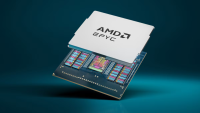
Data Center revenue hit $5.78 billion in Q1 FY26, up 57% year over year, anchored by EPYC server CPUs and Instinct GPUs. The customer roster includes a Meta partnership for 6 gigawatts of Instinct GPUs, an OpenAI deployment of 6 gigawatts on the MI450 Series, expanding EPYC instances at AWS, Google Cloud, Microsoft Azure, and Tencent, plus an Oracle Cloud 50,000-GPU AI supercluster. Lisa Su put it plainly on the Q1 call: “Customer engagement around MI450 Series and Helios is strengthening, with leading customer forecasts exceeding our initial expectations.”
The market has been catching on. AMD has returned 354.98% over the past year, with Q1 FY26 revenue growing 37.8% year over year and non-GAAP gross margin expanding to 55%. Q2 FY26 guidance calls for roughly $11.2 billion in revenue at a ~56% gross margin. Analysts agree: 41 buy or strong buy ratings against 10 holds and zero sell ratings.
Retirement-focused investors chasing the Intel turnaround headline are buying a narrative. The cash flow statements point to AMD as the company that’s already winning. The cash-flow gap between the two names is hard to ignore.
Contact [email protected] for any questions or corrections.
Alex Sirois is a financial writer with experience spanning both retail and institutional investing. He has written for InvestorPlace and held roles at BNY Mellon and Bernstein, giving him a perspective that bridges Main Street portfolios and Wall Street analysis.
Alex holds an MBA from George Washington University and has built his career across multiple industries, including e-commerce, education, and translation — a breadth of experience that informs how he breaks down complex financial topics for everyday investors. His writing is conversational, actionable, and grounded in long-term, buy-and-hold investing principles.
At 247 Wall St., Alex focuses on delivering analysis that is both accessible and useful, with a clear emphasis on helping readers make more informed decisions with their money.