5 Tech Stocks Most at Risk From NVIDIA’s Stranglehold on the Industry
NVIDIA now controls the chokepoint for every major AI buildout, and some of the biggest names in tech are more exposed than their stock prices suggest. Five companies face a reckoning depending on how tightly NVIDIA tightens its grip.

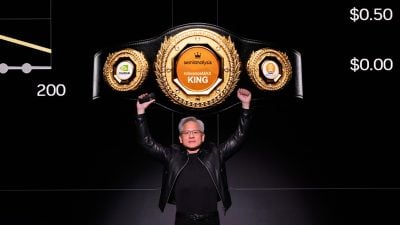
Jim Cramer’s “First National Bank of Nvidia” framing captures a growing unease on Wall Street: NVIDIA (NASDAQ:NVDA | NVDA Price Prediction) has become the de facto clearinghouse for AI compute, and every hyperscaler CapEx dollar, every accelerator roadmap and every foundry partnership now flows through its ecosystem. Cramer specifically flagged the divide between “Tech that’s not semi v. Nvidia,” implying the rest of tech is increasingly hostage to NVIDIA’s pricing power, CUDA moat and product cadence.
The Reddit crowd is saying the same thing louder. The viral r/wallstreetbets post “34% of the S&P is 10 stocks making the same bet. We’re basically all in a leveraged ETF with extra steps” pulled 4,824 upvotes in days. Below, we rank the five tech names most exposed to NVIDIA’s stranglehold, from most at risk to least.
1. Intel (INTC): The Weakest Accelerator Hand

Intel (NASDAQ:INTC) posted Q2 FY26 revenue of $16.13 billion, up 25.4% year over year, with Data Center and AI revenue surging 59% to $6.26 billion. Yet Intel’s Xeon 6 was selected as the host CPU for NVIDIA’s DGX Rubin NVL8 systems, and NVIDIA itself made a $5.0 billion equity investment in Intel. Intel’s Gaudi accelerator is largely absent from the AI narrative, and Intel Foundry ran a $2.1 billion operating loss in Q2. Shares are up 137.52% year to date, but sentiment on Reddit is Very Bearish with a score of 12. CEO Lip-Bu Tan said “AI is driving unprecedented demand for compute,” but Intel is capturing that demand as NVIDIA’s plumbing.
2. AMD: The Only Direct GPU Challenger

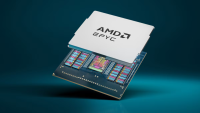
Advanced Micro Devices (NASDAQ:AMD) is the closest thing to a genuine NVIDIA alternative. Data Center revenue hit $5.775 billion in Q1 FY26, up 57%, and AMD locked in a Meta partnership to deploy up to 6 gigawatts of Instinct GPUs, with the first 1-GW on MI450. CEO Lisa Su noted “Customer engagement around MI450 Series and Helios is strengthening.” AMD shares are up 119.31% YTD. But the risk is symmetric: If ROCm never closes the CUDA gap, or Blackwell/Rubin outruns MI450, AMD’s re-rating unwinds. MI308 China export controls cost roughly $440M in FY25.
3. Meta Platforms (META): The Captive Buyer

Meta Platforms (NASDAQ:META) raised its FY26 capex guidance to $125 billion to $145 billion, with Q1 FY26 CapEx of $19.0 billion, up 46.8%. Nearly every dollar of that flows to NVIDIA. Meta is hedging via the AMD 6-GW deal, but for now it is a hostage buyer. Shares are down 16.41% YTD and 29.71% over one year. Reality Labs continues bleeding, with an FY25 operating loss of $19.2 billion. NVIDIA’s pricing power directly compresses Meta’s return on AI capital.
4. Microsoft (MSFT): Scale Cushions the Bill

Microsoft (NASDAQ:MSFT) spent $30.88 billion on CapEx in Q3 FY26, up 84.4%, much of it on NVIDIA silicon for Azure. Satya Nadella said “Our AI business surpassed an annual revenue run rate of $37 billion, up 123% year-over-year.” Commercial RPO of $627 billion, up 99%, gives Microsoft the pricing leverage to pass GPU costs through. Shares are down 2.85% YTD after its post-earnings rally, though. In-house Maia/Cobalt silicon remains a work in progress.
5. Alphabet (GOOGL): The TPU Hedge

Alphabet (NASDAQ:GOOGL) is the least exposed. Google Cloud revenue grew 82% to $24.77 billion in Q2 FY26, and Sundar Pichai credited “demand for AI infrastructure and AI solutions.” Crucially, Google’s TPUs train and serve Gemini at production scale, the only hyperscaler alternative to CUDA. CapEx still ran $44.92 billion in Q2 FY26, up 100%, but a meaningful share bypasses NVIDIA. Shares are up 80.25% over the past year.
Conclusion: Concentration Is the Real Risk
The Polymarket H100 rental market prices in a 95% probability of hitting $2.75 per hour at some point in 2026, and B200 pricing is expected to command a premium above $3.00.
Translation: NVIDIA’s pricing power is intact. Intel is most at risk because it lacks a competitive accelerator; Alphabet is least at risk because it built one. AMD sits between reward and reckoning, while Meta and Microsoft write the checks either way.
Contact [email protected] for any questions or corrections.
Joel South covers large-cap stocks, dividend investing, and major market trends, with a focus on earnings analysis, valuation, and turning complex data into actionable insights for investors.
He brings more than 15 years of experience as an investor and financial journalist, including 12 years at The Motley Fool, where he served as an investment analyst, Bureau Chief, and later led the Fool.com investing news desk. He has also co-hosted an investing podcast and appeared across TV and radio discussing market trends.