The Tech Stock Everyone Wrote Off Just Quietly Built a $553 Billion Backlog
Ten years ago, Oracle (NYSE: ORCL | ORCL Price Prediction) was the database company everyone respected but few investors loved. It had missed the first wave of cloud, ceded ground to Amazon (NASDAQ:AMZN), Microsoft (NASDAQ:MSFT), and Alphabet (NASDAQ:GOOGL), and seemed…


Ten years ago, Oracle (NYSE: ORCL | ORCL Price Prediction) was the database company everyone respected but few investors loved. It had missed the first wave of cloud, ceded ground to Amazon (NASDAQ:AMZN), Microsoft (NASDAQ:MSFT), and Alphabet (NASDAQ:GOOGL), and seemed destined to be a slow-growth dividend payer. A decade later, it is one of the most aggressive AI infrastructure builders on the planet.
From Cloud Laggard to AI Landlord
The pivot took years. Under Safra Catz and Larry Ellison, Oracle poured capital into Oracle Cloud Infrastructure and embedded its database directly inside AWS, Azure, and Google Cloud. That multicloud bet quietly rewired the business. Then the AI buildout arrived, and Oracle suddenly had the right product at the right moment.
The numbers behind the narrative are staggering. In Q3 FY2026, IaaS revenue jumped 84% year over year to $4.888 billion, and remaining performance obligations hit $553 billion, up 325%. Co-CEOs Clay Magouyrk and Mike Sicilia now run a company guiding to $90 billion in FY2027 revenue.
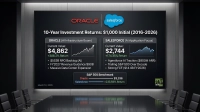
Your $1,000 Became Nearly $7,000
1-Year Return
- Initial Investment: $1,000
- Current Value: $1,420
- Total Return: 42%
- S&P 500 (same period): $1,270 (27.04%)
5-Year Return
- Initial Investment: $1,000
- Current Value: $3,050.90
- Total Return: 205.09%
- Annualized Return: 25%
- S&P 500 (same period): $1,791.50 (79.15%)
10-Year Return
- Initial Investment: $1,000
- Current Value: $6,956.30
- Total Return: 595.63%
- Annualized Return: 21%
- S&P 500 (same period): $3,582.20 (258.22%)
Most of that ten-year gain came in the final eighteen months. Oracle traded near $33.97 in June 2016 and spent years grinding through a slow cloud transition. The stock then ripped to $308.70 after Q1 FY2026 in September 2025, crashed to $196.76 on the December revenue miss, and recovered to $236.34. Holding through that drawdown in one quarter was the price of admission.
The Bull Case, With Eyes Open
The bull case holds up if you believe the $553 billion RPO backlog converts to revenue as scheduled and that AI compute demand stays ahead of supply. Catz has telegraphed OCI growing to $144 billion by FY2030, and she claims most of that is already booked. If she is right, the stock is still cheap on forward earnings at roughly 30x.
The bear case centers on the capex math. Oracle is spending $50 billion in FY2026, trailing free cash flow sits at negative $24.7 billion, and long-term debt has ballooned to $124.7 billion. Any slip in datacenter execution or GPU supply turns this from a growth story into a leverage problem fast.
The takeaway: the backlog is real, the customer list is real, and the multicloud strategy is working. Position sizing matters more than ever after a rally of this magnitude.
Contact [email protected] for any questions or corrections.
Alex Sirois is a financial writer with experience spanning both retail and institutional investing. He has written for InvestorPlace and held roles at BNY Mellon and Bernstein, giving him a perspective that bridges Main Street portfolios and Wall Street analysis.
Alex holds an MBA from George Washington University and has built his career across multiple industries, including e-commerce, education, and translation — a breadth of experience that informs how he breaks down complex financial topics for everyday investors. His writing is conversational, actionable, and grounded in long-term, buy-and-hold investing principles.
At 247 Wall St., Alex focuses on delivering analysis that is both accessible and useful, with a clear emphasis on helping readers make more informed decisions with their money.