




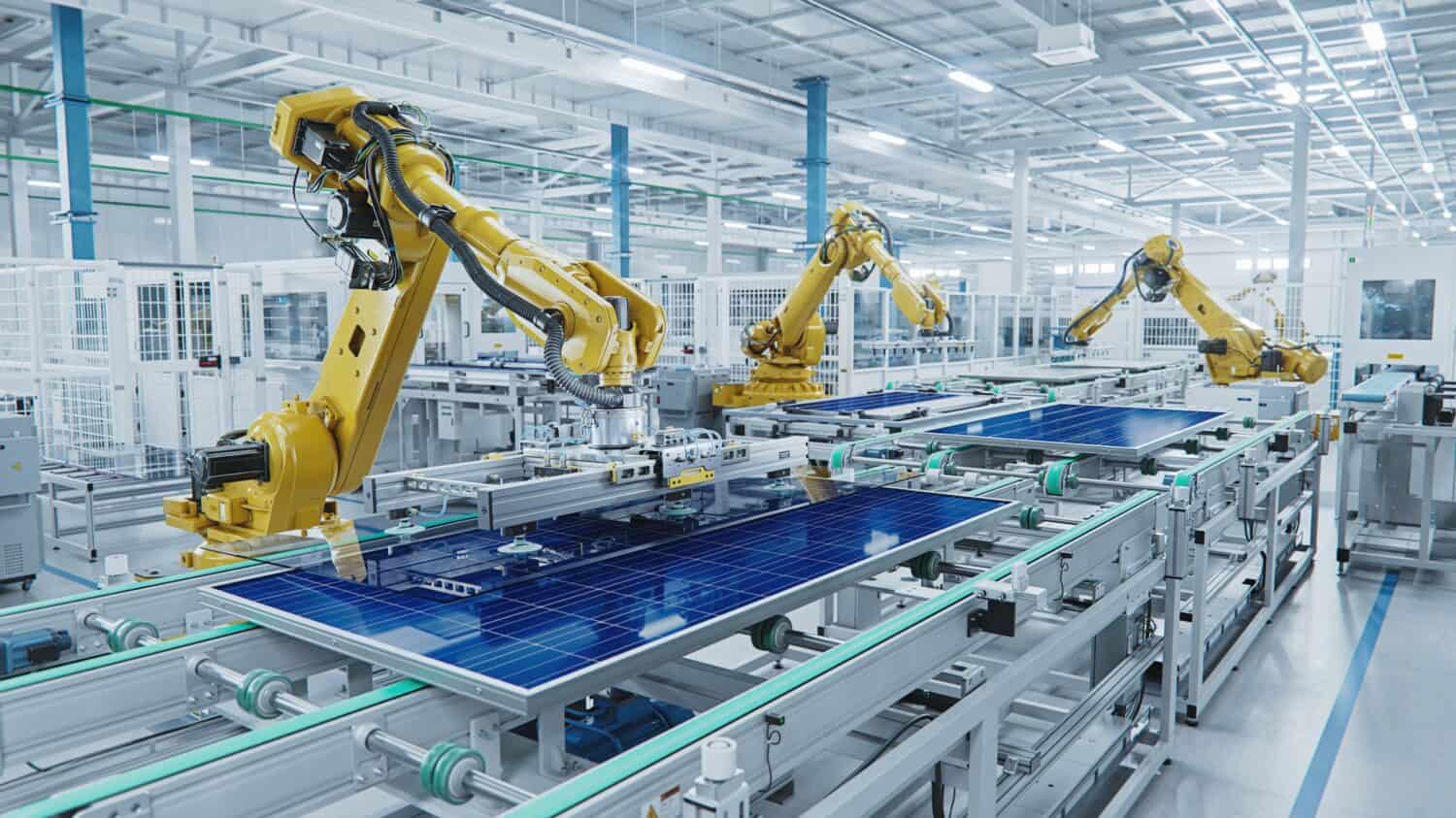
Owning Tesla (NASDAQ:TSLA | TSLA Price Prediction) for the robotics story is now the dominant retail thesis: bulls argue Optimus and the Cybercab are option value the market has not paid for, and that the auto business is almost a free call on humanoid robots. The case has logic. Tesla is installing first-generation Optimus production lines at Fremont and a second-generation line at Gigafactory Texas, both designed to produce 10 million robots a year. The problem is structural. For a reader who wants exposure to robotics rather than a Tesla position, the Global X Robotics & Artificial Intelligence ETF (NASDAQ:BOTZ) already holds companies that ship robots and the chips that train them.
Why the Tesla robotics bet is expensive
Tesla trades at a trailing P/E of 371 with a $1.43 trillion market cap. Optimus revenue today is effectively zero. The upside in robotics is priced into a multiple that already assumes execution. Q1 FY26 was a solid auto quarter, with revenue of $22.39 billion, up 15.78% year over year, and non-GAAP EPS of $0.41. However, the auto gross margin of 21.1% funds the robot program, but does not justify the multiple.
Prediction markets are skeptical of the near-term catalysts that would close the gap. Polymarket assigns a 13.5% probability to an Optimus release by year-end 2026 and a 2.8% probability to a California robotaxi launch by June 30. That means concentrated key-person, regulatory, and execution risk in a single stock that has already declined 15.14% year-to-date.
What BOTZ actually owns
That basket maps to existing robotics revenue. NVIDIA (NASDAQ:NVDA) reported Q1 FY27 revenue of $81.62 billion, up 85.23% year over year, with Data Center revenue at $75.25 billion, up 92%. That is the compute backbone for every robotics program, including Tesla’s own Optimus training. ABB, the Swiss industrial robotics leader, has gained 88.52% over the past year. Intuitive Surgical (NASDAQ:ISRG) just posted 22.96% revenue growth with da Vinci procedures up 16% and Ion procedures up 39%. Cognex (NASDAQ:CGNX), whose machine vision systems sit inside production-line robots, has risen 115.92% over the past year, driven by 24.26% revenue growth.
The diversification mechanism
The argument is the same one that pushes investors into a chip ETF rather than a single chipmaker. Whichever company eventually wins humanoid robots, the picks-and-shovels names (NVIDIA for compute, Cognex for vision, ABB and FANUC for industrial arms) get paid along the way. BOTZ captures that flow today rather than waiting on a single product launch.
The tradeoffs
For taxable accounts, selling Tesla after holding it for a long time would trigger capital gains. A partial swap, sizing BOTZ to the robotics conviction the reader actually has while keeping a residual Tesla position for the auto and Optimus optionality, may be more tax-efficient than a full exit.
What this changes for a Tesla holder
If the reason for owning Tesla is the car company plus full self-driving (FSD), with active subscriptions reaching 1.28 million, up 51% year over year, the position still makes sense on its own terms. If the reason is robotics specifically, paying 378 times earnings for zero current robotics revenue is a steep way to access a theme already represented in a diversified ETF. BOTZ is the cleaner expression of that thesis, with the tradeoff that the upside is spread across many names rather than concentrated in one.
Contact [email protected] for any questions or corrections.









 Top Gaining Stocks
 Top Losing Stocks