





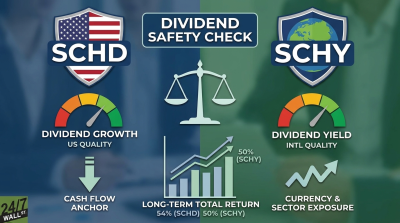
There is a lot to like about the Schwab U.S. Dividend Equity ETF (NYSE:SCHD). At a 0.06% expense ratio, investors get what is essentially a high-quality, value-oriented multifactor ETF for almost nothing in fees.
The fund tracks the Dow Jones U.S. Dividend 100 Index, which screens for quality rather than simply chasing the highest yields. Companies must have at least 10 consecutive years of dividend payments and are further evaluated on free cash flow to total debt, return on equity, dividend yield, and five-year dividend growth. That combination of income discipline and balance sheet rigor is what has kept SCHD popular through multiple market cycles. It is also worth noting that Schwab executed a 3-for-1 share split in October 2024, so any pre-split price comparisons need to be adjusted accordingly.
The income is respectable as well. SCHD offers a 30-day SEC yield around 3.35% while trading at a relatively reasonable multiple compared with the broader S&P 500 index, making it a natural starting point for income-focused portfolios.
That said, international equities remain cheaper still. If the goal is to roughly mirror the global stock market, around 30% to 40% of an equity portfolio would typically go toward international developed and emerging markets. Income investors who want that diversification do not have to sacrifice yield to get it.
Here are two international dividend ETFs that some income investors are choosing alongside, or instead of, SCHD.
Schwab International Dividend Equity ETF (SCHY)
The Schwab International Dividend Equity ETF (NYSE:SCHY) serves as SCHD’s global counterpart. The fund has grown to approximately $2.31 billion in assets under management and charges a very competitive 0.08% expense ratio.
SCHY tracks the Dow Jones International Dividend 100 Index, applying many of the same quality screens used by SCHD, including the 10-consecutive-year dividend payment requirement and screening for financial strength. The result is a portfolio with a pronounced large-cap value tilt, but at noticeably cheaper valuations than its domestic sibling. The portfolio trades at approximately 15 times earnings compared with SCHD, while still maintaining solid profitability. Price-to-book is also meaningfully lower. Over the past year, SCHY has delivered a total return of roughly 22%, reflecting the broad rally in international equities.
International companies also tend to pay somewhat higher dividends than their U.S. counterparts. SCHY currently offers a forward yield above 4%, though the 30-day SEC yield is slightly lower. One drawback worth understanding is taxes. International dividends are generally subject to foreign withholding taxes before reaching U.S. investors, which reduces the net yield slightly.
In taxable accounts, investors can often recover some or all of those taxes through the foreign tax credit, reducing the overall impact. The complexity is real but generally less punitive than many investors assume. Those who prefer to sidestep the issue entirely may want to prioritize SCHY inside a Roth IRA, where foreign tax credits cannot be claimed but distributions are tax-free at withdrawal.
Amplify CWP International Enhanced Dividend Income ETF (IDVO)
For investors who want more income than SCHY provides, the Amplify CWP International Enhanced Dividend Income ETF (NYSE:IDVO) takes a different approach entirely. Unlike SCHY, IDVO is actively managed rather than index-based, and it crossed $1 billion in assets under management in February 2026.
The portfolio typically holds 30 to 50 American Depositary Receipts (ADRs) selected from the MSCI ACWI ex-U.S. universe. Managers evaluate holdings on earnings growth, free cash flow, dividend growth, return on equity, market capitalization, and management quality. That fundamental screen produces a portfolio of companies with genuine dividend growth characteristics rather than simply the highest current payers.
The portfolio is then enhanced through a tactical covered call strategy. Rather than writing calls on a broad international index, the managers selectively write covered calls on individual holdings. That selective approach generally preserves more upside than traditional index-wide covered call strategies while still generating meaningful option income on top of the underlying dividends.
The result is a distribution rate of approximately 6%, calculated by annualizing the most recent monthly distribution and dividing by net asset value. Despite offering a lower headline yield than many covered call ETFs, IDVO has posted strong total returns. Over the three-year period ending June 30, 2026, the fund compounded at an annualized rate near 22%, assuming distributions were reinvested. Morningstar awards IDVO a 5-star overall rating within the 85-fund Derivative Income category, reflecting strong historical risk-adjusted returns. It is worth noting that a Morningstar analyst review published in July 2026 acknowledged the fund’s covered call approach “has been rewarded lately” while also flagging that reliance on manager skill introduces uncertainty about whether the edge can be sustained over the long run.
The primary drawback is cost. At a 0.65% expense ratio, IDVO is substantially more expensive than SCHY. Investors drawn to the fund should be prepared to hold it over the long term, giving its active strategy sufficient time to justify those higher fees through continued income generation and capital growth.
Editor’s note: This article has been updated to reflect that IDVO’s Morningstar 5-star rating is based on 85 funds in the Derivative Income category as of June 30, 2026 (not 82), that IDVO surpassed $1 billion in assets under management in February 2026, that SCHY’s assets under management stand at approximately $2.31 billion, and that SCHD completed a 3-for-1 share split in October 2024. A July 2026 Morningstar analyst note flagging questions about IDVO’s long-term manager-skill reliance has also been added.
Contact [email protected] for any questions or corrections.











 Top Gaining Stocks
 Top Losing Stocks