SCHD Has an International Twin. It Returned 28% in a Year, Yields 3.7%, and Charges 0.08%
SCHD dominates domestic dividend portfolios, but roughly half the world's quality payers never appear in a U.S. screen. Schwab built a companion fund applying the same rigorous filters to international markets, and the performance and yield numbers may surprise you.

This post may contain links from our sponsors and affiliates, and Flywheel Publishing may receive compensation for actions taken through them.

If you own the Schwab U.S. Dividend Equity ETF (NYSEARCA:SCHD), you own one of the most popular quality-dividend vehicles ever assembled, with $111.42 billion in net assets and a portfolio of profitable U.S. payers screened for return on equity, cash flow to debt, and dividend growth. That formula has worked: SCHD returned 30.27% over the past year and 240.51% over the past decade. The one thing SCHD does not do is leave the United States. Schwab built a companion fund that applies the same screening philosophy to developed and emerging markets outside the U.S., and it is worth a look for any income portfolio limited to U.S.-listed payers.
Why an All-Domestic Dividend Sleeve Leaves Money on the Table
SCHD’s top holdings are concentrated in U.S. mega-caps, with top holdings in companies like UnitedHealth Group, Coca-Cola, Merck, Chevron, and Verizon. That concentration in U.S. mega-caps is by design, but it can also limit exposure to quality dividend payers. Roughly half the world’s dividend-paying market cap sits outside the United States, in companies like Nestle, Novartis, Shell, and Toyota that never appear in a domestic screen. A dividend portfolio built entirely from SCHD collects none of that yield and carries none of that diversification.
Meet Schwab’s International Counterpart
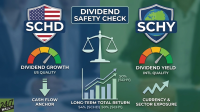
The alternative is the Schwab International Dividend Equity ETF (NYSEARCA:SCHY), which tracks the Dow Jones International Dividend 100 Index using the same quality and dividend-consistency filters Schwab applies domestically. The fund holds roughly $2.60 billion in net assets across companies in Europe, Australia, Canada, Asia, the Middle East, and Latin America. The top positions include BHP Group at 4.55%, Eni SpA at 4.52%, TotalEnergies at 4.50%, Wesfarmers at 4.26%, Deutsche Post at 4.26%, and Allianz at 4.25%, with meaningful positions in Roche, GSK, Unilever, and British American Tobacco. The sector mix leans harder into energy, telecom, and insurance than SCHD does, which is exactly what you would expect from a screen applied to a non-U.S. universe.
SCHY’s Return, Yield, and Distribution Profile
SCHY’s one-year total return through September 4, 2026 came in at 22.82%, with the price moving from $27.06 to $33.24. Year-to-date, the fund is up 13.39%. On distributions, SCHY paid $1.1083 over the trailing twelve months, with an annualized forward figure of $1.4284. SCHD, for comparison, paid $1.048 on a trailing basis with $1.01 annualized forward. SCHY has historically carried a low expense ratio typical of Schwab’s index products. The current expense ratio is 0.08%.
Currency Is the Real Difference
The single biggest thing separating SCHY’s return experience from SCHD’s is currency. SCHY holds unhedged foreign equities, so when the dollar weakens against the euro, pound, Australian dollar, and yen, dollar-denominated returns get a lift. When the dollar strengthens, the reverse happens. Part of SCHY’s strong trailing year returns is due to favorable currency translation (and that tailwind can reverse without warning). Investors who cannot tolerate the extra volatility in quarterly distributions, which are visibly lumpy in SCHY’s payment record, should size the position accordingly.
How to Size SCHY as a Global Complement
SCHY functions as the missing half of a global dividend allocation, complementing rather than replacing SCHD. A holder whose entire income sleeve sits in SCHD can add SCHY at a modest weighting (perhaps 15% to 25% of the dividend allocation) to pick up non-U.S. quality payers, sector exposures that SCHD structurally cannot own, and a currency profile that offsets a portion of the domestic bet. In a taxable account, consider that foreign withholding tax on SCHY’s distributions may be reclaimable as a foreign tax credit, which is friendlier in a taxable account than in an IRA. It is also important to remember that, if you already hold a broad international index, layering SCHY on top may duplicate exposure.
What This Means for Your Next Rebalance
SCHD remains one of the best-designed domestic dividend products available, and its trailing return reflects that. The question is whether your dividend portfolio should be entirely domestic in a world where half the qualifying payers trade abroad. SCHY answers that question with the same methodology you already trust, applied to a different universe. Evaluate the currency risk, the tax location, and the sizing against your own goals before adding it.
Contact [email protected] for any questions or corrections.
Ryne Mauck is an investment writer covering exchange-traded funds, retirement planning, and portfolio strategy. Through his work at 24/7 Wall St. and other investment platforms, including Seeking Alpha, he aims to provide clear, research-driven insights that help investors make more informed decisions while maintaining a long-term approach to investing.
Ryne holds a B.Sc. in Finance and an M.A. in Political Science. He is a formerly registered Municipal Advisor Representative and has passed the Series 50, Series 63, and Series 65 exams. His articles are not intended to be, nor should they be interpreted as, financial advice.