SCHD’s International Twin Has Rivals From Vanguard, Fidelity, and BlackRock. We Ranked All Four
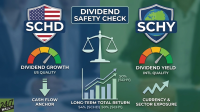
SCHY was built to be SCHD's international twin, but three rivals from Vanguard, Fidelity, and BlackRock have quietly challenged its crown, and one of them beats it on nearly every metric SCHD investors actually care about.

This post may contain links from our sponsors and affiliates, and Flywheel Publishing may receive compensation for actions taken through them.

SCHD holders reaching for international diversification usually land on one name first: Schwab International Dividend Equity ETF (NYSEARCA:SCHY), built on the same Dow Jones dividend-quality methodology that made the Schwab U.S. Dividend Equity ETF (NYSEARCA:SCHD) a portfolio staple. SCHY looks like SCHD’s international twin because Schwab designed it that way. However, three deep-pocketed rivals from Vanguard, Fidelity, and BlackRock now compete for the same wallet share, and one has quietly outrun SCHY on nearly every metric that matters to a SCHD-style investor.
Why SCHY Feels Like the Obvious Pick
SCHD attracted followers by pairing a quality screen (10 years of dividend growth, strong cash flow, low debt) with a rock-bottom fee. SCHY exports that recipe to non-US equities. It tracks the Dow Jones International Dividend 100 Index, holds names like BHP Group, TotalEnergies, Allianz, and Roche, and charges an expense ratio of 0.08%. Assets sit near $2.6 billion, respectable but far from dominant.
Where the Twin Falls Behind
Over the last year, SCHY returned 22.9%, trailing every rival here. Its SEC yield of 3.79% is acceptable, but two of its three competitors offer higher yields. The quality screen produces a relatively concentrated portfolio of roughly 106 positions, which caused it to miss several of 2026’s best-performing non-US names.
VYMI Wins: Vanguard’s Broader Net
The Vanguard International High Dividend Yield ETF (NASDAQ:VYMI) takes first in our ranking. Its expense ratio is 0.07%, slightly lower than SCHY. It yields around 3.41%, slightly under SCHY, but that trade buys a much wider net covering both developed and emerging markets.
The mechanism is simple. VYMI’s breadth dilutes single-country and single-sector risk, so no one position drives the fund. It delivered 29.2% over the past year against SCHY’s 22.9%. Over five years it has returned 96.72% and over ten years 188.4%, versus SCHY’s 56.51% five-year figure. For a SCHD holder who wants low-cost, broad, dividend-paying international equity, VYMI does that job perfectly.
IDV: Highest Yield, Highest Cost
The iShares International Select Dividend ETF (CBOE:IDV) posts the fattest yield at 5.07% and the largest AUM at $8.7 billion. It also charges 0.50%, roughly seven times VYMI. The portfolio runs 122 positions concentrated in European energy, banks, and tobacco, with TotalEnergies alone near 4.88%. It edged the field with a 29.9% one-year gain. If distributions fund living expenses, IDV pays the most. If you are still accumulating, that fee compounds against your returns over time.
FIDI: Small, Cheap Enough, But Redundant
Fidelity International High Dividend ETF (NYSEARCA:FIDI) charges 0.18%, yields 3.89%, and manages only $318 million. Its 22.46% one-year return is respectable, but holdings skew heavily to European energy and Canadian utilities. Thin AUM raises liquidity concerns for larger positions.
Ranking the Four Funds
- VYMI: Low fee, broadest exposure, best long-term total return.
- SCHY: Similar expense ratio as VYMI, cleaner quality screen, slower recent performance.
- IDV: The right pick only if the 5.07% yield outweighs a 0.50% fee.
- FIDI: A fine fund, but hard to prefer over the three above.
Making the Swap Without a Tax Surprise
In an IRA, moving from SCHY to VYMI is a same-day trade with no tax consequences. In a taxable account, check your cost basis before selling: SCHY launched in 2021, so many holders still carry embedded gains after this year’s rally. A partial swap—or directing new contributions to VYMI while holding existing SCHY shares—sidesteps the tax hit while shifting the portfolio’s center of gravity.
What to Do
If SCHY is in your account purely as SCHD’s international counterpart, VYMI fulfills that role at a near identical expense ratio with better recent returns and materially broader diversification. Keep SCHY if you specifically want the tighter dividend-quality screen, and lean on IDV only when yield outweighs cost. The ranking would flip only if VYMI raised its fee or if SCHY’s quality methodology started winning again after the broad international rally cools.
Contact [email protected] for any questions or corrections.
Ryne Mauck is an investment writer covering exchange-traded funds, retirement planning, and portfolio strategy. Through his work at 24/7 Wall St. and other investment platforms, including Seeking Alpha, he aims to provide clear, research-driven insights that help investors make more informed decisions while maintaining a long-term approach to investing.
Ryne holds a B.Sc. in Finance and an M.A. in Political Science. He is a formerly registered Municipal Advisor Representative and has passed the Series 50, Series 63, and Series 65 exams. His articles are not intended to be, nor should they be interpreted as, financial advice.