Forget the Other Five: These 2 Mag7 Stocks Deserve Your Attention
Most of the Magnificent Seven stocks carry narratives that have quietly stopped holding up, but two names in the group still pass every test our model throws at them. Find out which two made the cut and why the gap…


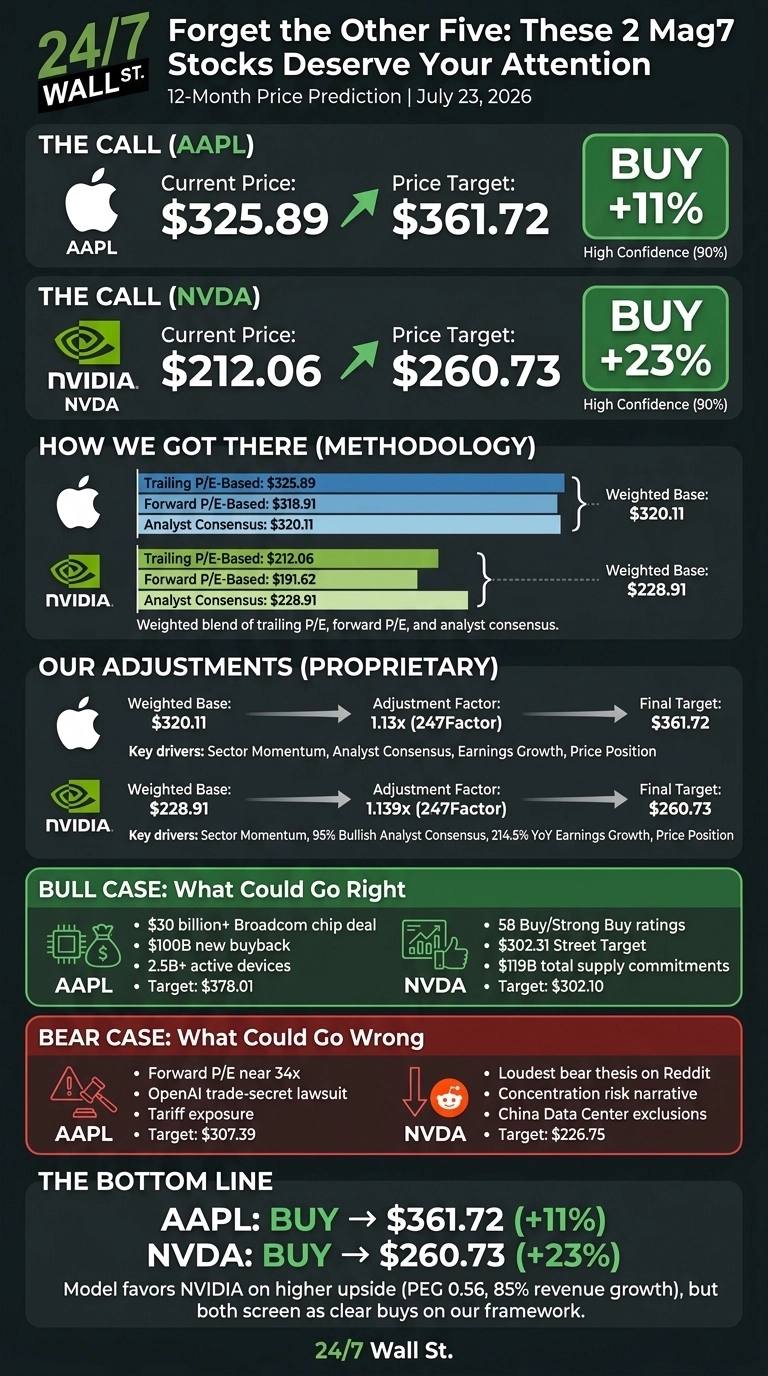
Five of the Magnificent Seven have grown crowded, expensive, or exposed to narratives that no longer justify their premium. Two still screen as high-quality holdings on our framework. Below are our 24/7 Wall St. price targets for Apple (NASDAQ:AAPL | AAPL Price Prediction) and NVIDIA (NASDAQ:NVDA), the two Mag7 names our proprietary model rates as clear buys heading into the back half of 2026.
24/7 Wall St. Price Target Summary
| Metric | Apple | NVIDIA |
|---|---|---|
| Current Price | $325.89 | $212.06 |
| 24/7 Wall St. Price Target | $361.72 | $260.73 |
| Upside | 11.0% | 22.95% |
| Recommendation | BUY | BUY |
| Confidence | 90% | 90% |
How the Two Have Traded Into July
Apple has been the momentum trade of 2026, gaining 20.1% year to date and 52.61% over the past year. On July 20, Apple briefly overtook NVIDIA as the world’s most valuable company, a symbolic moment driven by investor rotation toward capital-efficient AI strategies. The fundamentals back the move: fiscal Q2 revenue of $111.18 billion grew 16.6% and EPS of $2.01 topped estimates for the eighth straight quarter.
NVIDIA has consolidated, up 13.84% YTD and sitting 28% below its 52-week high of $236.26. Yet Q1 FY27 delivered revenue of $81.62 billion (+85% YoY) and Data Center revenue of $75.25 billion. CEO Jensen Huang called the AI factory buildout “the largest infrastructure expansion in human history.”
The Bull Case for Both
Apple bulls point to the $30 billion+ Broadcom chip deal, the $100 billion new buyback, and 2.5 billion+ active devices that turn every Services release into recurring cash. If Siri’s AI refresh and China stabilization hit, our bull case takes AAPL to $378.01. Morgan Stanley raised the firm’s price target on Apple to $364 from $360 and keeps an Overweight rating on the shares.

NVIDIA bulls have 58 buy or strong-buy ratings against just one sell, a Street target of $302.31, and $119 billion in total supply commitments. Our NVDA bull case reaches $302.10.

What Could Go Wrong
Apple trades at a forward P/E near 34x, and its OpenAI trade-secret lawsuit plus tariff exposure could compress the multiple. Our bear case: $307.39.
NVIDIA faces the loudest bear thesis on Reddit right now, with a 4,220-upvote wallstreetbets thread warning that “34% of the S&P is 10 stocks making the same bet.” Add China Data Center exclusions and AI capex digestion, and NVDA’s bear case sits at $226.75. Counterfactual: NVIDIA’s PEG of 0.56 suggests earnings growth is outrunning valuation.
How They Compare to Microsoft
The natural Mag7 benchmark is Microsoft (NASDAQ:MSFT), which trades at a P/E near 28x with an AI run rate above $37 billion growing 123% YoY. Microsoft is cheaper than Apple on earnings and grows AI faster, but its Q3 revenue growth of 18.3% trails NVIDIA’s 85%.
On PEG, NVIDIA’s 0.56 makes both AAPL (PEG 2.63) and MSFT look expensive relative to growth. That contrast is exactly why our model gives NVDA the larger upside and still rates AAPL a buy on quality.
The Bottom Line: Model Favors NVIDIA on Higher Upside
Our 24/7 Wall St. price target is $361.72 on Apple and $260.73 on NVIDIA, both buy, both 90% confidence. The model favors NVIDIA more heavily here. The setup pairs a 28% drawdown with 85% revenue growth, and PEG under 1 rarely stays that low.
The model frames Apple as attractive on pullbacks toward $300 and NVIDIA as compelling at current levels. The setup would weaken if AI capex commitments start slipping or if China exposure widens.
Apple and NVIDIA Price Prediction 2026-2030
| Year | AAPL Target | NVDA Target |
|---|---|---|
| 2026 | $361.72 | $260.73 |
| 2027 | $390 | $298 |
| 2028 | $418 | $335 |
| 2029 | $446 | $365 |
| 2030 | $473 | $393 |
These projections assume Apple continues Services acceleration and NVIDIA sustains Data Center growth. Major AI capex resets or China policy shocks would push both toward bear-case levels.
Contact [email protected] for any questions or corrections.
Vandita Jadeja is a financial publisher with over a decade of experience writing about financial topics, including investment, savings, retirement, insurance and banking. Vandita is a Chartered Accountant who loves to debunk financial concepts for readers.
Her work has appeared on sites that include The Motley Fool, InvestorPlace, and Benzinga. She covers investing and focuses on stock picks and price prediction for 24/7 Wall St.
When not looking for the next stock investment opportunity, she can be found traveling, reading, chasing sunsets and enjoying her iced latte.