Is Kevin Warsh Quietly Building a Case for Rate Cuts? Markets May Be Underestimating the Odds.
A senior Brookings economist thinks Kevin Warsh is laying intellectual groundwork that traders have not yet priced in, and her reasoning has nothing to do with the hawkish data dominating headlines.

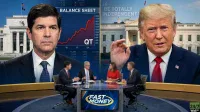
Markets have largely priced Federal Reserve Chairman Kevin Warsh as a hawk. Wendy Edelberg, senior fellow at the Brookings Institution, has a different read. In a recent Marketplace segment with host Kai Ryssdal titled “The four dollar threshold,” Edelberg argued that Warsh may be quietly laying the groundwork for rate cuts, and that traders are underestimating the odds.
Her thesis rests on how Warsh has spent his early days at the helm. According to Edelberg, Warsh has created five task forces examining issues including inflation measurement, AI’s effects on prices, policy rules, and the Fed’s balance sheet. Those groups are set to report over the coming months and have not yet concluded anything.
The Macro Backdrop Looks Hawkish
The data landscape does not obviously invite easier policy. Oil hit $90 a barrel, pushing the average price of a gallon of gas to exactly $4.00, matching levels from late March. FRED weekly data confirms the gasoline reading at $4.00 per gallon as of July 20, 2026, sitting in the 77th percentile of the 12-month range. WTI crude last printed at $84.38 per barrel after touching a 12-month high of $114.58 on April 7, 2026.
On the same day Edelberg spoke, former New York Fed President Bill Dudley publicly called for rate hikes. And Edelberg noted that inflation has now run above the Fed’s target for 63 to 64 consecutive months. The Federal Reserve’s preferred gauge, core PCE, stood at 130.08 as of May 1, 2026, up 0.3% month over month, sitting in the 90.9th percentile of its recent range.
Against that, the Fed funds target upper bound has held at 3.75% since December 10, 2025, following 75 basis points of cuts over the past 12 months. The 10-year Treasury yield has climbed to 4.71%, its 12-month high, a level consistent with markets pricing sustained restrictive policy rather than imminent easing.
Edelberg’s “Scaffolding” Thesis
Edelberg’s argument, framed clearly as her interpretation rather than established Fed intent, is that Warsh may be constructing “the intellectual infrastructure, the scaffolding” to justify rate cuts without appearing to bend to White House pressure. She predicts the task forces will find, “serendipitously,” that AI-related price increases should be excluded from inflation measures and that alternative inflation indices show prices already under control.
Ryssdal pressed directly, asking Edelberg: “You are insinuating here that he is stacking the deck.” Edelberg reframed the dynamic as “a coincidence of wants” between Warsh and President Trump, who made rate cuts a clear condition of the nomination. She did not assert manipulation, and Warsh has not signaled any predetermined conclusion from the task forces.
What the Market Signals Say
Consumer sentiment gives Edelberg’s dovish read some support. The University of Michigan index sits at 44.8 as of May 1, 2026, down 10.0% from a month earlier and in recessionary territory. Unemployment held at 4.2% in June 2026, still in the healthy band. The 10-year minus 2-year spread has steepened to 0.36% from a June low of 0.27%, a modest recovery from near-flat territory.
Goldman Sachs Research projects the Fed will reduce its policy rate by 50 basis points to 3-3.25% in 2026, with potential for cuts beyond that. JPMorgan notes that the market is pricing in roughly 80 basis points of rate cuts through 2026. Edelberg’s core call is that even those expectations may be too conservative.
What to Watch
The immediate catalysts are the task force releases. If Warsh’s working groups produce frameworks that reweight or reinterpret inflation data, Edelberg’s “scaffolding” theory gains empirical footing. Investors tracking the FOMC path can review official meeting materials and statements on the Federal Reserve’s FOMC calendar as each report lands.
Edelberg’s reading remains a prediction. But given the gap between hawkish surface data and her dovish institutional read, the next few months of Fed communication will matter more than the last few months of price data.
Contact [email protected] for any questions or corrections.
AJ spent 10 years writing about financial markets at The Motley Fool. His coverage centers on technology stocks and the broader macroeconomic trends, from interest rates to geopolitics, that shape where markets are headed next. AJ is drawn to the stories where big-picture economics and individual companies collide.