After Losing An Average Of $16.3 Billion A Day For Over A Month, Elon Musk Says “Money Won’t Matter in 2036”
Elon Musk has been shedding wealth at a pace that staggers any reasonable scale of measurement, yet in the middle of the freefall he sat down with The Economist and made a prediction about money itself that reframes the entire…

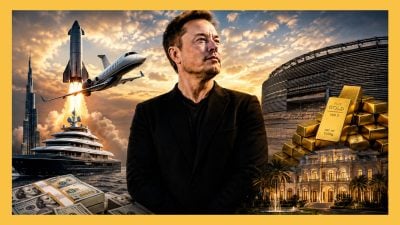
The world’s richest man has been losing money at a historic clip. Over roughly the past month, Elon Musk’s net worth has fallen by an average of $16.3 billion a day, according to a Benzinga tally. In the middle of that stretch, Musk sat down with The Economist at the Gigafactory in Texas and offered a forecast that reads, in context, as either serenely detached or perfectly on brand: “I’ll make another prediction. Money won’t matter in 2036.”
The peak came in mid-June. Shortly after SpaceX’s June 12, 2026 IPO, priced at $135 a share and valuing the company near $1.77 trillion, Musk’s paper wealth touched roughly $1.45 trillion, briefly making him the world’s first trillionaire. The trajectory since then has been almost vertical the other way. Per Benzinga, his net worth fell from about $1.32 trillion to roughly $832 billion over the course of a month, a decline of $488 billion, the figure that produces the $16.3 billion daily average.
Two engines drove the drawdown. SpaceX shares, after their debut spike, slid 41% to 45% at various points through the month, erasing more than $1 trillion in market capitalization at points. Then Tesla (NASDAQ:TSLA | TSLA Price Prediction) delivered a Q2 report that compounded the pain. Revenue of $28.24 billion beat the Street, but non-GAAP earnings per share of $0.33 missed the $0.5367 estimate, operating margin compressed to 1.4%, and free cash flow flipped to negative $1.09 billion. Tesla shares are down 23.92% since the SpaceX IPO date, closing Monday at $309.22.
Estimates vary by tracker, but the scale of the decline is consistent across all of them. Forbes had Musk at roughly $722.4 billion as of July 23, 2026, while Bloomberg’s Billionaires Index put him at $833 billion as of July 16, 2026. Even at the lower reading, he remains the world’s richest person by a wide margin.
The Economist interview, conducted by editor-in-chief Zanny Minton Beddoes, is where the juxtaposition sharpens. Musk frames the coming decade as “an age of amazing abundance where anyone can have anything they can think of,” and predicts AI will “exceed the sum of human intelligence in about… around five years.” The “money won’t matter” line is offered as the logical endpoint of that thesis about abundance. In the same conversation he sketches “universal high income,” says “work is going to be optional,” and suggests the Treasury should “just simply issue people checks.”
The abundance is meant to arrive via the machines Tesla is building. The company’s $25 billion capital budget, capital expenditures of $5.79 billion in the quarter (up 141.81% year over year), and 47% surge in operating expenses to $4.35 billion are the near-term price of that vision. The one paying it, at the moment, is the shareholder.
The pick-and-shovel trade tells a different story. NVIDIA (NASDAQ:NVDA) carries a market capitalization of roughly $5.01 trillion, and is up 5.49% year to date while Tesla is down 31.24%. Jensen Huang is selling shovels today. Musk is selling 2036.
The signal to watch next is whether Tesla’s free cash flow stabilizes in Q3 and whether SpaceX shares find a floor as the post-IPO lockup dynamics settle. Until then, the world’s richest man will remain the most visible real-time example of wealth volatility, and the person forecasting that wealth itself will soon stop mattering.
Contact [email protected] for any questions or corrections.
Joel South covers large-cap stocks, dividend investing, and major market trends, with a focus on earnings analysis, valuation, and turning complex data into actionable insights for investors.
He brings more than 15 years of experience as an investor and financial journalist, including 12 years at The Motley Fool, where he served as an investment analyst, Bureau Chief, and later led the Fool.com investing news desk. He has also co-hosted an investing podcast and appeared across TV and radio discussing market trends.