Prediction: Microsoft Could Be the Next $5 Trillion Stock
Azure just crossed $100 billion and commercial bookings are stacking up at a pace that redefines what valuation ceiling even means for a company this size. The math toward an unprecedented market cap milestone is closer than most investors realize.

This post may contain links from our sponsors and affiliates, and Flywheel Publishing may receive compensation for actions taken through them.
Microsoft is once again flirting with mega-cap history. With a market capitalization of $3.74 trillion and Azure now a $100 billion business, the path to a $5 trillion valuation is now a math problem.
Microsoft (NASDAQ:MSFT | MSFT Price Prediction) trades at $503.92 as I write this. Our 24/7 Wall St. price target for Microsoft is $599.92, implying 18.9% upside over the next 12 months. That would push the market cap right to the doorstep of $5 trillion. Our recommendation is buy, with high confidence at 90%.
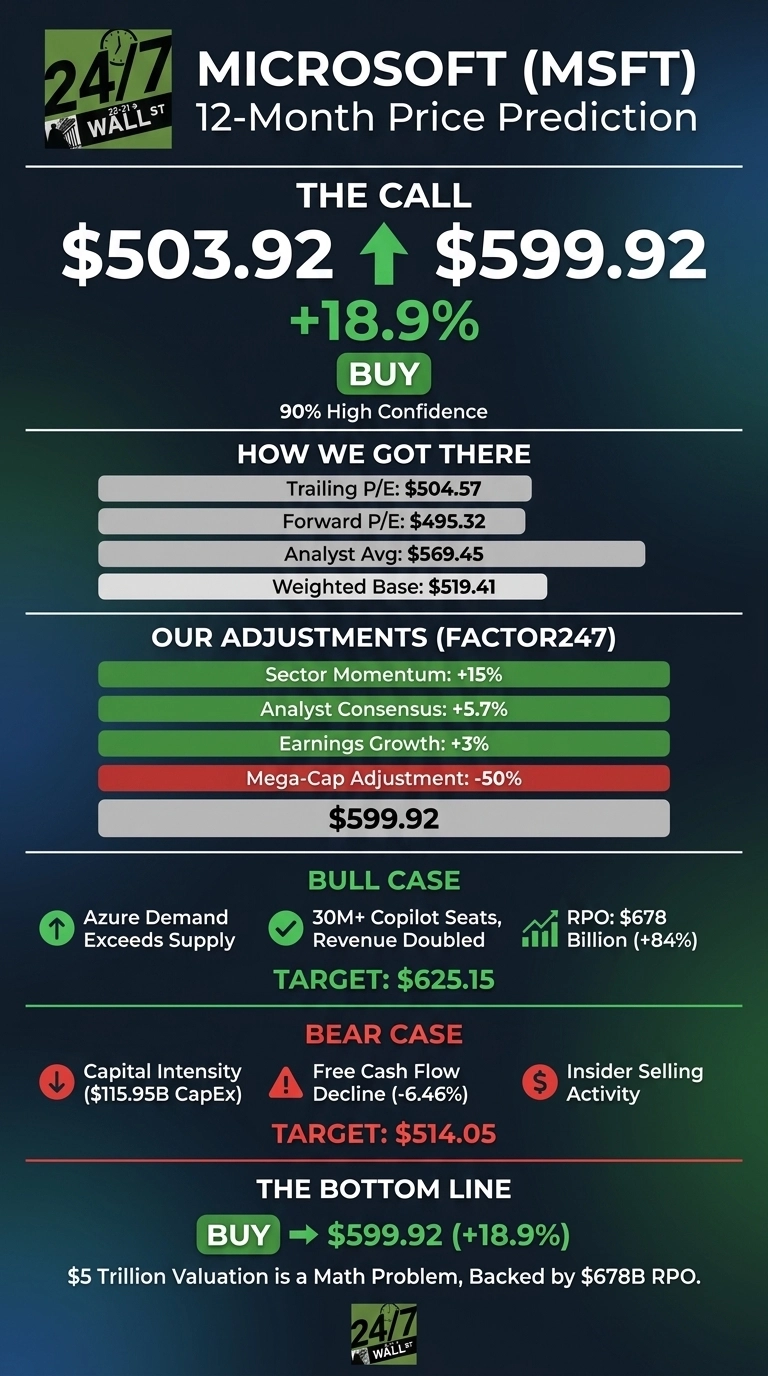
24/7 Wall St. Price Target Summary
| Metric | Value |
|---|---|
| Current Price | $503.92 |
| 24/7 Wall St. Price Target | $599.92 |
| Upside | 18.9% |
| Recommendation | BUY |
| Confidence Level | 90% |

A Blowout Fiscal Year Reset the Story
MSFT is up 27.81% over the past month and 3.29% year to date, recovering from an early-2026 drawdown that briefly took shares below $400. The 52-week range runs from $348.54 to $549.20.
The catalyst for the rebound was the July 29 earnings report: Q4 FY26 revenue of $90.01 billion (up 17.75%), non-GAAP EPS of $4.74 beating by 11.81%, and Azure growth of 43%. Commercial RPO ballooned to $678 billion, up 84%, giving investors unprecedented forward visibility.
Why Bulls See a Breakout Ahead
The bull case is straightforward: demand exceeds supply. Amy Hood said flatly, “Demand continues to exceed available supply.” Microsoft guided Q1 FY27 Azure growth to roughly 45% in constant currency. Microsoft 365 Copilot now has 30 million paid seats, with net additions more than doubling sequentially.
GitHub Copilot has 50 million users, and its revenue accelerated over 60% quarter over quarter after the shift to usage-based billing. Our bull-case scenario points to $625.15, a 23.9% return that would clear the $5 trillion mark decisively.

What Could Go Wrong
The bear case centers on capital intensity. FY26 CapEx hit $115.95 billion, and free cash flow fell 6.46%. More Personal Computing revenue declined 4%. Insider activity is characterized as selling.
Bulls will counter that Hood explicitly framed CapEx as flexible, noting that “if the demand environment changes, you just slow down” the short-lived GPU and CPU spend that drives most of the outlay. Our bear case sits at $514.05, essentially flat.

How Microsoft Compares to Alphabet and Amazon
Alphabet (NASDAQ:GOOGL) is the sharpest hyperscaler valuation contrast. Google Cloud grew 82% in Q2 2026, faster than Azure, yet Alphabet trades at a P/E of just 15 versus Microsoft’s 28. Alphabet already sits at a $4.18 trillion market cap. That gap suggests Microsoft carries a premium for enterprise stickiness, but it also caps how much multiple expansion can carry MSFT to $5 trillion.
Amazon (NASDAQ:AMZN) sits at a $2.76 trillion market cap with AWS growing 37% at a 39.4% operating margin. Amazon’s P/E of 36 and price-to-free-cash-flow of 365 make Microsoft’s multiples look reasonable given MSFT’s 46.78% operating margin.
| Company | P/E | Operating Margin |
|---|---|---|
| Microsoft | 28 | 46.78% |
| Alphabet | 15 | 32.03% |
| Amazon | 36 | 11.16% |
The peer set makes our $599.92 target look reasonable rather than aggressive.
Microsoft Price Prediction 2026-2030
Our 24/7 Wall St. price target is $599.92, a buy at 90% confidence. The tipping factor is the $678 billion RPO backlog, which converts supply constraint into visible revenue.
The bullish thesis holds if Azure sustains 40%+ growth into FY27 as guided. Caution is warranted if CapEx crosses $150 billion without matching bookings.
| Year | 24/7 Wall St. Price Target |
|---|---|
| 2026 | $545.22 |
| 2027 | $606.30 |
| 2028 | $671.50 |
| 2029 | $732.01 |
| 2030 | $825.32 |
These projections assume Microsoft sustains double-digit revenue growth and disciplined AI infrastructure returns. Significant deviation could come from AI monetization outperformance or a broader hyperscaler CapEx reset (the same buildout that powers our free report on seven non-chip stocks riding the AI infrastructure wave).
Contact [email protected] for any questions or corrections.
Vandita Jadeja is a financial publisher with over a decade of experience writing about financial topics, including investment, savings, retirement, insurance and banking. Vandita is a Chartered Accountant who loves to debunk financial concepts for readers.
Her work has appeared on sites that include The Motley Fool, InvestorPlace, and Benzinga. She covers investing and focuses on stock picks and price prediction for 24/7 Wall St.
When not looking for the next stock investment opportunity, she can be found traveling, reading, chasing sunsets and enjoying her iced latte.