Wall Street Sees 40% Upside For Microsoft as AI Monetization Finally Pays Off
Wells Fargo just added Microsoft to its Q4 Tactical Ideas list and pushed its price target well above Wall Street consensus, betting that Azure and Copilot are about to prove the skeptics wrong.


Wells Fargo lifted its price target on Microsoft (NASDAQ:MSFT | MSFT Price Prediction) to $725 from $700 and kept its Overweight rating. It also added the shares to its Q4 “Tactical Ideas list”.
Analyst Michael Turrin sees a “favorable tactical setup” heading into the fourth quarter. The higher target shows that Wall Street is growing more confident Microsoft can turn its AI lead into lasting earnings growth.

| Ticker | Company | Firm | Action | Old Rating | New Rating | Old Target | New Target |
|---|---|---|---|---|---|---|---|
| MSFT | Microsoft | Wells Fargo | Price Target Raised | Overweight | Overweight | $700 | $725 |
Analyst’s Case: Catalysts Lining Up for Q4
Turrin cited a “number of key catalysts,” including Microsoft’s AI advantage starting to pay off, its Ignite conference in November and its new segment reporting.
Wells believes momentum among mega cap tech stocks is “shifting back to” Microsoft as the company “delivers on AI monetization story alongside balanced investment approach.”
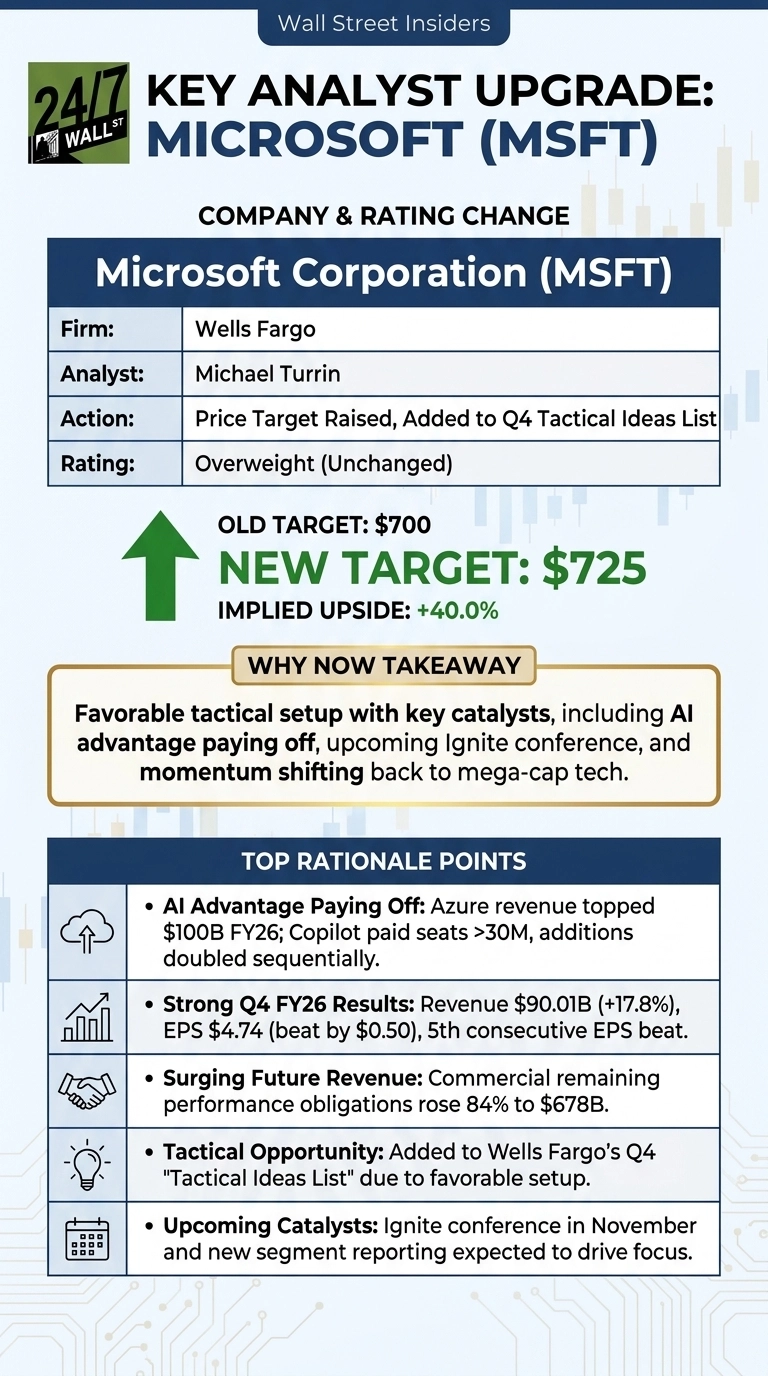
Recent results back that view: Azure revenue topped $100 billion for the fiscal year. The number of paid seats for Microsoft 365 Copilot exceeded 30 million, and net paid seat additions more than doubled sequentially. Chief Financial Officer Amy Hood said “demand continues to exceed available supply.”
Record Quarter and Contract Backlog Fuel the Upgrade
Microsoft reported fiscal Q4 2026 results on July 29, 2026. Revenue came in at $90.01 billion, up 17.8% and ahead of the $87.63 billion consensus. Non-GAAP EPS of $4.74 beat the $4.24 estimate, helped partly by a $3.2 billion gain on its Anthropic investment.
That was the company’s fifth consecutive EPS beat. Commercial remaining performance obligations, a measure of contracted future revenue, rose 84% to $678 billion.

For the full fiscal year, revenue reached $331.84 billion and EPS was $17.28. Heavy spending weighed on cash: capex hit $115.95 billion, and free cash flow fell 6.46% to $66.99 billion.
Why the Move Matters Now
Microsoft stock trades at $517.75. It is up 7.74% year to date but only 0.79% over the past year, and it sits below its 52-week high of $549.20. Shares trade at roughly 28x trailing earnings and 25x forward earnings.
Wells Fargo’s target is well above the consensus target of $578.42. Analyst sentiment leans strongly positive, with 14 Strong Buy, 38 Buy and 3 Hold ratings. The average fiscal 2027 EPS estimate has risen to $19.7597 from $19.3730 90 days ago.
Over the past 30 days, analysts made 21 upward revisions and 8 downward ones. Management expects Azure growth of about 45% in constant currency this quarter.

What It Means for Your Portfolio
Spending remains the main risk: Microsoft now expects capex of about $175 billion. Microsoft Cloud gross margin slipped to 65% because of the shift toward AI infrastructure. Hood said much of that spending goes to shorter-lived chips, which gives the company “a lot more flexibility to manage through those” changes in demand.
Income-focused investors get a modest dividend yield of about 0.69%, with the next ex-dividend date on November 19, 2026.
Long-term investors may see the higher target as a sign of rising analyst confidence, though near-term volatility is still a real risk. Keep an eye on Ignite in November and on Microsoft’s first earnings report under its new segment structure.
Contact [email protected] for any questions or corrections.
Vandita Jadeja is a financial publisher with over a decade of experience writing about financial topics, including investment, savings, retirement, insurance and banking. Vandita is a Chartered Accountant who loves to debunk financial concepts for readers.
Her work has appeared on sites that include The Motley Fool, InvestorPlace, and Benzinga. She covers investing and focuses on stock picks and price prediction for 24/7 Wall St.
When not looking for the next stock investment opportunity, she can be found traveling, reading, chasing sunsets and enjoying her iced latte.