Retiring to The Villages Is Easy. Leaving Is the Expensive Part
Most retirement plans for The Villages run the numbers on moving in. Almost none of them account for the financial shock that comes when it is time to leave, and that missing calculation can unravel an otherwise solid plan.


The sales pitch for The Villages is easy to understand. Sell the house up north, trade snow shovels for a golf cart, and spend retirement playing pickleball, golfing, and wondering how you became busier at 70 than you were at 40.
The financial math looks pretty attractive, too. Florida has no individual income tax, The Villages offers an enormous menu of amenities for a relatively modest monthly fee, and a paid-off home can keep ordinary retirement expenses manageable.
But retirement plans tend to focus on the move in. Almost nobody runs the numbers on the move out.
For a couple planning to spend 20 or 30 years in The Villages, there are really two retirement numbers to calculate: what it takes to finance the healthy years, and what it takes to survive the expensive transition that may come later.
The Villages Is Cheaper to Enter Than It Was
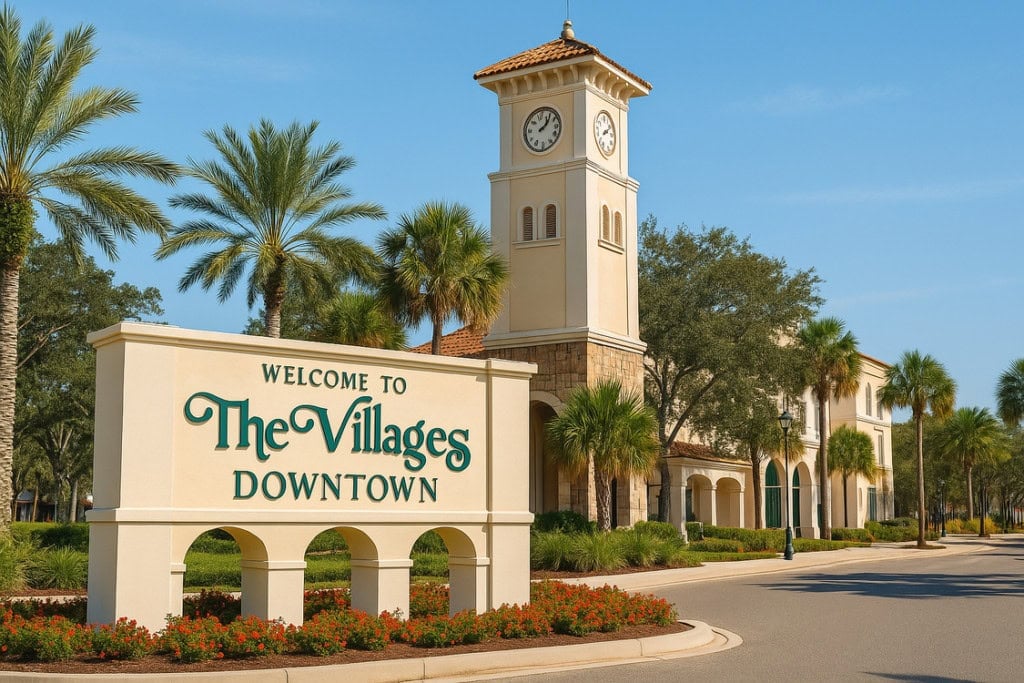
The Villages housing market is considerably friendlier to buyers than it was during the pandemic boom. The median listing price stood at $377,784 in August 2026, down from a peak of $436,850 in 2022. Homes were typically spending about 60 days on the market, twice the 30-day pace seen at the 2022 peak.
The broader housing market has cooled as well. Existing-home sales fell to a seasonally adjusted annual rate of 3.98 million in August, while available inventory climbed to a 4.9-month supply, its highest level in more than a decade.
That is good news when you are 65 and buying. The problem is that retirement eventually puts many owners on the opposite side of the transaction.
A Comfortable Retirement Can Still Cost $65,000 a Year

Assume our hypothetical couple buys a mid-range home with cash and therefore has no mortgage. A reasonable planning budget might still land somewhere around $65,000 to $70,000 a year.
Housing-related costs including property taxes, homeowners insurance, CDD assessments, the amenity fee, utilities and maintenance can easily consume five figures. The Villages currently advertises a $204 monthly amenity fee alone.
Add Medicare premiums, supplemental coverage, prescriptions, groceries, dining, two vehicles, a golf cart, travel, hobbies and home repairs, and the spending adds up quickly.
That is still below the $78,535 the average U.S. consumer unit spent in 2024, according to the Bureau of Labor Statistics, but a paid-off house is doing a lot of work in this scenario.
Florida’s Tax Advantage Is Very Real

Florida remains one of the more tax-friendly states for retirees because it has no individual income tax. That means Social Security benefits, pensions and IRA or 401(k) withdrawals are not subject to Florida individual income tax.
The Tax Foundation ranks Florida fifth overall in its 2026 State Tax Competitiveness Index.
That does not mean retirees escape taxes altogether. Property taxes, sales taxes, federal income taxes and other costs still apply. Florida collected about $5,141 per resident in combined state and local taxes in the latest available fiscal-year data.
Still, avoiding state income tax on retirement withdrawals can make a meaningful difference when a household is pulling tens of thousands of dollars from tax-deferred accounts every year.
The First Portfolio Number Looks Manageable

Suppose our couple spends $68,000 a year and receives $48,000 in combined Social Security. That leaves roughly $20,000 a year for the investment portfolio to supply.
Using a simple 4% withdrawal assumption, $20,000 points to about $500,000 of invested assets. Give the plan additional room for taxes, unexpected spending and market volatility, and something around $600,000 starts looking more comfortable.
But the Social Security assumption matters enormously.
The Social Security Administration estimates that the average aged couple both receiving benefits gets about $3,208 per month in 2026, or $38,496 annually.
At that level, a $68,000 lifestyle leaves a gap of roughly $29,500. At 4%, that alone points to nearly $740,000 before building a separate long-term-care reserve.
The lesson is simple: there is no universal ‘$600,000 is enough for The Villages’ number.
The Tax Code Gives Seniors Some Extra Breathing Room

Federal taxes on retirement withdrawals are also a little friendlier in 2026 than they used to be.
The standard deduction for a married couple filing jointly is $32,200. Married taxpayers age 65 or older can generally add another $1,650 per qualifying spouse under the regular additional standard deduction.
There is also a newer enhanced senior deduction of up to $6,000 per qualifying person for tax years 2025 through 2028. A couple in which both spouses qualify could potentially claim another $12,000, although the deduction begins phasing out once joint modified adjusted gross income exceeds $150,000.
Those deductions can reduce the tax drag on retirement income. They do not, however, make traditional IRA and 401(k) withdrawals tax-free.
Long-Term Care Is Where the Math Changes

The retirement plan looks very different once one spouse needs substantial care.
CareScout’s 2025 Florida survey puts the statewide median cost of assisted living at about $66,000 a year. A semi-private nursing-home room runs about $124,100, while the median private room reaches roughly $146,000 annually.
Those are not fringe luxury numbers. They are statewide medians.
Memory-care pricing varies widely based on the facility and level of care, and CareScout does not publish it as a separate statewide category in the same survey. But dementia care can add another layer of expense to an already costly assisted-living arrangement.
A household that comfortably lived on $68,000 can suddenly face care expenses that exceed its entire previous annual budget.
Medicare Is Not Going to Pay That Bill

This is where plenty of otherwise solid retirement plans run into trouble.
Medicare generally does not pay for long-term custodial care, whether that care is provided in a nursing home, assisted-living setting or the community.
Medicare Part A can cover qualifying skilled nursing-facility care for a limited period after hospitalization, with coverage potentially lasting up to 100 days in a benefit period when all of Medicare’s requirements are satisfied. That is rehabilitation or skilled care, not a permanent nursing-home benefit.
Once long-term help with bathing, dressing, eating or supervision becomes the real need, families generally turn to private assets, long-term-care insurance or Medicaid if the person qualifies.
That is why the ‘exit reserve’ belongs in the retirement plan from day one.
Your House Might Not Sell When You Need It To

The eventual exit from The Villages may come after a death, stroke, dementia diagnosis or major fall. None of those events politely waits for a great real-estate market.
The Villages’ median listing price has declined for four straight years from its 2022 peak, and homes now typically sit on the market about 60 days.
National conditions are not particularly forgiving either. The latest Case-Shiller national index was up 1.9% from a year earlier in July 2026, but inflation was running at 3.4%, meaning home values declined in real terms for the 14th consecutive month.
A house that eventually sells for $400,000 can still represent substantial wealth. But a house is not the same thing as $400,000 sitting in a money-market fund when a care facility wants its first payment next week.
The CDD Bond Can Follow the House

The Villages’ Community Development District bond is another number buyers and sellers need to understand.
Infrastructure in many districts was financed through tax-exempt bonds, and an individual property’s share appears on its annual tax bill as a non-ad valorem bond debt assessment. Owners may pay the remaining balance off early, but they are not universally required to do so.
That matters at resale. A remaining bond balance can stay with the property rather than automatically being paid at closing, so buyers will consider it when comparing homes.
There also is not one useful Villages-wide bond number. Some older properties may have little or no balance left, while newer areas can carry much larger obligations. The district provides property-specific amortization schedules and payoff figures, which are what actually matter.
Widowhood Changes the Math Again

Long-term care is not the only financial shock. The death of one spouse can reduce household income almost immediately.
A surviving spouse does not keep both Social Security checks. In general, the survivor ends up receiving the higher eligible benefit rather than continuing to collect two full retirement benefits.
Meanwhile, many household expenses do not fall by half. Property taxes, insurance, utilities and home maintenance continue. The survivor may also decide that staying in Central Florida no longer makes sense without a spouse, especially if adult children live several states away.
Moving closer to family can mean selling the Villages home, paying moving costs, entering another housing market and doing all of it while adjusting to a one-person income and eventually a less favorable single-filer federal tax structure.
That is the exit the original retirement calculator never asked about.
The Real Number Includes an Exit Reserve

For the hypothetical couple receiving $48,000 of Social Security, a roughly $600,000 core retirement portfolio may support the healthy-years spending gap under a 4% planning assumption.
Then add a separate $250,000 to $300,000 reserve for long-term care, relocation or an extended home sale. At Florida’s current median private nursing-room cost, that reserve represents roughly two years of care, give or take.
That puts the total closer to $850,000 to $900,000 of invested assets, plus the paid-off home.
If the couple’s Social Security is closer to SSA’s average of about $38,500, the core portfolio requirement rises substantially. In that case, a more conservative total can push toward $1 million or more, including the exit reserve.
The exact number will vary by household. The larger point does not.
Buying the retirement lifestyle is only half the calculation. A complete plan also finances the day when one or both spouses can no longer live it.
Contact [email protected] for any questions or corrections.