Nobody Plans to Retire Alone in The Villages. Here’s What It Costs When It Happens
Solo retirement in The Villages looks straightforward until you run the numbers and realize the community's fixed costs were built for two people sharing them. Here is what the budget actually demands when only one person is paying.

This post may contain links from our sponsors and affiliates, and Flywheel Publishing may receive compensation for actions taken through them.
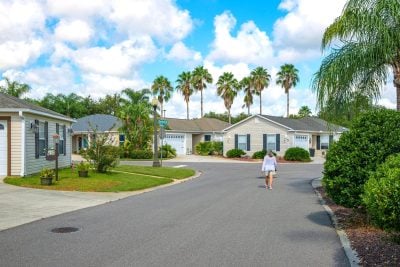
What Solo Life in The Villages Actually Costs in Current Dollars
Housing is where the community’s economics get least intuitive. A modest designer home bought outright still carries a Community Development District bond assessment, an annual maintenance assessment, and the monthly amenity fee that funds all that recreation infrastructure. Add Sumter County property taxes, Florida homeowners insurance, and a realistic maintenance reserve. Between those items alone, a paid-off house runs roughly $12,000 to $15,000 a year before you even change a light bulb.
Healthcare for a single Medicare enrollee stacks up next. The 2026 standard Part B premium is $202.90 a month, with a $283 annual deductible, and the Part A inpatient deductible is $1,736. Layer on a Medigap Plan G, a Part D drug plan, dental, vision, and a realistic out-of-pocket buffer, and a healthy 70-year-old solo retiree lands around $6,500 to $8,000 a year.
Then you have food, utilities, a car, a golf cart, phone and internet, entertainment, gifts, travel to see family, and miscellaneous reserves for the roof, the HVAC, and the next vehicle to round it all out. Florida’s cost-of-living index sits at 103.414 against the national benchmark of 100, so groceries and services are not the bargain the state’s tax reputation might suggest. A working solo budget in The Villages runs between $55,000 and $65,000 a year in current dollars. Call it $60,000.
Turning That Budget Into a Portfolio Number
Florida has no state income tax on Social Security, pensions, or IRA withdrawals. A solo retiree collecting a Social Security benefit near the recent average, roughly $24,000 a year, and expecting the 3.1% 2027 COLA that is currently tracking, closes a chunk of the gap but not most of it. Against a $60,000 budget, the portfolio has to produce around $36,000 a year, gross of federal tax on the taxable portion.
At a 4% withdrawal rate, that is a $900,000 portfolio. At a more conservative 3.5% withdrawal rate, appropriate for someone retiring in their early to mid-sixties with a long solo horizon, it is closer to $1.03 million. Claiming Social Security at 70 rather than 62 changes the arithmetic materially: an extra $700 to $900 a month, indexed to inflation for life, shaves roughly $200,000 off the portfolio requirement and hardens the plan against years when markets do not cooperate. For anyone retiring before 65, the bridge to Medicare requires an ACA silver plan with income managed to keep subsidies intact, which in Florida means paying attention to how Roth conversions and taxable withdrawals push modified adjusted gross income.
Survivor Math Nobody Runs Until It Is Too Late
The Villages is engineered around fixed costs that do not shrink when a household goes from two to one. The housing services line and the healthcare services line are national reminders of the same reality: shelter and health do not halve themselves. The amenity fee is the same. The CDD assessment is the same. Property tax and insurance are the same. Food falls, but not by half, because minimal grocery packaging and eating out alone are inefficient.
Meanwhile, Social Security’s survivor rule pays the higher of the two benefits, not both. A household that had been receiving, say, $2,400 and $1,600 in monthly checks becomes a household with $2,400. That is roughly $19,000 a year of income gone while the fixed cost structure barely moves. Any Windfall Elimination Provision or Government Pension Offset exposure compounds it: a spousal or widow(er) benefit is reduced by two-thirds of a noncovered government pension, which has bankrupted the plans of retired teachers and municipal workers who assumed the survivor check would arrive intact.
Considered actuarially, the numbers look like this. The couple’s plan that worked at $80,000 a year with two Social Security checks needs to survive on one check and a budget that only drops to about $60,000. The portfolio that supported the couple, often around $1.2 million, now has to support the survivor for a horizon that may stretch fifteen or twenty more years. If it was not built with a survivor scenario in mind, retirements quietly break. The survivor claiming sequence is its own puzzle, and we walked through the couples-before-70 decisions in a free guide here.
What It Actually Takes
The workable version of retiring alone in The Villages looks like this: a paid-off home, roughly $900,000 to $1.05 million invested across a treasury ladder for near-term spending and broad index funds for the long tail, a 3.5% to 4% withdrawal rate, Social Security claimed as late as health and cash flow allow, and a survivor scenario stress-tested before anyone signs a purchase agreement. The risk sits in the household’s fixed costs, which were designed for two, while the income eventually arrives for one. A plan built for one generally accommodates the two-person version as well.
Contact [email protected] for any questions or corrections.
David Beren has been a Flywheel Publishing contributor since 2022. Writing for 24/7 Wall St. since 2023, David loves to write about topics of all shapes and sizes. As a technology expert, David focuses heavily on consumer electronics brands, automobiles, and general technology. He has previously written for LifeWire, formerly About.com. As a part-time freelance writer, David’s “day job” has been working on and leading social media for multiple Fortune 100 brands. David loves the flexibility of this field and its ability to reach customers exactly where they like to spend their time. Additionally, David previously published his own blog, TmoNews.com, which reached 3 million readers in its first year. In addition to freelance and social media work, David loves to spend time with his family and children and relive the glory days of video game consoles by playing any retro game console he can get his hands on.