Rocket Lab Shed 25% Over 3 Months: 150% Returns Sure to Come According to This Wall Street Pro
Rocket Lab has shed a quarter of its value in months, yet a growing chorus of Wall Street analysts sees a path to returns that would dwarf those losses. The catch involves one unproven rocket and a deadline Rocket Lab…

Rocket Lab (NASDAQ:RKLB | RKLB Price Prediction) trades at $52.60. The consensus price target sits at $102.15, meaning roughly 94.2% upside.
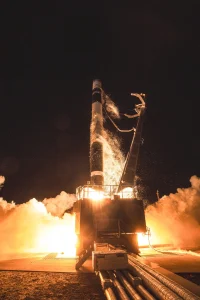
Rocket Lab flies Electron rockets and HASTE hypersonic test vehicles, builds spacecraft, and is developing Neutron, a reusable medium-lift rocket. Wall Street has followed the company closely because of its record backlog of $2.36 billion, which grew 137% year over year. Other attractions include an $816M Space Development Agency contract and the pending Iridium Communications (NASDAQ:IRDM) acquisition, which Iridium stockholders have approved.
The high end of Wall Street goes further. Trevor Walsh at Citizens JMP previously held a Street-high target near $130.00. From today’s price, that target works out to about 147% upside.
Neutron Slips to 2027 and Drags the Stock Down
The main reason for the selloff was a delay. Rocket Lab said Neutron’s first launch had slipped to 2027 after it had been targeted for the fourth quarter. The stock fell as much as 14% during that session and closed down 6.6%. Chief executive Peter Beck blamed manufacturing issues in the first stage’s forward propellant dome. He added, “Possible success isn’t our standard.”
Selling continued after that. Shares dropped almost 8% in a single session to $50.84 during a multi-day losing streak. The stock is down 25.19% over the past month and 21.42% over three months. With a beta of 2.938, swings this large are normal for Rocket Lab.
Earnings revisions point the same way. Second-quarter GAAP EPS of -$0.08 missed the -$0.0767 consensus. Over the past 90 days, the 2027 EPS consensus fell from -$0.0273 to -$0.0912. Dilution also weighs on the shares: the company raised $1.53B through at-the-market sales in the first half.
16 of 20 Analysts Still Rate It a Buy
Of the 20 analysts covering Rocket Lab, four give a Strong Buy rating, 12 rate it Buy and four rate it Hold. Nobody rates it Sell. Gregory Pendy at Clear Street currently maintains a target of up to $129.00, representing approximately 145% upside.
Three factors drive the optimistic view. First, Neutron becomes the main commercial alternative to SpaceX’s Falcon 9. Second, Space Systems grows its higher-margin business. Third, Rocket Lab shows it can win and deliver as a defense prime contractor. Early evidence supports this. Non-GAAP gross margin rose to 41.5% from 36.9%, and the adjusted EBITDA loss narrowed to $8.8M from $27.6M.
Analysts watching for near-term catalysts will look first at third-quarter revenue guidance of $250M to $265M and more than $1B in contracts already signed. Consensus revenue rises from $959.2 million this year to $1.33 billion next year. Defense spending helps too. The FY 2027 Space Force request is $71.2 billion, Golden Dome is budgeted at $17.9 billion, and Rocket Lab is listed as a prime contractor for national security launch. Price targets are opinions with no guarantee attached. Several were probably set before the Neutron delay.
Space Stocks Are Falling Together, and Planet Labs Shows the Most Upside
Rocket Lab’s closest peers dropped just as hard.
AST SpaceMobile (NASDAQ:ASTS) trades at $39.79, down 35.63% in a month. Its target of $74.68 meaning 87.7% upside, a bit less than Rocket Lab’s. Analysts are split: seven of 14 rate it Hold and two rate it a Sell.
Planet Labs (NYSE:PL) trades at $13.41, down 23.06% in a month. Its target of $30.27 meaning 125.7% upside. Seven of its 11 analysts rate it a Buy or Strong Buy, and none rate it Sell.
Planet Labs has the most consensus upside of the three. Rocket Lab sits in the middle on upside but has the strongest Buy consensus.
Down 24.6% While the S&P 500 Is Up 11.45%
At $52.60, Rocket Lab has 94.2% implied upside to the $102.15 consensus of 20 analysts. Year to date, the stock is down 24.6%, while the S&P 500 is up 11.45%.
Shares trade well below their 200-day moving average at $80.59 and far below the 52-week high of $151. The price-to-sales ratio still sits at 43.73 after the decline.
Neutron Will Decide Whether the 147% Call Pays Off
I’d find Rocket Lab compelling here if Neutron flies smoothly early in 2027, the backlog turns into revenue on time, and the Iridium deal adds communications revenue without more heavy dilution. If all three happen, analysts in the $130 range have a credible path.
The risk profile worsens sharply if Neutron slips again. Another delay would leave a company that still posts GAAP losses trading at more than 40 times sales, while it integrates acquisitions and keeps selling stock to fund them.
The outlook leans cautiously positive. The defense demand looks real and margins are improving. Still, the 147% call depends on Neutron flying, and Rocket Lab has now pushed back the Neutron timeline. A successful first flight would shrink the risk quickly.
Contact [email protected] for any questions or corrections.
Alex Sirois is a financial writer with experience spanning both retail and institutional investing. He has written for InvestorPlace and held roles at BNY Mellon and Bernstein, giving him a perspective that bridges Main Street portfolios and Wall Street analysis.
Alex holds an MBA from George Washington University and has built his career across multiple industries, including e-commerce, education, and translation — a breadth of experience that informs how he breaks down complex financial topics for everyday investors. His writing is conversational, actionable, and grounded in long-term, buy-and-hold investing principles.
At 247 Wall St., Alex focuses on delivering analysis that is both accessible and useful, with a clear emphasis on helping readers make more informed decisions with their money.