Jensen Huang Said Its China AI Business Was Dead. Reuters Just Found $3.2 Billion That Raises Questions

This post may contain links from our sponsors and affiliates, and Flywheel Publishing may receive compensation for actions taken through them.
For four straight quarters, NVIDIA (NASDAQ:NVDA | NVDA Price Prediction) gave guidance that left China out entirely. A Reuters investigation published November 13, 2026 found that Chinese demand for NVIDIA hardware kept going anyway. The report came out the same week CBS News covered Jensen Huang’s resignation as chief executive.

Huang’s “95% to Zero” Line
In 2025, Huang said NVIDIA’s China market share had fallen from 95% to zero after U.S. export restrictions. The company’s filings told the same story. In Q3 FY2026, NVIDIA said H20 sales were “insignificant in Q3, reflecting export restriction impacts on China-targeted products.”[1] In Q1 FY2027, it shipped no H20 compute products to China, compared with $4.6B[2] a year earlier.
On the August 26[3] call, CFO Colette Kress said: “Given ongoing geopolitical uncertainty, there is no China data center compute revenue in our forward outlook.” Licensed Hopper 200 shipments to China made up less than 1% of Data Center revenue, and she called them “dilutive to corporate gross margins.” NVIDIA’s August filing said the company was effectively excluded from China’s data-center computing market.
What Reuters Found in China
Reuters found more than 150 Chinese procurement notices, investment plans, contracts, and corporate reports. Together they cover over 23 billion yuan ($3.2 billion) in AI computing projects built around restricted NVIDIA processors, including H100, H200 and H800 chips. That total includes supporting infrastructure, so it measures what Chinese buyers are spending on projects, a broader figure than NVIDIA’s chip revenue. Some of the projects are running, some are under construction, and some are still planned.
Reuters also quoted IDC estimates that NVIDIA held 34% of Chinese AI-accelerator shipments in the first half of 2026. That figure counts shipments into China, including hardware NVIDIA may not have sold directly or legally. Reuters has not linked these projects to the separate Megaspeed claims.
Read together, Huang’s “zero” described NVIDIA’s legal access to China. Chinese demand for its chips continued.
Demand Huang Said He Couldn’t Fill
Huang’s own words help explain why losing China barely showed up in the results. Talking about fiscal 2028, he said: “Even though our demand is much greater than 70%, our supply allows us to confidently deliver 70%.”[3] He added: “The unconstrained number would be a lot higher.”
The numbers support that. Q2 FY2027 revenue reached $96.22B[4], up 105.8% year over year and ahead of the $92.07B consensus. Non-GAAP EPS of $2.22[4] beat the $2.09 estimate. Data Center revenue was $89.02B[4], and Q3 guidance of $108.0B plus or minus 2% assumes no China Data Center compute revenue. “Now, compute is revenue,”[4] Huang said.

Why China Is Back on Investors’ Radar
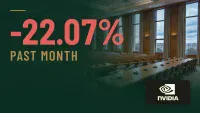
The stock closed at $162.85 on November 13. That was down 12.75% for the week and 26.41% for the month. Because guidance already assumes nothing from China, any licensed reopening would add to the forecast. But the same reporting shows restricted NVIDIA chips running inside Chinese projects, and Reuters says the leadership change and U.S. scrutiny now imperil those projects. That raises export-control risk for a company that has already told investors to expect zero revenue from China.

Contact [email protected] for any questions or corrections.
After two decades of patrolling the dark corners of suburbia as a police officer, Rich Duprey hung up his badge and gun to begin writing full time about stocks and investing. For the past 20 years, he’s been cruising the markets looking for companies to lock up as long-term holdings in a portfolio while writing extensively on the broad sectors of consumer goods, technology, and industrials. Because his experience isn’t from the typical financial analyst track, Rich is able to break down complex topics into understandable and useful action points for the average investor. His writings have appeared on The Motley Fool, InvestorPlace, Yahoo! Finance, Money Morning, and, of course, 24/7 Wall St. He has been featured in both U.S. and international publications, including MarketWatch, Financial Times, Forbes, Fast Company, and USA Today.