Rocket Lab Just Grew Revenue 73%. Its Next Chapter Could Be Even Bigger

This post may contain links from our sponsors and affiliates, and Flywheel Publishing may receive compensation for actions taken through them.
Rocket Lab (NASDAQ:RKLB | RKLB Price Prediction) has grown into a full-scale space company. It flies Electron, sells HASTE hypersonic test flights to the Pentagon, and has more than 55 spacecraft[1] in development and build for NASA, the Space Force and commercial constellations. Third-quarter revenue rose 72.7%[2] to $267.83 million. CEO Peter Beck called it “a defining quarter for Rocket Lab.”[2]
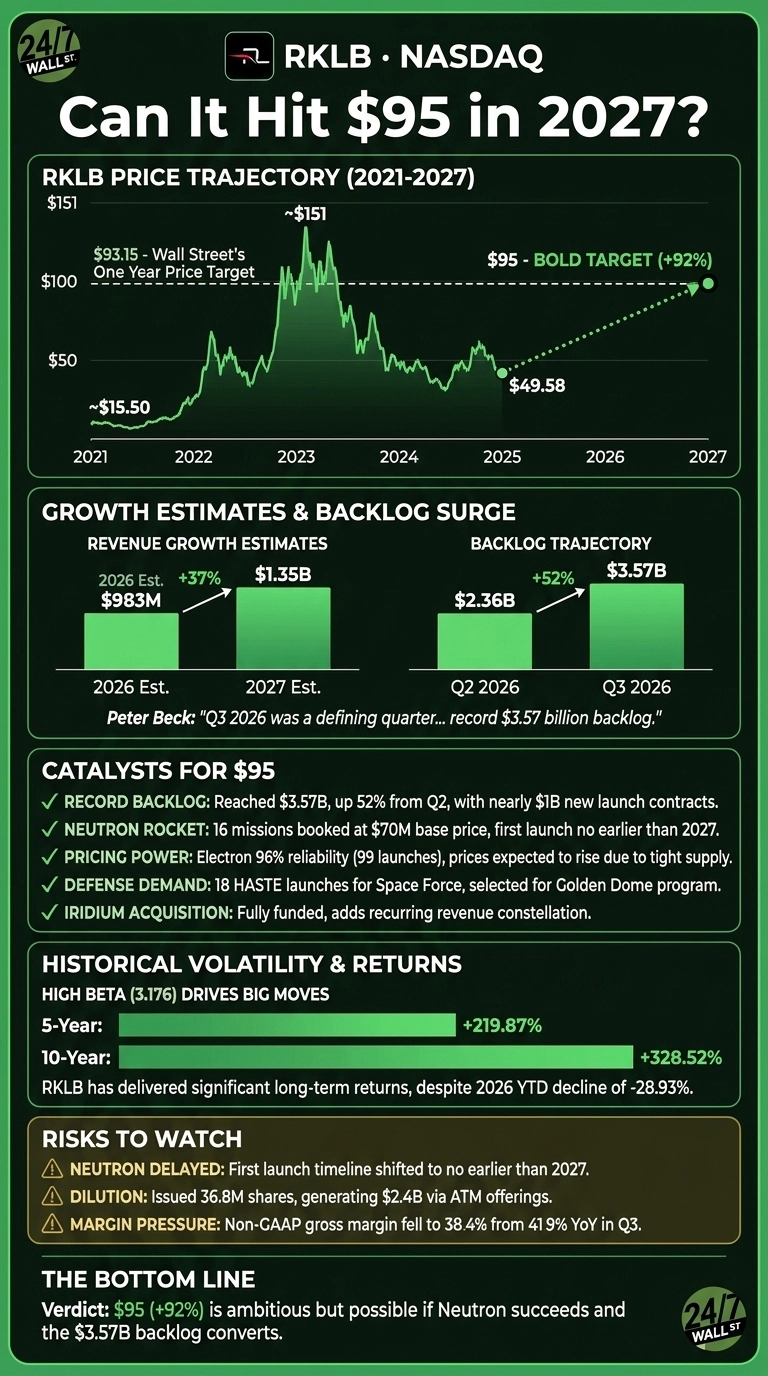
The stock hasn’t kept pace. Shares are down 28.93% year to date but still up 219.87% over five years. Let’s look at what Rocket Lab needs to do to hit $95 per share in 2027.

Wall Street Already Sees Shares Nearly Doubling
The average analyst target of $93.15 implies 88% upside from $49.58. The ratings include 5 strong buys and 13 buys, with zero sells.

Analysts expect revenue of $1.35 billion in 2027, up 37% from this year’s projected $983 million. Rocket Lab has also exceeded revenue estimates in each of the past seven quarters, so actual sales could come in above forecasts.
Here’s the Math Behind $95 Per Share
Because Rocket Lab is still unprofitable, price-to-sales is the right lens. Shares currently trade at about 23x 2027 revenue estimates. At $95, that multiple rises to roughly 45x. That’s a steep premium, but shares traded as high as $151 within the past 52 weeks.

What Could Push Rocket Lab to $95?
- Record backlog: Backlog hit $3.57 billion[2], up 52% since Q2.
- Neutron: The first launch is targeted for no earlier than 2027, with 16 launches[1] already reserved at a base price of $70 million. Management expects adjusted EBITDA to turn positive within six months of a successful first flight[1].
- Pricing power: Launch supply is tight, and management expects Electron and HASTE prices to rise. Electron has a 96% reliability rate across 99 launches[1].
- Defense demand: Rocket Lab won 18 HASTE launches[1] for Space Force Systems Command and was selected for Golden Dome’s Space Based Interceptor program with Raytheon.
- Iridium Communications (NASDAQ:IRDM): The fully funded acquisition adds a recurring-revenue constellation.
Rocket Lab fits the profile of a high-upside tech story built on a clear infrastructure boost, the kind of setup we broke down in a free guide on spotting the next 100x technology winner early: here.
Rocket Lab’s Volatility Makes $95 Reachable
Reaching $95 would mean a 92% gain. With a beta of 3.176 and a 52-week range of $39.30 to $151, this stock can move that far in either direction. It rose 9.16% in early trading today alone.
$95 Is a Stretch, but the Backlog Supports It
Reaching $95 would require Rocket Lab to nearly double in 2027. Wall Street already sees most of that move, revenue beats keep coming, and Neutron could change the business.
There are real hurdles. Neutron has been delayed before, Rocket Lab issued 36.8 million shares[1] through at-the-market offerings, and non-GAAP gross margin fell to 38.4% from 41.9% a year ago. A run like this shouldn’t be expected every year, but we’ve outlined the path for how Rocket Lab could see outsized returns in 2027.
Contact [email protected] for any questions or corrections.
Vandita Jadeja is a financial publisher with over a decade of experience writing about financial topics, including investment, savings, retirement, insurance and banking. Vandita is a Chartered Accountant who loves to debunk financial concepts for readers.
Her work has appeared on sites that include The Motley Fool, InvestorPlace, and Benzinga. She covers investing and focuses on stock picks and price prediction for 24/7 Wall St.
When not looking for the next stock investment opportunity, she can be found traveling, reading, chasing sunsets and enjoying her iced latte.