Tony Robbins Has Some Brilliant Advice for Retirees
With an estimated net worth that most credible sources place in the $600 million to $700 million range, author, motivational speaker, personal coach, and entrepreneur Tony Robbins has built a lucrative career on studying and emulating the practices of successful…

This post may contain links from our sponsors and affiliates, and Flywheel Publishing may receive compensation for actions taken through them.
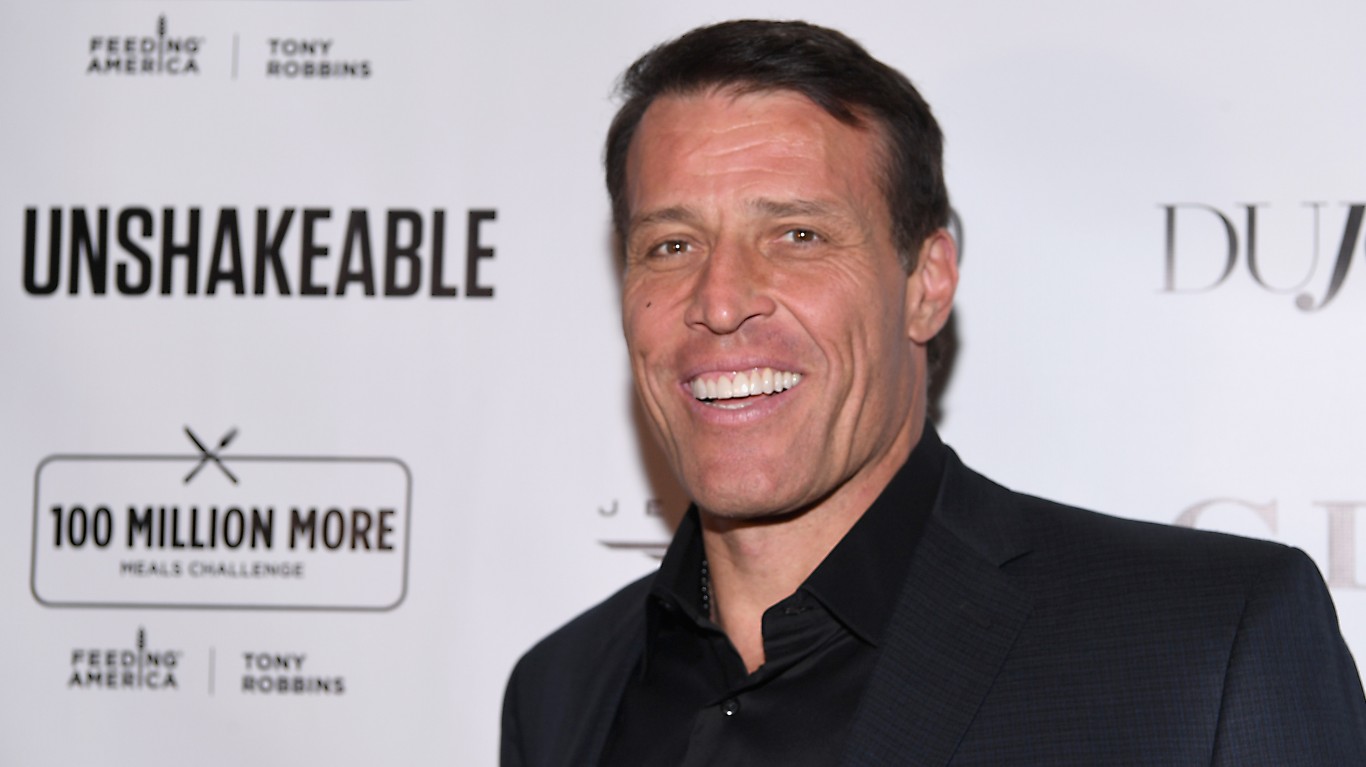
Tony Robbins is one of the most recognizable and commercially successful motivational speakers in history. Most credible sources, including figures cited by Forbes, place his wealth in the $600 million to $700 million range, while Celebrity Net Worth raised its estimate to $1 billion as of early 2026, reflecting decades of compounding returns from his business portfolio. The 6’7″ Robbins overcame a pituitary tumor during his high school years to become a globally recognized author, personal coach, and entrepreneur. His book Awaken the Giant Within, originally published in 1991, has sold more than 4 million copies and opened the door to a string of subsequent bestsellers. In May 2026, Robbins released an updated 35th anniversary edition of the title. He now chairs a holding company with stakes in more than 100 privately held businesses, and according to speaking agency Gotham Artists, a single appearance commands between $500,000 and $750,000. Fortune has dubbed him the “CEO Whisperer,” and Accenture has honored him as one of the “Top 50 Business Intellectuals in the World.” In 2025, Robbins publicly disclosed a diagnosis of Hashimoto’s thyroiditis, an autoimmune condition affecting the thyroid gland, yet he did not cancel events and continued his full schedule.
Robbins has channeled his research into a focused body of work on investing and financial management, including these four titles:
- MONEY Master the Game: 7 Steps to Financial Freedom
- UNSHAKEABLE: Your Financial Freedom Playbook
- THE PATH: Accelerating Your Journey to Financial Freedom
- The Holy Grail of Investing
Robbins does extensive research and acknowledges his sources. His books feature interviews with financial luminaries such as John Bogle, Carl Icahn, and Warren Buffett. His real gift lies in building easy-to-remember analogies that illuminate proven strategies, translating complex financial thinking into language accessible to everyday investors.
A significant share of Robbins’ advice targets retirees, a group that tends to resist change unless a concept genuinely resonates or a major attitude shift occurs. His books blend mindset principles with practical applications, revolving around discipline, emotional control at critical decision points, and the consistent habit of modeling successful people across many fields.
The Financial Mental Challenge

Robbins’ financial counsel divides naturally into two tracks: mental frameworks around attitudes and strategy, and concrete action steps anyone can implement. Several core principles from MONEY Master the Game: 7 Steps to Financial Freedom deserve special attention from retirees:
- Shift From Consumer to Owner: Robbins argues that an ownership mindset, shared by successful entrepreneurs everywhere, is the true foundation of financial independence. Choosing to invest is an ownership-triggered decision, one that returns control over one’s future lifestyle to the individual rather than leaving it to chance or circumstance.
- Become An Insider: One of Robbins’ central principles is learning as much as possible about any endeavor before committing capital. For investing, that means mastering the rules of the game and understanding fee structures in full. His warning is blunt: what you don’t know can cost you far more than any market downturn ever will.
- The Psychology of the “Exit”: Retirees often face “One More Year Syndrome” or identity foreclosure when leaving high-growth careers. Robbins argues that breaking through this mental block requires reframing retirement as a re-founding of personal purpose, not a cessation of productivity.
- Creating a Lifetime Income Plan: Robbins draws heavily on the All Seasons Strategy from Ray Dalio, which balances assets across four economic environments: inflation, deflation, rising growth, and declining growth. The classic All Seasons allocation breaks down as follows:
- 30% stocks
- 40% long-term bonds
- 15% intermediate U.S. bonds
- 7.5% commodities
- 7.5% gold
The strategy targets steady returns and shallower drawdowns across all economic conditions, trading some upside in bull markets for resilience during recessions and inflation spikes. For investors who want direct access to Dalio’s approach, the SPDR Bridgewater All Weather ETF (NYSEARCA:ALLW) launched on March 6, 2025, a collaboration between Bridgewater Associates and State Street Global Advisors. Confirmed as an actively managed, diversified global multi-asset allocation fund, ALLW is designed to generate consistent returns across different economic environments. From its launch through January 2026, the fund delivered a higher risk-adjusted return than both a global 60/40 portfolio and a global all-equity portfolio. By mid-2026, ALLW had grown to approximately $1.3 billion in assets, and it earned three 2026 ETF.com awards: Best New ETF, Best New Multi-Asset ETF, and Best New Active ETF.
- Invest Like the .001%: Robbins advises modeling the habits of financial titans like Buffett and Icahn: protect capital first, risk a little to make a lot, diversify across scenarios, and never stop refining the process.
Putting Concepts Into Action

Robbins’ effectiveness as a financial communicator comes from tracing the emotional roots of financial behavior and converting them into clear, repeatable action steps. Across his books and seminars, he consistently returns to several practical themes that retirees can act on immediately.
- Income Layering via Synthetic Dividends: Retirees can enhance portfolio yield by using institutional-grade strategies such as covered calls or cash-secured puts. This active management approach creates what practitioners call “synthetic dividends,” generating a consistent income stream while preserving the underlying equity positions. The technique lets retirees extract income from holdings without liquidating them during down markets.
- Asset Allocation: Citing historical market turbulence, Robbins demonstrates that staying the course with a diversified mix of low-cost index funds consistently outperforms portfolios liquidated in a panic. Dollar-cost averaging during downturns keeps emotion-driven decisions in check and preserves the long-term compounding that retirement portfolios depend on most.
- Capitalize on Compound Interest: Robbins encourages early participation to maximize the power of compounding. For those approaching retirement, projecting Social Security cost-of-living adjustments alongside long-term asset growth clarifies exactly how large a portfolio needs to be before it becomes self-sustaining.
- AI and Automation: Where automation once meant little more than automatic contributions, today’s investor can leverage AI-powered research tools to monitor portfolio health, screen for volatility signals, and filter opportunities in real time. That capability effectively automates the kind of rigorous “insider” research process Robbins has long championed in his seminars.
- Use a Fiduciary Instead of a Broker: A fiduciary carries a legal obligation to act in the client’s best interest, eliminating the conflicts of interest that routinely surface with commission-based brokers. Robbins is emphatic on this point: reducing annual advisory fees by even 1% can preserve a meaningful share of total wealth across a multi-decade retirement horizon, compounding quietly in the background in the same way the fees themselves would have eroded it.
Editor’s note: This pass updated the ALLW ETF’s assets under management to approximately $1.3 billion based on current Investing.com data, added Tony Robbins’ speaking fee range of $500,000 to $750,000 per appearance per Gotham Artists, and incorporated his 2025 public disclosure of a Hashimoto’s thyroiditis diagnosis as post-publication context.
Contact [email protected] for any questions or corrections.
After 15 years on Wall Street with 7 of them as Director of Corporate and Municipal Bond Trading for a NYSE member firm, I started my own project and corporate finance consultancy. Much of the work involves writing business plans, presentations, white papers and marketing materials for companies seeking budgetary allocations for spinoffs and new initiatives or for raising capital for expansion or startup companies and entrepreneurs. On financial topics, I have been published under my own byline at The Motley Fool, 247wallst.com, DealFlow Events’ Healthcare Services Investment Newsletter and The Microcap Newsletter, among others. Additionally, I have done freelance ghostwriting writing and editing for several financial websites, such as Seeking Alpha and Shmoop Financial. I have also written and been published on a variety of other topics from music, audiophile sound and film to musical instrument history, martial arts, and current events. Publications include Copper Magazine, Fidelity (Germany), Blasting News, Inside Kung-Fu, and other periodicals.