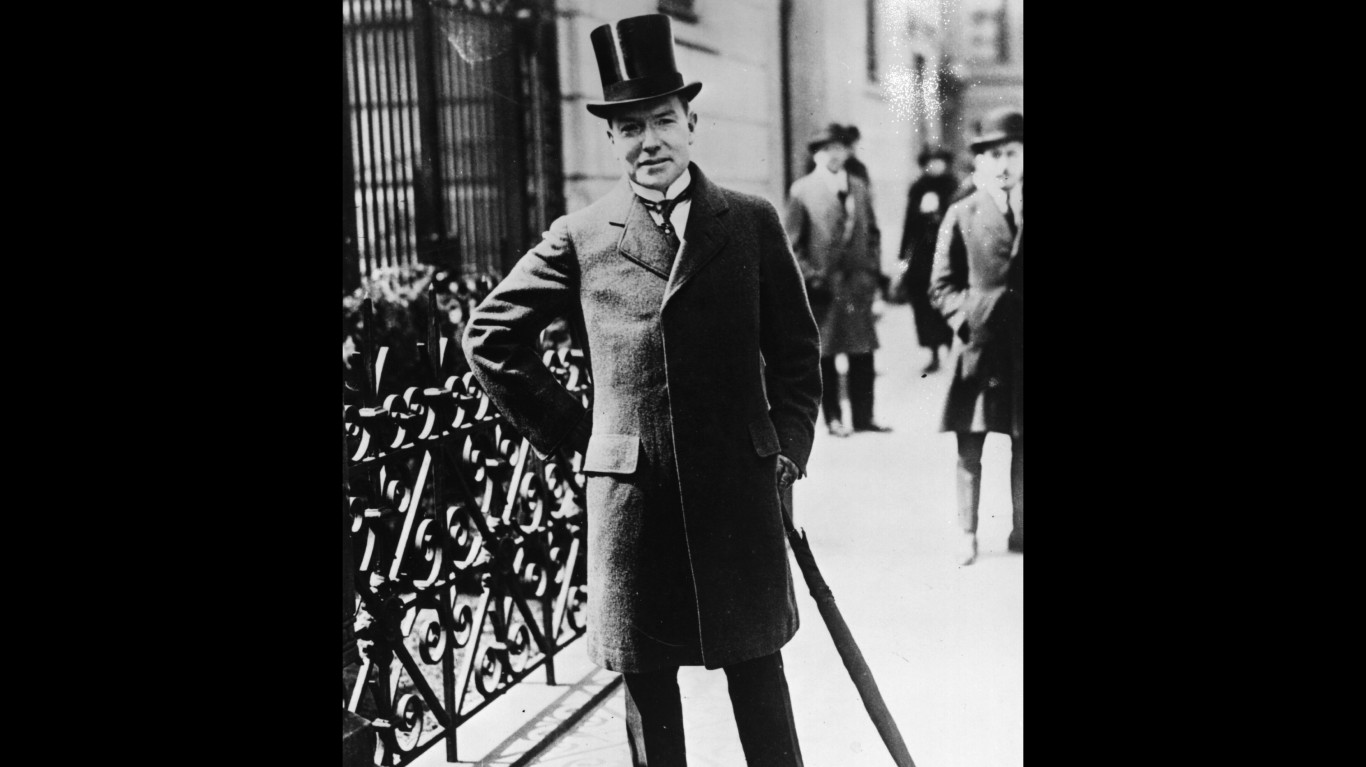
William Randolph Hearst Died in 1951. The Trust Holding His Fortune Is Still Running, Still Private, and Legally Can’t Dissolve Until the Last Family Member Alive That Day Is Gone
William Randolph Hearst built a media empire, died in 1951, and somehow his trust is still running in 2026 without a single public filing. The legal trick his lawyers used is older than America, and it is sitting in the…

This post may contain links from our sponsors and affiliates, and Flywheel Publishing may receive compensation for actions taken through them.

If you own a living trust or have ever considered setting one up, you are working with the same basic legal structure that has kept the Hearst family fortune out of public view for three-quarters of a century. William Randolph Hearst died in 1951, yet the trust holding his newspaper and media empire is still running, still private, and still not a matter of public record. The reason it can legally persist that long comes down to an obscure concept called the rule against perpetuities, and the workaround his lawyers used is available to anyone who drafts a trust with competent counsel.
A trust is a legal arrangement in which a grantor transfers assets to a trustee, who manages them on behalf of named beneficiaries. Under traditional common law, trusts could not run indefinitely. Interests had to vest within a defined window: the lifetime of someone alive when the trust was created, known as a life in being, plus 21 years.
Lawyers quickly realized that naming a group of living people as the measuring lives would push the termination clock far into the future. The Hearst Family Trust is widely understood to use exactly that method, tying its end date to the last family member alive at Hearst’s death in 1951. That is how a mid-century estate plan is still legally operating in 2026, more than 75 years after it was funded.
Where the Rule Actually Comes From
The rule against perpetuities is a common law doctrine with roots in the 1682 English Duke of Norfolk’s Case, a dispute over shifting property interests across multiple generations of one family. That case established the foundational principle that property cannot be tied up beyond a life in being plus 21 years, and American state property law absorbed the doctrine over the following two centuries. The Uniform Statutory Rule Against Perpetuities, adopted in most states, offers a 90-year wait-and-see alternative to the lives-in-being formula, giving trustees more breathing room when the termination date is genuinely uncertain.
Since the 1990s, a number of states have modified or abolished the rule entirely, permitting so-called dynasty trusts that can run for centuries or, in a handful of jurisdictions, indefinitely. What your trust can actually do depends entirely on the state whose law governs it.
Who This Is Actually For
The privacy benefit applies at any asset level, not just to media empires. A will passes through probate, the court-supervised process that makes the document, the asset inventory, and the beneficiary list part of the public record. A properly funded trust bypasses probate entirely and stays private. The distribution-control benefit, specifying when and how assets pass to heirs, works the same way whether an estate is worth $200,000 or $200 million. The Hearst structure is a scaled-up version of tools ordinary families already use (the full estate checklist, beneficiary forms, and titling guidance are in a free report here).
How to Put One to Work
- Choose between a revocable trust (changeable during your lifetime, offers privacy but no creditor protection) and an irrevocable trust (cannot be altered once signed, but shields assets and controls distributions long after death).
- Pick a trustee. A family member costs nothing. A corporate trustee at a bank or trust company charges an annual fee, typically a percentage of assets under management, in exchange for professional administration.
- Fund it. A trust does nothing until assets are retitled into its name. Deeds, brokerage accounts, and business interests must be formally transferred.
- Write distribution terms. Age triggers, education conditions, spendthrift clauses, and charitable remainders are standard.
- Coordinate with a pour-over will that directs anything left outside the trust into it at death.
A Gotcha Buried in the Fine Print
Irrevocable trusts pay their own federal income tax, and the brackets are compressed. Undistributed ordinary income hits the top marginal rate at a threshold far lower than what an individual would pay on the same dollar, and the 3.8% net investment income tax stacks on at that same compressed level. Trustee fees compound over decades. A structure written to control heirs in 1951 can easily become a source of family conflict rather than protection, and the Hearst family itself has been in court over its own trust more than once.
Long-duration trusts also live at the mercy of the rate environment, and that environment has shifted sharply since this article was first published. The 10-year Treasury yield reached 5.17% on September 25, 2026, up from roughly 4.73% in late August, as sticky inflation and heavy bond issuance pushed the benchmark to its highest level in nearly two decades. The Federal Reserve added to that pressure on September 16, 2026, raising the federal funds target range by 25 basis points to 3.75%–4.00%, its first rate hike since 2023, with markets pricing in at least one more move before year-end. Both the direction of rates and the pace of change shape how a trustee must balance income against long-term growth across generations. Anyone considering a similar structure should review the specifics with an estate attorney licensed in the applicable state.
Editor’s note: This article has been updated to reflect the Federal Reserve’s September 16, 2026 rate hike, which raised the federal funds target range to 3.75%–4.00%, and to replace the August 28 Treasury yield figure with the September 25 reading of 5.17%, which represents a 19-year high for the benchmark.
Contact [email protected] for any questions or corrections.
David Beren has been a Flywheel Publishing contributor since 2022. Writing for 24/7 Wall St. since 2023, David loves to write about topics of all shapes and sizes. As a technology expert, David focuses heavily on consumer electronics brands, automobiles, and general technology. He has previously written for LifeWire, formerly About.com. As a part-time freelance writer, David’s “day job” has been working on and leading social media for multiple Fortune 100 brands. David loves the flexibility of this field and its ability to reach customers exactly where they like to spend their time. Additionally, David previously published his own blog, TmoNews.com, which reached 3 million readers in its first year. In addition to freelance and social media work, David loves to spend time with his family and children and relive the glory days of video game consoles by playing any retro game console he can get his hands on.