Let’s Be Real. For Most Retirees, Only One Florida Key Actually Works
The Florida Keys sell a lifestyle that most retirement budgets quietly cannot support, and the math breaks down in ways that only reveal themselves after you request one specific document on the property you want to buy.

This post may contain links from our sponsors and affiliates, and Flywheel Publishing may receive compensation for actions taken through them.
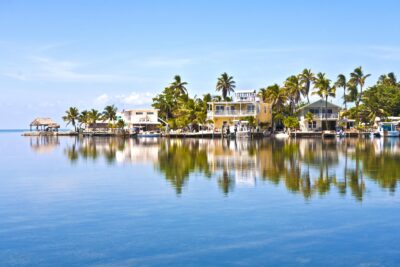
Retirees selling out of New Jersey or Ohio routinely ask whether Keys retirement pencils out. The short version: for most retirees, only one Key is defensible on the math, and for many asking, the correct answer is mainland Florida.
Why the Keys Trade Differently From Mainland Florida
A single road, US-1, connects the entire chain to Homestead, so groceries, fuel, lumber, roofing crews, propane, and medical oxygen all arrive along that one causeway. When a truck breaks down at Jewfish Creek, register prices move. Florida’s statewide cost-of-living index runs 103.414 against a national baseline of 100, and the Keys sit meaningfully above the state figure once you price in the logistics premium on food, contractors, and building materials.
Supply is capped by design, as Monroe County operates a permit allocation system tied to the state’s hurricane evacuation clearance time, which means new residential building rights are rationed rather than issued on demand. Capped supply against national retiree demand is why Keys housing has decoupled from mainland Florida price behavior. The national Case-Shiller index sits at 336.7 as of the June 2026 reading. Unsurprisingly, median pricing in the Keys per bedroom usually runs at a multiple when compared to mainland pricing. Verify the specific median for the specific Key with a current MLS pull before building a budget.
Insurance Is the Line Item That Decides Everything
A Keys homeowner buys three policies in practice: an HO3 for the structure, a separate windstorm policy (often through Citizens, Florida’s state-backed insurer of last resort), and an NFIP flood policy dictated by flood zone and elevation certificate. On an older, at-grade CBS home in a VE zone, the combined annual premium routinely runs into five figures. Get an actual quote on the specific address before signing anything. A regional average is worthless because two houses on the same street can price differently once elevation certificates come in.
Overlay Social Security’s fixed-income reality, while the 2027 COLA is tracking to 3.3%. Keys insurance renewals do not respect that cap.
Healthcare Decides Which Key, If Any
The Keys have three small hospitals spaced along the chain, each capable of stabilization and routine care. Anything cardiac, oncologic, neurologic, or surgical of consequence goes to the mainland, generally Baptist Health in Homestead and Miami. If you develop a condition requiring a specialist visit every six weeks, you are driving US-1 every six weeks. Evacuation orders are phased, with clearance times for the lower Keys measured in tens of hours. For a retiree on dialysis, oxygen, or with mobility limits, that timing is a medical planning problem.
Key Largo Is the Default Choice
For most retirees who want a Key, Key Largo is the answer. It sits closest to Homestead and Miami specialist care, Mariners Hospital in Tavernier is minutes away, and the drive to a Baptist Health emergency room is single-digit miles once you clear the eighteen-mile stretch. Insurance still bites, groceries still cost more, and the permit constraint still limits inventory, but the healthcare geometry is survivable into your late seventies and eighties in a way that Marathon and the lower Keys are not.
Key West suits a different buyer: someone who wants a walkable town with its own hospital ecosystem and cultural depth, is willing to fly out of EYW for advanced care, and has the portfolio to self-insure volatility. Islamorada works for wealthier buyers wanting more privacy. For everyone else, the truthful recommendation is a mainland Florida market with a Keys weekend rental in the budget.
What the Math Actually Requires
Working backward from a defensible Key Largo budget: assume a base annual spend meaningfully above the national Consumer Expenditure Survey figure of $78,535 for 2024, because insurance, groceries, and repairs run hot. Call the working number around $110,000 to $130,000 for a couple owning a modest single-family home, before income taxes on withdrawals. Florida helps on the tax side, ranking 4th overall on the 2025 State Tax Competitiveness Index with no individual income tax.
Subtract a couple’s Social Security, roughly $55,000 to $70,000 combined at full retirement age, and the residual gap is $55,000 to $75,000. At a 3.5% withdrawal rate suitable for a thirty-year horizon (we made the full case for going below the old 4% figure, and what to run instead, in a free report), that implies a liquid portfolio of roughly $1.6 million to $2.1 million, plus the house owned outright, plus a dedicated cash reserve for the deductible on the next named storm.
Before you make an offer on any Keys property, get one document: a bound insurance quote for that specific address, including wind and flood, with the elevation certificate attached. If that number works within the budget above, the plan is real. If it does not, the Key is telling you the answer.
Contact [email protected] for any questions or corrections.
David Beren has been a Flywheel Publishing contributor since 2022. Writing for 24/7 Wall St. since 2023, David loves to write about topics of all shapes and sizes. As a technology expert, David focuses heavily on consumer electronics brands, automobiles, and general technology. He has previously written for LifeWire, formerly About.com. As a part-time freelance writer, David’s “day job” has been working on and leading social media for multiple Fortune 100 brands. David loves the flexibility of this field and its ability to reach customers exactly where they like to spend their time. Additionally, David previously published his own blog, TmoNews.com, which reached 3 million readers in its first year. In addition to freelance and social media work, David loves to spend time with his family and children and relive the glory days of video game consoles by playing any retro game console he can get his hands on.