Arizona Retirees Who Buy a House With a Pool Will Call It the Most Expensive Thing They Never Use
A pool sounds like the obvious perk of retiring in Arizona's desert heat, but the price tag hiding beneath the surface has nothing to do with the listing price and everything to do with how much bigger your portfolio needs…

This post may contain links from our sponsors and affiliates, and Flywheel Publishing may receive compensation for actions taken through them.
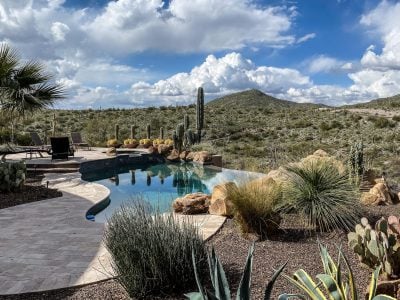
People planning a move to Phoenix, Scottsdale, or Tucson often put a pool near the top of their wish list. In a desert state, it looks like the obvious amenity. Below is what it actually costs to retire in Arizona with a pool, and how much bigger the portfolio has to be over a 30-year retirement to cover it.
Carrying Costs Most Buyers Never Price In
Homes in Maricopa County sold for a median of $474K over the three months ending in August. Phoenix single-family prices fell to a median of $485,000, 3.5% lower than a year earlier, while the national Case-Shiller index rose 1.9%.
That gives buyers some leverage. In Arizona, a pool adds roughly 5% to 8% to a home’s value, so on a median house you’re paying somewhere between $23,700 and $37,920 just for the pool. That money sits in home equity, where you can’t spend it.
The sticker price is the smaller part of the cost. Here is what the pool costs every year in the higher-cost case:
| Pool Line Item | Annual Cost |
|---|---|
| Chemicals, pump electricity, evaporation water, supplies | $3,600 |
| Equipment replacement reserve | $1,000 |
| Resurfacing reserve ($20,000 spread over a decade) | $2,000 |
| $1 million umbrella liability policy | $383 |
| Total | $6,983 |
A basic Phoenix remodel covering resurfacing, tile, and coping costs $15,000 to $25,000. If you do all the maintenance yourself and stretch out the remodel, the low case comes to about $3,633 a year. The table also leaves out a heater, and some retirees may want one in winter.
Turning the Whole Budget Into a Portfolio Target
Arizona’s cost-of-living index is 100.677, so national spending data is a reasonable baseline for metro Phoenix. The average U.S. household spends $78,535 a year, covering housing, food, healthcare, and everything else. For a 65-year-old couple, that includes Medicare Part B at $202.90 a month each, or $4,870 a year before a supplement, drug plan, or the $283 deductible. It also has to cover groceries at USDA’s liberal food plan, roughly $978 a month for two adults. Arizona property taxes run about 0.48% of a home’s value, which keeps the housing line manageable.
Add the pool and the budget comes to $85,518. A retired couple who both collect Social Security averages $3,208 a month, or $38,496 a year. Arizona doesn’t tax Social Security, but the state taxes IRA withdrawals at a flat 2.5%. There’s a $47,022 gap. Gross it up for the 12% federal bracket plus state tax, then divide by a 4% withdrawal rate; the target is about $1.37 million. The same couple without a pool needs about $1.17 million.
When you claim Social Security, it moves the number more than the pool does. If both partners wait from age 67 until 70, their checks grow about 24%, and the target with the pool falls to roughly $1.1 million.
Why a Backyard Pool Is a $200,000 Decision
You pay for a kitchen remodel once, but a pool keeps billing you, and those bills grow with inflation. At the high-cost estimate, funding the pool from pretax savings requires about $204,000 more in your portfolio. Prices rose 3.7% over the past year, and at that rate the pool’s annual cost rises to about $10,000 within a decade. That increase doesn’t show up in the 4% math, which assumes the cost holds steady (we laid out why that assumption wobbles, and the income-first alternative, in a free guide here).
Timing also matters because a resurfacing bill doesn’t wait for a good market, so a $20,000 withdrawal during a downturn means selling assets cheap. Age also matters: skimming and brushing at 70 can feel like a chore at 80, and professional weekly service runs $150 to $300 a month. As the pool gets used less, the cost of keeping it goes up.
What It Takes to Make the Pool Pencil Out
A couple with average Social Security who claims at full retirement age needs about $1.37 million to own a pool home in metro Phoenix, drawing 4% a year from a diversified mix of index funds. Keeping the resurfacing reserve in a short Treasury ladder would keep it from coming from stocks. Delaying Social Security to 70 brings the target down near $1.1 million, and a home without a pool needs roughly $1.17 million. Under any of these routes, the pool costs about $200,000 in retirement savings. For owners who would swim in it often, that cost may be justified. If you wouldn’t, a community pool membership or a home without one leaves that money in your portfolio.
Contact [email protected] for any questions or corrections.
David Beren has been a Flywheel Publishing contributor since 2022. Writing for 24/7 Wall St. since 2023, David loves to write about topics of all shapes and sizes. As a technology expert, David focuses heavily on consumer electronics brands, automobiles, and general technology. He has previously written for LifeWire, formerly About.com. As a part-time freelance writer, David’s “day job” has been working on and leading social media for multiple Fortune 100 brands. David loves the flexibility of this field and its ability to reach customers exactly where they like to spend their time. Additionally, David previously published his own blog, TmoNews.com, which reached 3 million readers in its first year. In addition to freelance and social media work, David loves to spend time with his family and children and relive the glory days of video game consoles by playing any retro game console he can get his hands on.