$10,000 in Taiwan’s ETF Became $16,178 in Five Months While the S&P 500 Limped to $11,093
A $10,000 stake in the iShares MSCI Taiwan ETF (NYSEARCA:EWT) on the last trading day of 2025 was worth about $16,178 five months later, after the fund rose from about $64 to $103 between December 31, 2025 and May 29,…


A $10,000 stake in the iShares MSCI Taiwan ETF (NYSEARCA:EWT) on the last trading day of 2025 was worth about $16,178 five months later, after the fund rose from about $64 to $103 between December 31, 2025 and May 29, 2026. That same $10,000 parked in the S&P 500 via the SPDR S&P 500 ETF Trust (NYSEARCA:SPY) would be worth around $11,093. Taiwan, in other words, is making the American benchmark look sleepy.
The headline numbers are not noise. EWT is up about 62% year to date and roughly 103% over the trailing year through May 29, 2026. SPY is up about 11% YTD and 28% over the trailing year. The trailing-year gap is roughly three to one. The YTD gap is closer to six to one. If you have a friend who keeps texting you a screenshot of their Taiwan ETF, they are not lying.
What you are actually buying
EWT markets itself as a single-country Taiwan equity fund, and on paper that is what it is, with $6.1 billion in net assets and a 0.59% expense ratio. In practice, you are buying a very large, very concentrated bet on the global semiconductor supply chain dressed up as a diversified country fund.
Taiwan Semiconductor Manufacturing (NYSE:TSM | TSM Price Prediction) alone is 22.3% of the fund. The top three holdings, TSMC, Hon Hai (the Foxconn parent), and MediaTek, account for 32.6% of assets. Add Delta Electronics at 3.6% and Quanta Computer at 1.9%, both AI server beneficiaries, and roughly four dollars out of every ten you put in EWT are working inside the chip and server food chain. The Taiwanese banks (Fubon, CTBC, Cathay) sit in the top ten as a counterweight, but the gravity is in the silicon.
The mechanism, in one sentence
TSMC did the work. Taiwan Semiconductor Manufacturing ADRs are up 38.08% YTD and 114.8% over the trailing year. When the single largest position in a fund is up triple digits in a year and represents more than a fifth of the basket, the rest of the holdings barely have to show up. They did, but they did not have to.
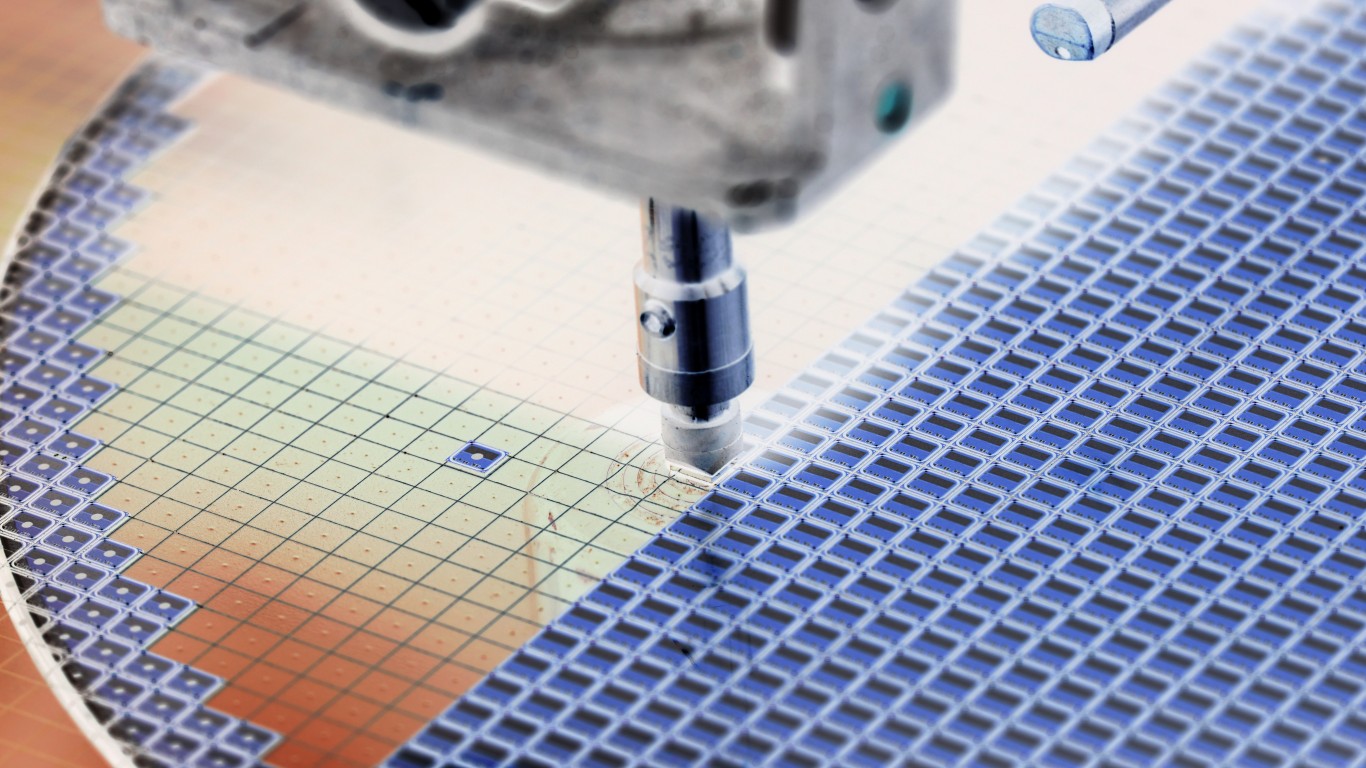
The why behind TSMC is the AI capex cycle in its most concrete form. Worldwide semiconductor revenue hit $298.5 billion in Q1 2026, a 79.2% year-over-year jump, with average selling prices up 57.1% versus Q1 2025 (that ASP move is the AI chip mix talking, not unit growth, since units only rose 14.0%). Taiwan’s slice of that was NT$1,926.1 billion, or US$61.7 billion, in Q1 alone, up 29.4% year over year. Foundry revenue in Taiwan, the TSMC line, ran 32.6% above Q1 2025.
The Taiwan Semiconductor Industry Association is now guiding to NT$8,445 billion (US$270.7 billion) in 2026 industry revenue, a 29.5% increase from 2025. Memory and other manufacturing inside Taiwan is projected to grow 111.9% for the full year. Those are not normal numbers for a mature industrial cluster. They are what it looks like when the world’s hyperscalers spend the GDP of a mid-sized country trying to corner accelerator supply, and Taiwan is the bottleneck most of that money has to flow through.
Is this a country fund or a TSMC tracker
Worth pressing on. If you back out TSMC’s contribution, EWT’s return profile gets a lot more ordinary. TSMC up 114.8% over a year at a 22.3% weight is mechanically a huge share of a 103% fund move. The Hon Hai and MediaTek positions amplify the same theme (AI servers, edge-AI silicon), which is why this works as a thematic vehicle and why it can stop working for the exact same reason. You are getting Taiwanese banking and consumer exposure as ballast, but the engine and the headline are one ticker.
The forward look, honestly
The conditions that produced the run are still present. AI capex guidance from the US hyperscalers has not been cut. TSIA’s full-year 2026 guide implies the back half of the year stays hot, with Q2, Q3, and Q4 Taiwan IC revenue projected at NT$2,048.7B, NT$2,202.6B, and NT$2,267.6B respectively, each one a fresh quarterly record. Foundry pricing has held. None of the leading indicators of a chip-cycle top, inventory builds at customers, ASP softness, capex deferrals, are visible in the Q1 numbers.
What you are buying now, though, is different from what was on offer a year ago. EWT is up roughly 18% in the past month alone and about 6% in the past week. TSMC has gone from $194 to $418 in twelve months. The price has changed while the underlying story has not. Whatever margin of safety existed against an air pocket in AI orders, a Taiwan Strait incident, or a TSMC capex cut at the next earnings call has compressed materially. The five-year return on EWT is about 130%, and most of that arrived in the last twelve months, which tells you how much of the long-run return is now stacked on top of one regime.
TSMC’s monthly revenue release, which lands in the first ten days of every month, is the cleanest read on whether the foundry order book is still accelerating. The hyperscaler capex prints from the next round of US mega-cap earnings will tell you whether the demand side is still leaning in. TSIA’s next quarterly statistics update will confirm or break the 29.5% full-year growth guide. And on the political side, any escalation in cross-strait language out of Beijing tends to show up in EWT’s discount to NAV before it shows up in the holdings, because EWT trades during US hours while the underlying does not.
The honest read is that EWT did exactly what a fund with 22.3% in TSMC and another 10% in adjacent AI-supply-chain names should do when the AI build-out runs hotter than anyone modeled. The mechanism is intact, the numbers behind it are real, and the same setup at $102 is a meaningfully different proposition than it was at $50. If you are sizing a new position today, the question is whether you are comfortable owning the chip backbone of the AI economy after a 103% year, with the next data point that matters being TSMC’s monthly revenue release.
Contact [email protected] for any questions or corrections.
Austin Smith is a financial publisher with over two decades of experience as an investor, analyst, and advisor. He covers stocks, ETFs, Artificial intelligence and personal finance for 24/7 Wall St. Previously, he spent over a decade at The Motley Fool as a senior editor for Fool.com, portfolio advisor for Millionacres, and launched The Ascent to help reader take control of their personal finances.
His work has been featured on Fool.com, NPR, CNBC, USA Today, Yahoo Finance, MSN, AOL, Marketwatch, and many other publications. He is as an advisor to private companies, and co-hosts The AI Investor Podcast with Eric Bleeker.
When not looking for investment opportunities, he can be found skiing, running, or playing soccer with his children. Learn more about Austin's investment approach here.