Billionaire Investor Bill Ackman: Buying Microsoft, Meta, and Amazon Today Could Be Like Adding Buffett’s Berkshire Hathaway 25 Years Ago
Billionaire investor Bill Ackman of Pershing Square has laid out one of the more provocative big-cap calls of this AI cycle. On the All-In Podcast, he argued that today's mega-cap incumbents are being treated the way the market treated Warren…

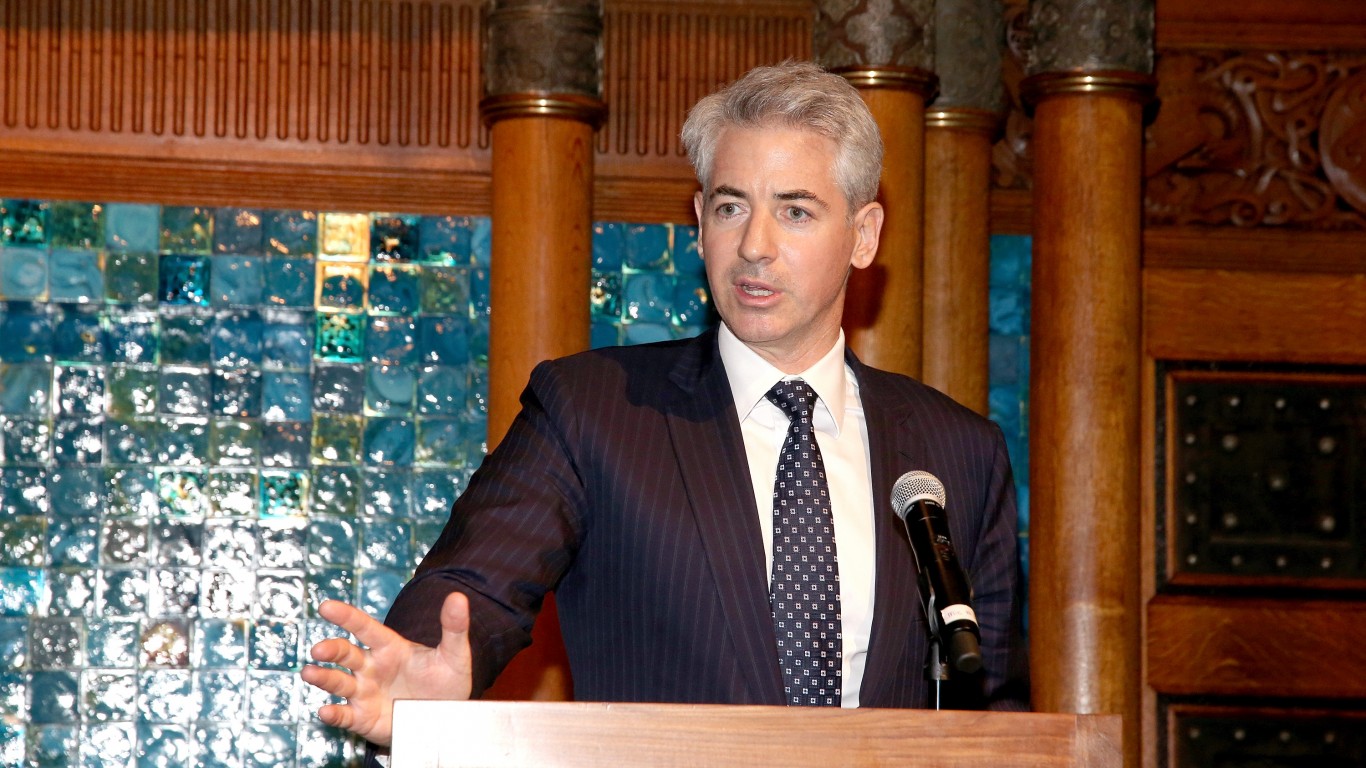
Billionaire investor Bill Ackman of Pershing Square has laid out one of the more provocative big-cap calls of this AI cycle. On the All-In Podcast, he argued that today’s mega-cap incumbents are being treated the way the market treated Warren Buffett’s empire at the peak of the dot-com bubble: as yesterday’s story while capital chases the newest thing.
His holdings make the point. “Today we own Microsoft, we own Meta, we own Amazon,” Ackman said, adding that AI is becoming so pervasive that nearly every major company will either benefit from it or be disrupted by it. As he put it, “Either directly or indirectly, you’re invested in AI, or it’s a threat.” Pershing Square runs a concentrated book of roughly eight to twelve positions at any given time, and these three AI-era incumbents now sit at its core.
The Berkshire-at-the-Dot-Com-Low Parallel
Ackman’s analogy is the spine of the thesis. In 2000, as money flooded into internet names, Berkshire Hathaway (NYSE:BRK-B | BRK-B Price Prediction) was dismissed as a relic. “Berkshire Hathaway traded at the lowest valuation I think it ever traded at in its history, as people said, okay, that’s all old stuff,” he recalled. His broader observation: “People always bring their eye to the new, new thing. The new, new thing is sort of chips, semiconductors, and energy… What tends to happen is really high-quality things get left behind.”
Berkshire’s B shares traded around $29.34 on March 1, 2000, and closed near $475.37 on June 3, 2026, a gain of roughly 1,520% on an adjusted basis. BRK-B is also up about 237% over the past ten years and roughly 63% over five. Past performance does not guarantee the same outcome for a different set of companies in a different era, but the lesson Ackman draws is that buying ignored quality has historically rewarded patient investors.
Why Own Microsoft, Meta, and Amazon
Microsoft (NASDAQ:MSFT) has emerged as a central AI beneficiary, and its most recent results validated the thesis in force. In Q4 FY2026, Azure revenue grew 43%, accelerating from 40% in the prior quarter and pushing Azure past $100 billion in annual revenue for the first time. Total quarterly revenue reached $90 billion, up 18% year over year, while commercial remaining performance obligations rose 84% to $678 billion, signaling locked-in demand for years ahead. The stock had fallen roughly 19% year-to-date heading into that report; it surged approximately 17% the day after results dropped, erasing most of those losses. Ackman has been adding to the position, with Microsoft now the third-largest holding in Pershing Square’s portfolio at approximately $2.32 billion.

Meta Platforms (NASDAQ:META) posted Q2 2026 revenue of $60.80 billion, up 28% year over year, as ad impressions rose 14% and average price per ad climbed 12%. Family daily active people across Meta’s apps reached 3.60 billion in June 2026, up from 3.56 billion in March. The headline profit picture was complicated by $2.4 billion in legal charges and $1.18 billion in severance tied to roughly 8,000 layoffs as management accelerated its shift toward AI priorities. Meta represents approximately 11% of Pershing Square’s portfolio, a position Ackman initiated in Q4 2025. Full-year 2026 capex guidance now stands at $130 to $145 billion, reflecting the scale of that AI infrastructure buildout.
Amazon (NASDAQ:AMZN) remains a core holding, though Ackman trimmed the position by roughly 25% in Q2 2026 to fund additions elsewhere. Pershing Square’s mid-year update nonetheless reiterated expectations for Amazon to compound earnings at more than 20% annually, citing AWS revenue growth acceleration to 37% and strong retail margin expansion. AWS represented 60% of Amazon’s operating income in the most recent quarter while accounting for less than a quarter of total sales, and Pershing Square describes e-commerce as a “one-of-a-kind logistics network” capable of nearly doubling profitability through advertising, automation, and network density.
Ackman pairs the bullish framing with a sober caveat: “This is the greatest era in history to build a business,” with unlimited compute and capital, meaning disruption risk has never been higher. Owning the incumbents is a bet that scale, distribution, and balance-sheet firepower let them absorb AI rather than be flattened by it.
The SaaSpocalypse: Where Ackman Sees Real Risk
Ackman is selective on software, expressing concern about names like Salesforce (NYSE:CRM). His framework is that niche software charging premium prices, which he pegs at “$30,000 a year,” is vulnerable to AI replication. Microsoft’s deeply embedded “$50 a seat” pricing, woven into enterprise workflows, is simply harder to dislodge.
Salesforce’s own Q1 FY27 results offer the counterargument: Agentforce ARR hit $1.2 billion, up 205% year over year, and management entered a $25 billion accelerated share repurchase. Combined Agentforce and Data 360 ARR reached nearly $3.4 billion. Whether that momentum is durable enough to offset Ackman’s structural concern is the open question, but the short-term numbers make the bear case harder to press.
The Takeaway
Bill Ackman’s view is that the market’s obsession with the next big thing has left genuine compounders underappreciated. Just as Berkshire Hathaway was cast as an old-economy relic during the dot-com boom before compounding wealth for decades, he believes today’s mega-cap leaders are being similarly passed over. The subsequent performance of his three core positions since this thesis was articulated has, at least in the near term, started to bear that out: Microsoft’s AI results drove a decisive rerating, Meta’s ad engine continues to grow despite heavy investment, and Amazon’s AWS acceleration remains on track.
The comparison is compelling without being a perfect parallel. Large, established companies benefit from scale, resources, and adaptability, yet technological disruption is a constant risk. The market is aware of both possibilities, and the degree to which today’s leaders ultimately dominate or merely survive the AI transition remains the central unresolved question for investors tracking this thesis.
Editor’s note: This article has been updated with Pershing Square’s Q2 2026 13F disclosures, which showed Ackman exiting Alphabet, trimming Amazon by 25%, and adding to Microsoft and Meta; Microsoft’s Q4 FY2026 results showing Azure growth accelerating to 43% and surpassing $100 billion in annual revenue; Meta’s Q2 2026 results showing daily active people reaching 3.60 billion and updated capex guidance of $130 to $145 billion; and Salesforce’s Q1 FY27 Agentforce ARR of $1.2 billion confirmed via SEC filing.
Contact [email protected] for any questions or corrections.
Thomas Richmond is a financial writer and content strategist with 5+ years of experience covering stocks and financial markets. He has published over 500 articles focused on individual stock analysis, helping investors better understand business fundamentals, stock valuations, and long-term opportunities.
Thomas previously served as a Content Lead at TIKR, a stock research platform, where he helped scale the company’s blog to hundreds of articles per month and contributed to a weekly newsletter reaching more than 100,000 investors.
Outside of work, Thomas enjoys weight lifting and soccer.