BofA Rates Strategist: New Fed Chair Warsh Is a Bond Market Stranger, Volatility Ahead
Mark Cabana, Co-Head of Global Rates Research at Bank of America Securities, came on CNBC this morning ahead of the FOMC decision with a thesis that has very little to do with the dot plot and almost everything to do…

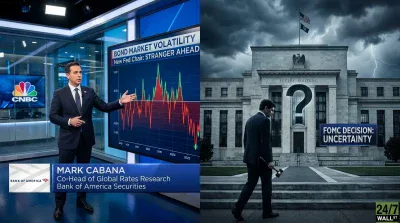
Mark Cabana, Co-Head of Global Rates Research at Bank of America Securities, came on CNBC this morning ahead of the FOMC decision with a thesis that has very little to do with the dot plot and almost everything to do with the man holding the gavel. “Kevin Warsh is a relative stranger to the bond market, at least as far as acting in Fed chair capacity,” Cabana said. That is the unusual part. The bond market has spent the better part of two decades learning the tells of Powell, Yellen, and Bernanke. Warsh is something closer to a returning expat.
A chair the bond market hasn’t traded against
Rates traders price personalities as much as data. Powell’s pauses, Yellen’s word choice, Bernanke’s academic tics all got absorbed into the curve over years. Warsh has been on the outside looking in for a long stretch. “It is also very unusual for an outsider to assume a Fed chair responsibility,” Cabana noted. “They grew up through the Fed. Warsh has been gone for 15 years.”
Warsh built a reputation as a hawk during the financial crisis era, but the world he inherits runs on AI productivity arguments, a disinflation story, and a labor market that keeps refusing to roll over. Cabana put the uncertainty plainly. “He wants regime change. He wants to change many things at the Fed. But we really don’t have a strong sense for how his leaning is on monetary policy.” You can read Warsh’s old speeches all you want. They were written before transformers, before tariffs became a fiscal tool, before the Fed’s balance sheet got this large.
The committee leans hawkish, and the dot plot will show it
Cabana expects no move today, but he is paying attention to where the rest of the committee plots itself. “We still think there will be individuals that pencil in hikes for this year,” he said. “And what we need to hear from Warsh is how prevalent is that view?”
The hawkish argument has a clean version. Cabana asked it out loud. “Are interest rates restrictive in this economy right now? To me, it is not clear at all that they are.” The U.S. consumer keeps spending. Credit spreads behave. Equities trade like a cut is coming. If policy is not actually restrictive, then the asymmetry shifts, and a chair with hawkish DNA might find a committee that already agrees with him.
What the curve and mortgages are pricing
The bond market is straddling the question. The 10-year Treasury sits at 4.43% and the 2-year at 4.05%, a modestly positive slope that says the market believes in eventual easing while refusing to commit to it. The 30-year mortgage sits near 6.5%, inside a 6.25% to 6.75% range, sticky and not particularly responsive to chatter about cuts. A meaningful hike from here would push that figure modestly higher, but the base case is flat.
The disinflation argument has a real anchor. WTI crude collapsed to roughly $76 a barrel after trading in a $90 to $100 range. That takes pressure off the goods side of the basket. If Warsh wants to lean dovish, energy gives him cover. If he wants to lean hawkish, the resilient consumer gives him cover. Cabana’s point is that you cannot yet tell which lever he reaches for, and that is the volatility.
Hold today, a choppy session ahead
Cabana’s setup is a hold at this meeting, with the rates market currently pricing roughly one hike over the next 6 to 12 months. The trade is really about the press conference. Every adjective Warsh picks is going to get parsed by people who do not have a decade of his behavior to compare it against. For a sense of the broader macro setup investors are weighing alongside this, see the Treasury’s daily yield curve data, which has shown a 13 basis point swing in the 10-year over the past two weeks. Volatility is the position. Clarity is the catalyst.
Contact [email protected] for any questions or corrections.
Omor Ibne Ehsan is a writer at 24/7 Wall St. He is a self-taught investor with a focus on growth, cyclical, and dividend equities that have strong fundamentals, value, and long-term potential. He also has an interest in high-risk, high-reward investments such as penny stocks.