5 Stocks That Can Win or Lose After Taiwan Semiconductor Earnings
When Taiwan Semiconductor reports earnings on July 16, its commentary on CoWoS packaging and advanced-node capacity will ripple through five chip giants with billions of dollars riding on what the world's largest foundry says next.

Taiwan Semiconductor Manufacturing (NYSE:TSM | TSM Price Prediction) reports its Q2 2026 earnings on Thursday, July 16, before the U.S. open, and every major fabless chip designer will be reading the tea leaves. As the world’s largest contract foundry, its wafer pricing, capacity utilization, advanced-node demand, and CoWoS packaging commentary telegraph the health of every customer that ships silicon.
Consensus expects EPS near $3.83 on estimated revenue of $1.26 trillion NT, and Polymarket currently pegs the probability of an earnings beat at 95%. A strong print would validate the AI capex cycle; softer guidance on the N2 ramp or CoWoS allocation could cascade quickly through customers.
Investors often gain this exposure through the VanEck Semiconductor ETF (NASDAQ:SMH), where Taiwan Semiconductor is the fourth-largest holding at 9% of net assets. However, you can consider building your own portfolio with these five stocks that could win or lose after Taiwan Semiconductor releases its closely watched financial results.
1. Qualcomm (QCOM)
Qualcomm‘s (NASDAQ:QCOM) Snapdragon mobile SoCs and custom silicon are fabricated at Taiwan Semiconductor on N4/N3 nodes. Its story hinges on smartphone commentary rather than AI accelerator allocation.
Qualcomm reported Q2 FY2026 revenue of $10.599 billion, down 4% year over year (YoY), with Handsets at $6.02 billion, off 13% on memory constraints and Chinese OEM softness. CEO Cristiano Amon stated, “We are equally excited by our entry into the data center, where a leading hyperscaler custom silicon engagement is on track for initial shipments later this calendar year.”
Qualcomm stock is up 17% over the past year, though it has slipped 13% over the past month. Taiwan Semiconductor’s smartphone-segment commentary and China handset outlook will be most relevant for Qualcomm shares.
2. Apple (AAPL)
Apple (NASDAQ:AAPL) is Taiwan Semiconductor’s single largest customer by volume, with A-series and M-series chips fabricated exclusively on advanced nodes. Apple gets priority allocation, which caps upside surprise but leaves it disproportionately exposed to any Taiwan disruption commentary.
Apple posted Q2 FY2026 revenue of $111.18 billion, up 17% YoY, with iPhone revenue of $56.99 billion. CEO Tim Cook asserted, “iPhone achieved a March quarter revenue record, fueled by such extraordinary demand for the iPhone 17 lineup.”
Apple stock has run 50% over the past year and 16% year to date (YTD). Watch for whether Taiwan Semiconductor addresses its N2 ramp timing, which drives iPhone silicon cost and availability for the next-generation cycle.
3. Broadcom (AVGO)
Broadcom‘s (NASDAQ:AVGO) custom AI accelerators and networking silicon are fabricated primarily at Taiwan Semiconductor on N3/N5, making it a heavy CoWoS packaging user. Its Q3 FY2026 AI revenue target of $16 billion depends entirely on that capacity being available.
Broadcom delivered Q2 FY2026 revenue of $22.187 billion, up 48% YoY, with AI semiconductor revenue of $10.8 billion, up 143%. CEO Hock Tan declared, “Q2 semiconductor revenue from AI of $10.8 billion grew 143% year-over-year, above our forecast, driven by increasing demand for custom AI accelerators and AI networking.”
Broadcom stock has climbed 41% over the past year, and analysts carry a consensus target of $523.73. Taiwan Semiconductor’s HPC and CoWoS capacity guide will directly validate or challenge Broadcom’s Q3 AI number.
4. Advanced Micro Devices (AMD)
Advanced Micro Devices (NASDAQ:AMD) has arguably more relative dependence on Taiwan Semiconductor’s advanced packaging than any peer. Its Instinct MI300X, MI355X, and MI450 GPUs use CoWoS, competing directly with NVIDIA for the same constrained allocation.
AMD reported Q1 FY2026 revenue of $10.253 billion, up 38% YoY, with Data Center revenue of $5.775 billion, up 57%. CEO Lisa Su stated, “We are seeing strong momentum as inferencing and agentic AI drive increasing demand for high-performance CPUs and accelerators.” A Meta Platforms partnership will deploy up to 6 gigawatts of AMD Instinct GPUs, contingent on CoWoS supply.
AMD stock has surged 151% year to date and 268% over one year. Given AMD’s trailing P/E ratio of 185x and forward P/E ratio of 79x, any capacity disappointment could be punishing.
5. NVIDIA (NVDA)
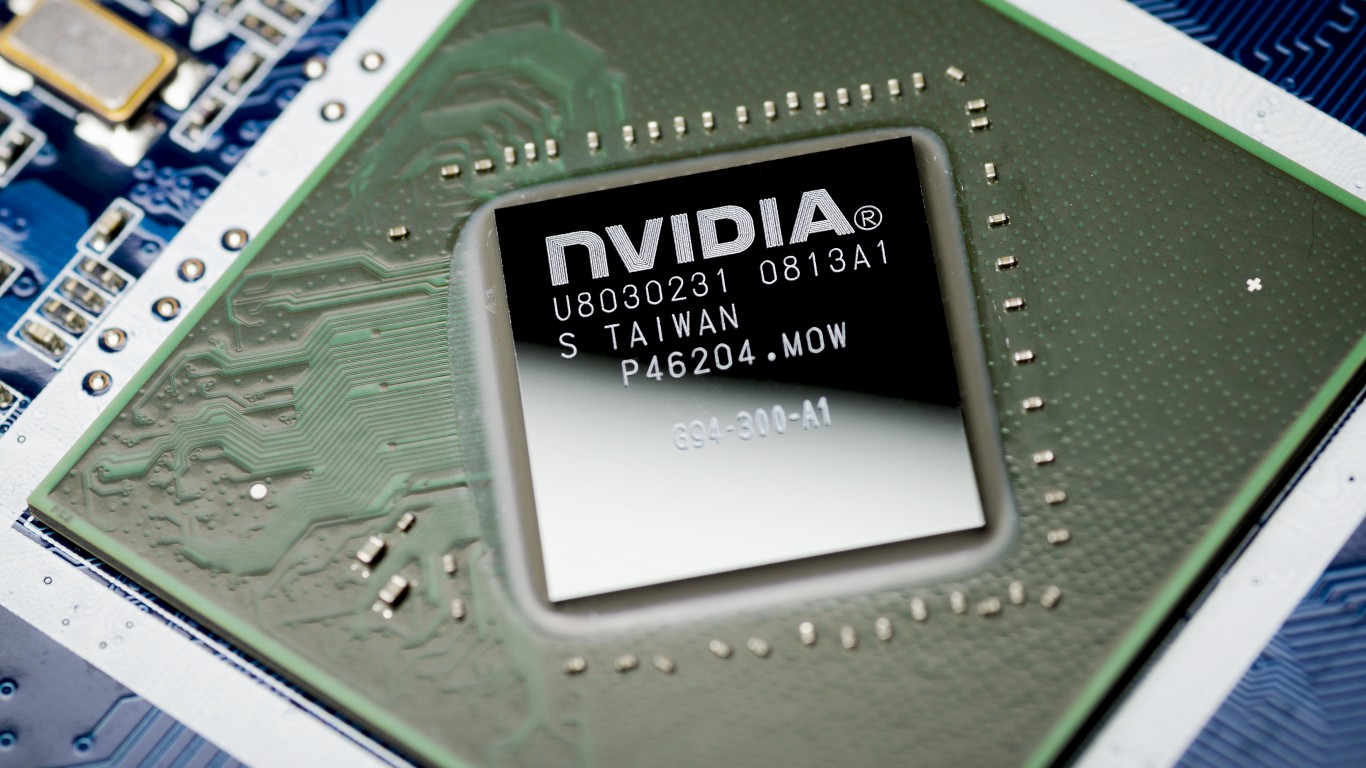
NVIDIA (NASDAQ:NVDA) is the single most Taiwan Semiconductor-dependent name on this list. Its Blackwell, Blackwell Ultra, and Vera Rubin GPUs are fabricated on N4/N3/N2 with heavy CoWoS packaging, and total supply-related commitments have reached $119 billion.
NVIDIA posted Q1 FY2027 revenue of $81.615 billion, up 85% YoY, with Data Center revenue of $75.246 billion, up 92%. CEO Jensen Huang stated, “The buildout of AI factories, the largest infrastructure expansion in human history, is accelerating at extraordinary speed.”
NVIDIA stock is up 24% over the past year, though Reddit sentiment has softened amid DeepSeek AI chip and NVIDIA server delay discussions. Any positive read on CoWoS capacity flows directly to NVIDIA shares; any Taiwan geopolitical friction hurts NVIDIA disproportionately.
The Takeaway
The common thread across these five names is CoWoS advanced packaging, which remains the choke point for AI accelerator supply. Taiwan Semiconductor’s Q2 capex commentary and N2 ramp timing can move all of these stocks, though a strong foundry print doesn’t automatically mean every customer rises given distinct product cycles and demand drivers.
Investors may want to size their positions carefully given elevated valuations across the group and the shared Taiwan geopolitical tail risk. Watch for whether management addresses U.S./China export controls and memory supply constraints, which have already surfaced in Qualcomm, AMD, and NVIDIA disclosures.
The SMH ETF offers a diversified way to play the read-through, but with the top four holdings representing 38% of the fund’s net assets, sector concentration risk is real. Thursday’s print sets the tone for the rest of AI earnings season.
Contact [email protected] for any questions or corrections.
David Moadel is financial writer specializing in stocks, ETFs, options, precious metals, and Bitcoin. David has written well over 1,000 articles for leading online publications, helping investors understand markets, income strategies, and risk.His work has appeared in The Motley Fool, InvestorPlace, U.S. News & World Report, TipRanks, ValueWalk, Benzinga, Market Realist, TalkMarkets, Finmasters, 24/7 Wall St., and others.With a master’s degree in education, David has taught at the elementary, high school, and college levels. That teaching background shapes his writing style: clear, educational, and practical. David has also built a loyal social-media audience by providing trustworthy financial content on YouTube, X/Twitter, and StockTwits.