Intel Owns Just 2 Stocks Worth $620 Million: Here’s What That Concentrated Bet Reveals
Intel sits on roughly $30 billion in cash, yet its entire disclosed stock portfolio fits inside just two struggling companies tied to autonomous flight and self-driving cars. The reasoning behind that concentrated bet says more about CEO Lip-Bu Tan's grand…


For a company with a $541.83 billion market cap, Intel (NASDAQ:INTC | INTC Price Prediction) runs an almost comically small disclosed equity book. Its Q2 2026 13F filing lists exactly two positions worth a combined $620 million as of June 30, 2026. Both are bets on autonomous, AI-driven mobility. Both are down sharply in 2026. And both sit at the intersection of CEO Lip-Bu Tan’s edge-AI thesis.
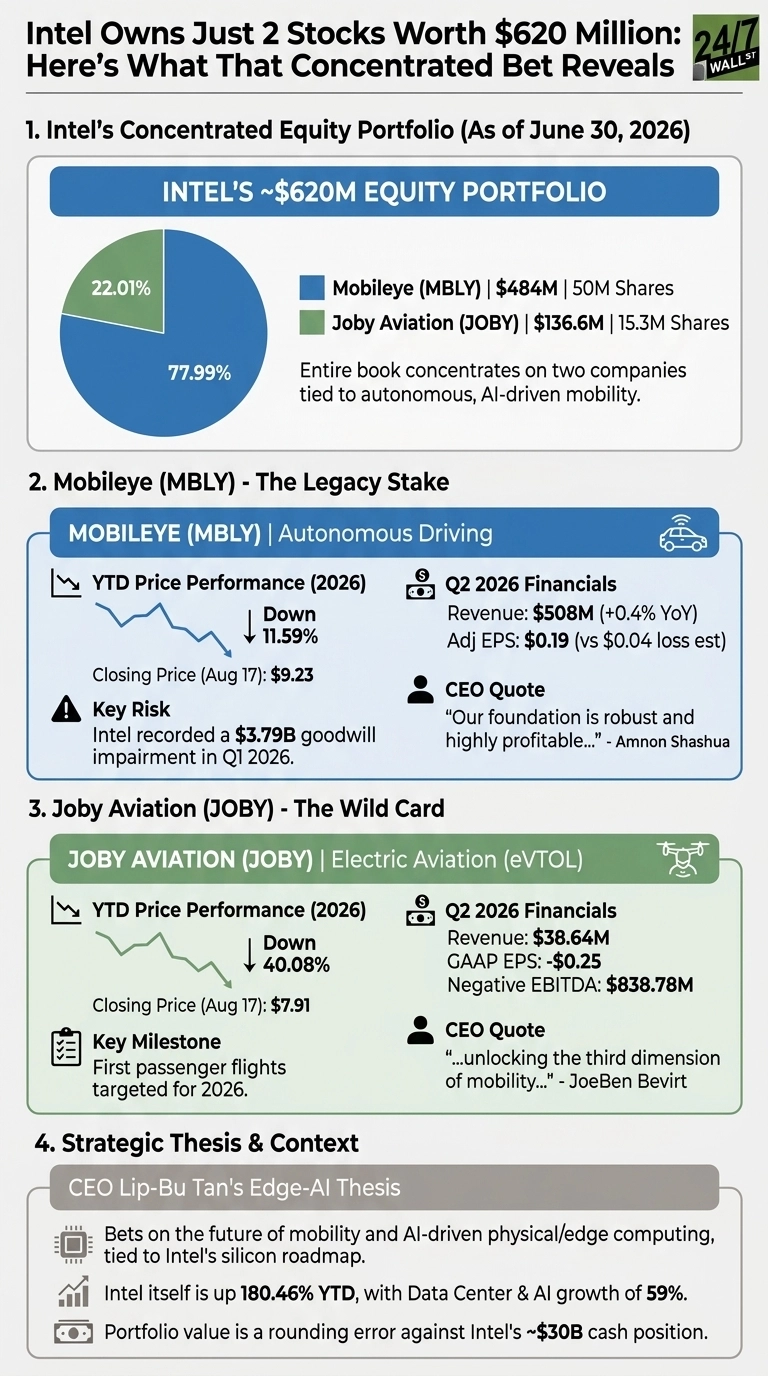
The concentration is striking. 50 million shares of Mobileye account for $484 million, or 77.99% of the portfolio, with 15.3 million shares of Joby Aviation making up the remaining $136.6 million, or 22.01%. The entire book concentrates on two companies tied to physical AI.
The Mobileye Legacy Stake
Mobileye (NASDAQ:MBLY) is the residue of Intel’s 2017 acquisition and 2022 spinout. The autonomous driving unit posted Q2 2026 revenue of $508 million (+0.4% YoY) and adjusted EPS of $0.19 versus a $0.04 loss estimate.
CEO Amnon Shashua told investors, “Our foundation is robust and highly profitable, boosted by the recently enacted R&D Law which we expect to sustainably raise the margin baseline of the business.”
The stake is far from unblemished. Intel recorded a $4.07 billion Q1 2026 restructuring charge largely tied to Mobileye goodwill impairment. Mobileye shares are down 11.59% year to date and 34.12% over the past year, closing at $9.23 on August 17, 2026. Analysts still carry a $12.10 average target, with five Strong Buys, eight Buys, and 14 Holds.

The Joby Wild Card
Joby Aviation (NYSE:JOBY) is the more unusual position for a semiconductor company. The eVTOL developer generated quarterly revenue growth of 2,574.93% YoY off a low base and burned enough cash to produce negative EBITDA of $838.78 million. Shares trade at 67.36 times sales and are off 40.08% year to date, closing at $7.91.
CEO JoeBen Bevirt framed the quarter this way: “With meaningful progress on certification, partnerships, infrastructure and commercial readiness, we are unlocking the third dimension of mobility and turning electric vertical flight from an extraordinary technology into an everyday reality.”
FAA type certification is progressing, with Stage 3 at 83% and Stage 4 at 20%, and first passenger flights are targeted for 2026.

What It Signals
Tan is treating these as active strategic bets. On the Q2 2026 call, he renamed the Client Computing group to recognize “the growing opportunity for AI at the edge,” which he said is “likely to at least match the client TAM over time.” Mobileye and Joby are effectively public-market expressions of that edge-AI thesis.
Intel itself is up 180.46% year to date, riding Q2 revenue of $16.13 billion (+25.4% YoY) and Data Center & AI growth of 59%. Against a $30 billion cash position, the $620 million book is a rounding error.
But it is the clearest public signal of where Tan thinks silicon meets the physical world next. Retail holders should watch two things: any further Mobileye impairment testing tied to the depressed share price, and whether Joby’s late-2026 certification milestones justify keeping the stake intact.
Contact [email protected] for any questions or corrections.
Vandita Jadeja is a financial publisher with over a decade of experience writing about financial topics, including investment, savings, retirement, insurance and banking. Vandita is a Chartered Accountant who loves to debunk financial concepts for readers.
Her work has appeared on sites that include The Motley Fool, InvestorPlace, and Benzinga. She covers investing and focuses on stock picks and price prediction for 24/7 Wall St.
When not looking for the next stock investment opportunity, she can be found traveling, reading, chasing sunsets and enjoying her iced latte.