Elon Musk Says AI Could Add $20-$30 Trillion a Year to the Global Economy
Elon Musk brought a staggering AI economic forecast to G20 policymakers, but Wall Street skeptics are raising pointed questions about the gap between today's debt-fueled buildout and the payoff Musk envisions.

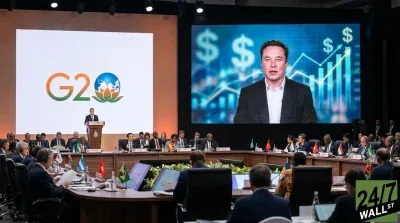
Speaking virtually at a G20 event in North Carolina, Tesla (NASDAQ:TSLA | TSLA Price Prediction) and SpaceX CEO Elon Musk offered what he called a rough estimate of AI’s economic upside. “I think AI will probably increase the global economy by 20% to 30%. That’s my rough estimate. Meaning on the order of $20 to $30 trillion per year,“ Musk said.
He paired that with a forecast of how AI’s capability will progress: “AI will be able to do anything that doesn’t require shaping of atoms by hand. Probably by the end of next year.”
Why Musk Took His $30 Trillion per Year AI Thesis to the G20
Musk’s argument, delivered to policymakers, is that AI’s productivity upside is large enough to reframe conversations about debt, spending and growth. This comes as investors watch a deepening global bond selloff and renewed U.S.-Iran attacks, with rate-hike expectations climbing again.
U.S. real GDP grew 1.5% in Q2’26, following 2.1% in Q1’26, per the Bureau of Economic Analysis series tracked by FRED. The 10-year Treasury yield sat at 4.79% and the 30-year at 5.27% on September 1, 2026.
Musk Is Far More Bullish Than Wall Street’s AI Skeptics
Musk is aggressively bullish on AI compared to some of the more skeptical analysts:
- The disciplined bull case: Goldman Sachs (NYSE:GS) CEO David Solomon, speaking at the same G20 meeting in North Carolina on August 31, argued AI productivity gains give the U.S. “a real opportunity to run at a higher growth rate” over the next 5-10 years, while warning the country must grow consistently faster or adjust spending policy given debt levels.
- The skeptics: Roger Altman has cautioned that no one yet knows whether AI spending will earn satisfactory returns. Mohamed El-Erian has flagged a funding gap and estimated a 3-4 year overbuild. Analyst Gil Luria has questioned the capex math outright.
- The near-term market risk: On an August 31 JonesTrading panel, Mike O’Rourke warned that debt-financed AI buildouts convert high-growth companies into rate-sensitive ones, and Peter Tchir cited $100 billion more corporate credit issuance than typical for August. That is the same bond pressure showing up in this week’s market action.
- The straight bull case: Jim Cramer has argued the era of profitless chip buying ended after NVIDIA (NASDAQ:NVDA) guided to 70% annual revenue growth against a Street looking for 45%. Cisco (NASDAQ:CSCO) CEO Chuck Robbins has framed AI as a secular supercycle.
Key Takeaways
Musk’s $20-$30 trillion estimate represents the extreme bull case for AI, with productivity gains so large they materially expand the global economy. The question for investors is what happens between today’s massive infrastructure spending and that potential payoff.
Contact [email protected] for any questions or corrections.
Thomas Richmond is a financial writer and content strategist with 5+ years of experience covering stocks and financial markets. He has published over 500 articles focused on individual stock analysis, helping investors better understand business fundamentals, stock valuations, and long-term opportunities.
Thomas previously served as a Content Lead at TIKR, a stock research platform, where he helped scale the company’s blog to hundreds of articles per month and contributed to a weekly newsletter reaching more than 100,000 investors.
Outside of work, Thomas enjoys weight lifting and soccer.