Chip Stocks Tumble as AI Pacing Call Reaches Beyond Memory: Intel Drops 7%, AMD Sinks 6%, NVIDIA Pulls Back
A weekend essay from an AI CEO that never named a single chipmaker just sent Intel, AMD, and NVIDIA sliding in unison, and the order in which they fell tells a story that contradicts the obvious explanation.

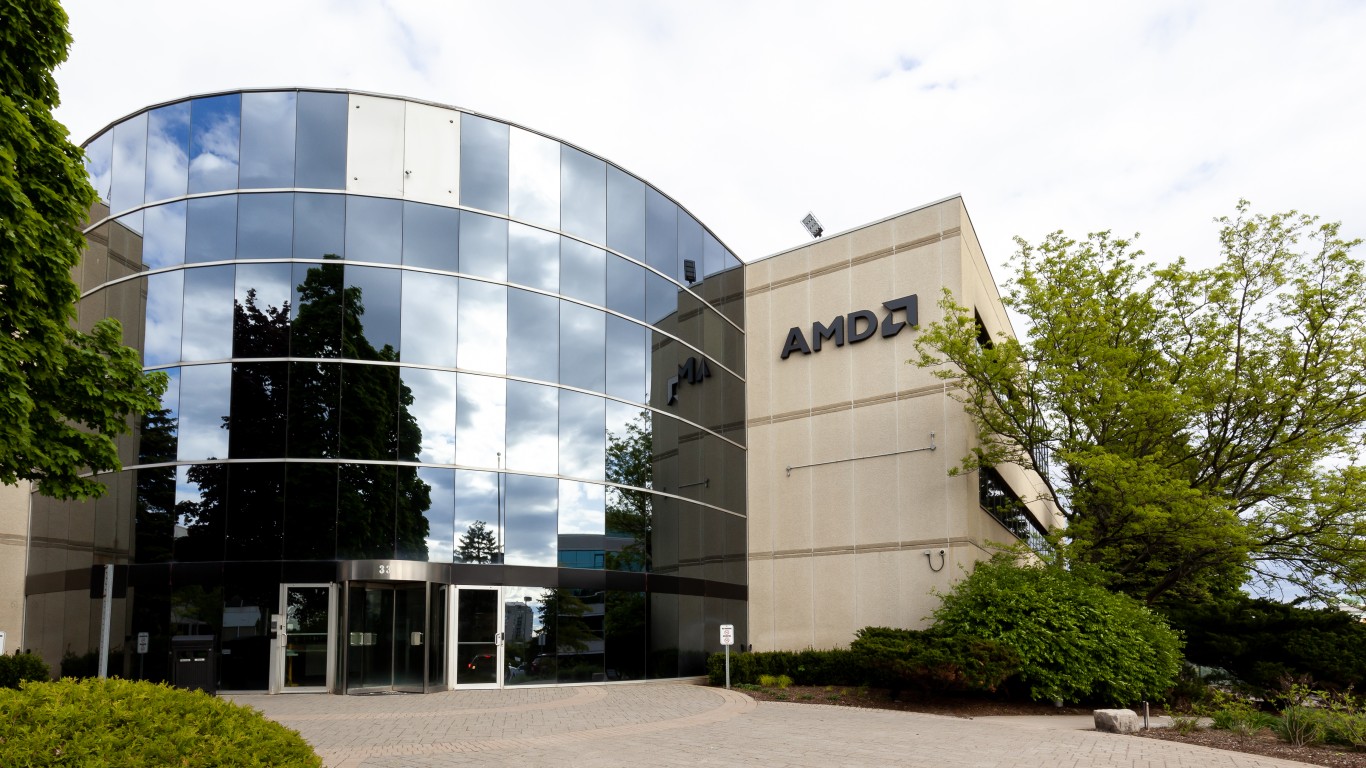
Chip stocks are sliding in early Monday trading after an AI pacing appeal over the weekend rippled beyond memory suppliers and into logic and accelerator names. Intel (NASDAQ:INTC | INTC Price Prediction) stock is falling 7% to $95.96, AMD (NASDAQ:AMD) stock is down 6% to $486.80, and NVIDIA (NASDAQ:NVDA) stock is declining 3% to $212.50. Intel is falling hardest of the three, NVIDIA is falling the least, and AMD sits in the middle, an ordering that runs opposite to each name’s exposure to AI accelerator demand.
Chip weakness is concentrated inside semiconductors rather than spread across technology. The iShares Semiconductor ETF (NASDAQ:SOXX) is down 6%, while the Invesco QQQ Trust (NASDAQ:QQQ) is slipping 2%. That gap places the selling squarely inside chips and not across the broader Nasdaq gauge that houses them.
Broadcom (NASDAQ:AVGO) is caught in the same wave, sliding alongside the other AI accelerator peers even though its September 2 fiscal third quarter update reaffirmed a Q4 FY2026 AI semiconductor revenue guide of $21.7 billion and AI chip revenue for the quarter of $16.7 billion6.7 billion, up 221% year over year. AMD’s move is the standout of the session, since AMD stock is up 127% year to date and a position carrying a gain that large invites profit taking on any excuse.
Pacing Call Reaches Beyond Memory
Anthropic CEO Dario Amodei used a weekend appeal to urge frontier AI companies to slow the pace of capability development, arguing that models are advancing faster than labs can reliably manage the risks. He proposed a three-part framework, calling for permanent independent evaluators with employee-like access to AI labs, coordinated safety standards among leading companies, and greater international cooperation.
Amodei framed the plan as a request for more time to test increasingly capable models and ruled out halting training or technical progress outright. OpenAI CEO Sam Altman backed the proposal early Monday, posting that pacing does “not mean ‘stopping.'” The essay that set off today’s selling doesn’t name a single chipmaker.
The push runs into an obvious tension, since AI labs have enormous financial and competitive incentives to keep moving quickly, particularly as OpenAI and Anthropic prepare for potential public listings. That tension is exactly what makes a pacing debate a market-moving event for the chip supply chain that finances the training buildout (the power, cooling, and networking suppliers behind that same buildout are the subject of a free report you can grab here).
Ordering Points to a Positioning Unwind
A genuine downgrade of AI infrastructure demand would hit the most levered accelerator suppliers first, putting NVIDIA at the front of the queue given data center revenue of $89.02 billion last quarter, with AMD not far behind. Today’s ordering is the reverse, with Intel down the most and NVIDIA down the least. That signature fits a positioning unwind in the crowded corners of the AI trade rather than a reassessment of orders.
AMD is the pressure point in that unwind, because AMD’s year-to-date gain has stretched the position size that has to be trimmed on any macro shock. On the bearish side, AMD’s Instinct MI450 and Helios ramp is priced for an uninterrupted training buildout, with a Q3 2026 revenue guide of $13 billion3 billion built off Q2 Data Center revenue of $6.72 billion, up 107% year over year. Set against that, Amodei explicitly ruled out halting training, and Anthropic itself agreed to deploy up to 2GW of MI450 GPUs in a partnership disclosed on AMD’s August earnings call.
Intel’s slide is the harder one to square with company commentary, since Intel management said on its Q2 2026 call that “server CPU demand continues to far outpace available supply,” with the Data Center and AI segment posting $6.26 billion in that quarter, up 59% year over year. NVIDIA CEO Jensen Huang framed the compute cycle at the Q2 FY2027 call more directly, stating that “AI has reached its inflection point.” Broadcom CEO Hock Tan on the September 2 call added that “Q3 demand was simply hot and we’re just getting started.”
What to Watch
Chip momentum can rebuild quickly when the catalyst is a positioning story rather than a numbers story. Investors managing AI-heavy exposure may want to check for confirmation that hyperscalers keep published capex plans intact through the October cloud earnings cycle. AMD’s next scheduled update is its Q3 2026 report, and the Helios ramp cadence remains the single item that could move the accelerator narrative most.
Right-sizing one’s exposure in AMD ahead of that reporting window makes sense given the size of the year-to-date gain, which turned the position into a natural profit-taking candidate on any macro shock. The pacing debate is now the macro shock AMD holders have to weigh.
Contact [email protected] for any questions or corrections.
David Moadel is financial writer specializing in stocks, ETFs, options, precious metals, and Bitcoin. David has written well over 1,000 articles for leading online publications, helping investors understand markets, income strategies, and risk.His work has appeared in The Motley Fool, InvestorPlace, U.S. News & World Report, TipRanks, ValueWalk, Benzinga, Market Realist, TalkMarkets, Finmasters, 24/7 Wall St., and others.With a master’s degree in education, David has taught at the elementary, high school, and college levels. That teaching background shapes his writing style: clear, educational, and practical. David has also built a loyal social-media audience by providing trustworthy financial content on YouTube, X/Twitter, and StockTwits.