Kevin Warsh Wants to Know If AI Can Transform the Economy. The Answer Could Change Interest Rates

This post may contain links from our sponsors and affiliates, and Flywheel Publishing may receive compensation for actions taken through them.
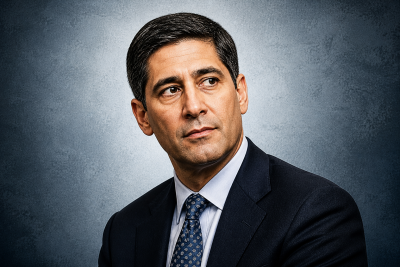
On Monday at 9 a.m. Pacific, Federal Reserve Chair Kevin Warsh will open a conference at the San Francisco Fed with 15 minutes of remarks. He will then spend most of the morning leading panels with Stripe co-founder Patrick Collison, Stanford economist Nick Bloom, and venture capitalist Marc Andreessen (per the published agenda). The topic sounds academic: how artificial intelligence, and what the Fed calls superintelligence, will change productivity and jobs.
The stakes are concrete. If AI raises the economy’s speed limit, the Fed can let growth run faster without tightening. If it doesn’t, today’s AI building boom starts to look like old-fashioned overheating.
Why Now: Long-Term Rates Just Jumped
The question comes at an awkward moment. The Fed lifted the upper bound of its target range to 4.00% in September, from 3.75%[1]. Real GDP grew at a 3.4%[2] annualized pace in the third quarter, above the 2% to 3% range considered healthy trend growth. In the week ending November 13, the 10-year Treasury yield rose from 4.86% to 5.15%, and the 30-year reached 5.47%. When bond investors demand more to lend long-term, they are signaling doubt that faster growth comes without inflation.
Warsh’s Unanswered Questions
Warsh has framed the issue himself. At Jackson Hole in August, he said “We’ve come to a hinge point in history,”[3] called AI “potentially a new factor of production,” and asked whether it would “cause a significant, sustained rise in productivity across the economy.” He also asked who ends up with the gains: chipmakers, cloud providers, AI developers, other businesses, or consumers. At his October 28 press conference, he said “Productivity growth is strong and capital investment robust,”[4] while noting that inflation has run above target “for close to six years.” He asked whether AI would bring a rapid productivity miracle or gradual gains, and whether it would make price stability easier or harder to achieve.
AI Infrastructure Bills Arrive Before the Payoff
This timing gap is the core problem. The efficiency gains come later, but the construction bills are due now. Warsh said capital spending sits “at a historically high share of GDP,”[4] led by high-tech investment. Data centers could use up to 12% of U.S. electricity demand by 2028, according to Energy Department projections. The independent market monitor for PJM Interconnection, which runs the largest U.S. power grid, concluded that “data center load growth is the primary reason” for its tight supply and high prices. Data centers compete with everyone else for power, chips, and electricians, which pushes prices up well before any productivity return (we covered seven of the power, cooling, and networking suppliers riding that expansion in a free report here).
Households are already feeling the costs. Inflation-adjusted average hourly earnings were $11.26 in October (a preliminary figure), down from $11.38 a year earlier. The University of Michigan’s consumer sentiment index fell to 48.1[5] in September, a level associated with recessions. Unemployment sits at 4.1%, so AI has not caused mass layoffs. It also has yet to show up in paychecks.
What Each Outcome Means for Rates, Stocks, and Bonds
If productivity rises fast enough to lower the cost of producing each unit, the Fed could hold or cut rates while growth stays strong. That would bring down mortgage rates and business borrowing costs, and support stock valuations well beyond NVIDIA (NASDAQ:NVDA | NVDA Price Prediction). If spending keeps outpacing the efficiency gains, the Fed is dealing with a classic overheating economy. Long-term yields above 5% could then stick, putting pressure on housing and on stocks whose prices depend on low interest rates.
Right now, the bond market is pricing in the second scenario. It is up to AI to prove otherwise.
Warsh has said the task force’s findings will inform future policy judgments, not dictate immediate decisions, so Monday is unlikely to bring a rate signal. Two things are worth tracking instead. First, whether Warsh presents strong productivity as a reason for patience on rates. Second, the next reading of core Personal Consumption Expenditures prices, the Fed’s preferred inflation measure, which rose 0.3% in September. Cooler readings alongside 3% growth would be the first real evidence of an AI productivity boom.
Contact [email protected] for any questions or corrections.
After two decades of patrolling the dark corners of suburbia as a police officer, Rich Duprey hung up his badge and gun to begin writing full time about stocks and investing. For the past 20 years, he’s been cruising the markets looking for companies to lock up as long-term holdings in a portfolio while writing extensively on the broad sectors of consumer goods, technology, and industrials. Because his experience isn’t from the typical financial analyst track, Rich is able to break down complex topics into understandable and useful action points for the average investor. His writings have appeared on The Motley Fool, InvestorPlace, Yahoo! Finance, Money Morning, and, of course, 24/7 Wall St. He has been featured in both U.S. and international publications, including MarketWatch, Financial Times, Forbes, Fast Company, and USA Today.