SanDisk Stock Has Pulled Back. Here’s Where Shares Could Be Headed Next

This post may contain links from our sponsors and affiliates, and Flywheel Publishing may receive compensation for actions taken through them.

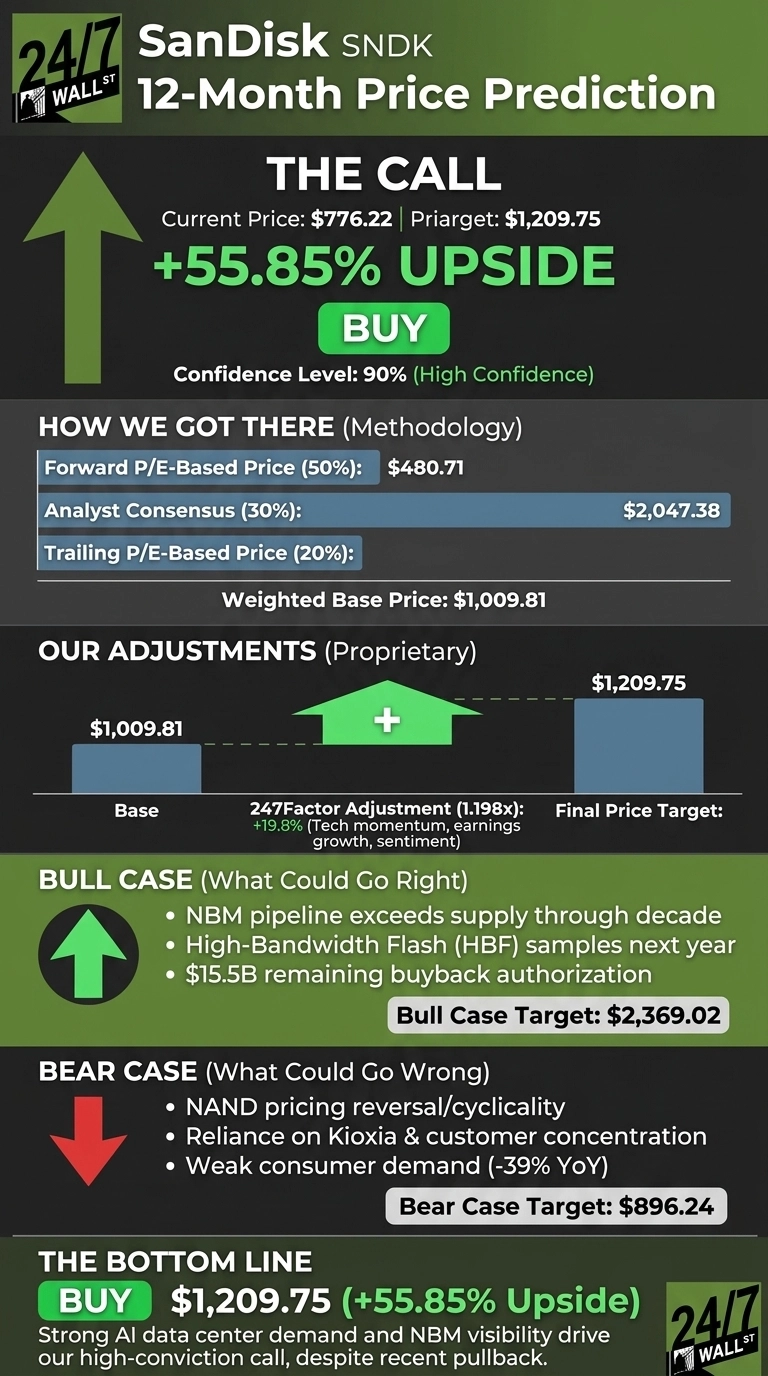
Shares of SanDisk (NASDAQ:SNDK | SNDK Price Prediction) closed at $776.22 on the eve of its 8-for-1 forward stock split[1]. The 24/7 Wall St. price target of $1,209.75 means 55.85% upside over 12 months.
| Metric | Value |
|---|---|
| Current Price | $776.22 |
| Price Target from 24/7 Wall St. | $1,209.75 |
| Upside/Downside | 55.85% |
| Recommendation | BUY |
| Confidence Level | 90% |
That is a high-conviction call. All figures here are pre-split. Split-adjusted trading begins November 20[2], at which point the target equals about $151.22 against a price near $97.03. The selloff has been sharp, but SanDisk’s fundamentals keep getting stronger, and that gap is what our model sees.
A Brutal Month Despite Six Straight Earnings Beats
Shares fell 17.1% over the past week and 40.89% over the past month, yet remain up 241.43% year to date. The stock sits about 67% below its 52-week high of $2,354.39 and well clear of its $183 low. It traded 4.41% higher premarket as split coverage drew attention from outlets like MarketWatch.
Fiscal Q1 revenue reached $11.031 billion[1], topping the $10.677 billion consensus and rising 377.95% year over year. Non-GAAP EPS of $49.51[1] beat the $46.27 estimate, marking the sixth straight beat. Datacenter revenue rose 61%[1] sequentially to $4.802 billion.

Why Bulls See $2,369 in Reach
The bull case reaches $2,369.02. About 50%[2] of fiscal 2027 bits and two-thirds of 2028 bits sit under long-term NBM agreements, and management said the pipeline “exceeds our supply throughout the end of the decade.”
High-bandwidth flash samples arrive next calendar year[2] and sit outside the long-term model. Management plans to return 100%[2] of excess cash, supported by $15.5 billion of remaining authorization. Analysts count 4 Strong Buy and 17 Buy ratings.

What Could Drag Shares Toward $896
The bear case sits at $896.24. About 40%[2] of the revenue increase came from pricing, which reverses when NAND cycles turn. Kioxia reliance, customer concentration and tariffs remain identified risks. GAAP EPS of $52.60[1] included a $513 million equity gain, though non-GAAP results strip it out.
Consumer revenue fell 39%[1] year over year, which management tied to higher pricing in a small segment. Management also identified fiscal Q3 as typically the weakest sequential quarter.
How SanDisk Compares to Micron, Western Digital and Seagate
| Company | Market Cap | Latest Gross Margin | YoY Revenue Growth |
|---|---|---|---|
| SanDisk | $110.45B | 85.0%[1] | 377.95%[1] |
| Micron | $797.96B | 87.0% | 379.27% |
| Western Digital | $107.88B | 58.1% | 55.46% |
| Seagate | $118.43B | 57.8% | 61.01% |
Micron Technology (NASDAQ:MU) is the closest AI memory comparable, matching SanDisk’s growth and margins with a far larger market cap, suggesting room for SanDisk to re-rate.
SanDisk’s former parent, Western Digital (NASDAQ:WDC), now sells hard drives and posts a similar valuation on quarterly revenue of $4.381 billion.
Seagate Technology (NASDAQ:STX) shares the hyperscaler storage catalyst and is worth more than SanDisk on revenue of $4.233 billion. Against this group, our target looks conservative.
What Investors Should Watch After the Pullback
The 24/7 Wall St. price target of $1,209.75 posts a buy rating at 90% confidence. The deciding factor is visibility from NBM contracts.
Key signals to watch include whether NBM coverage keeps rising and revenue lands within the $12.20 billion to $12.60 billion[1] guidance range. A rollover in NAND pricing would weaken the case. Our model considers potential reward above risk at these levels.

Our model projects where SanDisk could trade on a pre-split basis if current trends hold.
| Year | Price Target from 24/7 Wall St. |
|---|---|
| 2026 | $805.54 |
| 2027 | $1,209.75 |
| 2028 | $1,662.62 |
| 2029 | $2,012.91 |
| 2030 | $2,364.02 |
These projections assume SanDisk keeps executing on its data center strategy. Results could swing sharply higher or lower depending on how much demand high-bandwidth flash gets and which way NAND pricing moves.
Contact [email protected] for any questions or corrections.
Vandita Jadeja is a financial publisher with over a decade of experience writing about financial topics, including investment, savings, retirement, insurance and banking. Vandita is a Chartered Accountant who loves to debunk financial concepts for readers.
Her work has appeared on sites that include The Motley Fool, InvestorPlace, and Benzinga. She covers investing and focuses on stock picks and price prediction for 24/7 Wall St.
When not looking for the next stock investment opportunity, she can be found traveling, reading, chasing sunsets and enjoying her iced latte.