Wall Street May Not Be Ready for What’s Coming Next for These 3 AI Stocks

This post may contain links from our sponsors and affiliates, and Flywheel Publishing may receive compensation for actions taken through them.

AI’s biggest names are ending 2026 on the defensive. NVIDIA (NASDAQ:NVDA | NVDA Price Prediction) is down 26.05% year to date after its chief executive resigned. Palantir Technologies (NASDAQ:PLTR) has slipped 17.13%, and Broadcom (NASDAQ:AVGO) is off 7.92%.
All three still beat Wall Street’s estimates in their latest quarters. I’ll walk through how each could reach a bold target in 2027.
NVIDIA Could Climb to $250 if Vera Rubin Keeps Ramping
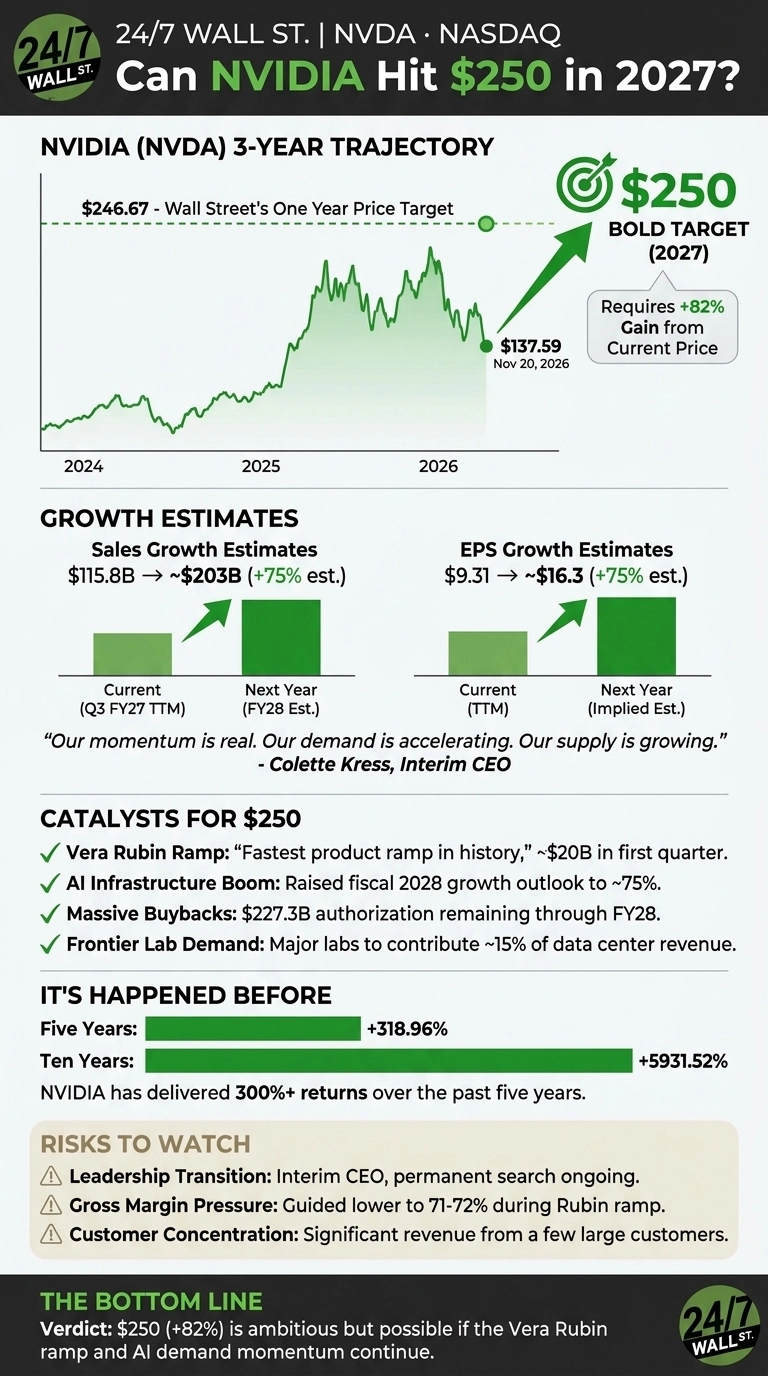
The selloff stems from leadership turmoil, while demand keeps accelerating. Fiscal Q3 revenue rose 103.2% to $115.84 billion[1], and adjusted EPS of $2.68 topped the $2.47 consensus. That makes 6 consecutive quarters of beats.
Vera Rubin generated nearly $20 billion[2] in its first production quarter, which management called “the fastest product ramp in NVIDIA’s history.” Interim CEO Colette Kress also raised the fiscal 2028 growth outlook to approximately 75%: “Our momentum is real. Our demand is accelerating. Our supply is growing.”
Analysts’ $246.67 target implies 79% upside from $137.59. My $250 target requires an 82% gain. NVIDIA trades at 15x trailing EPS of $9.31.
At $250, that becomes 27x, a modest premium to the S&P 500’s forward multiple of roughly 21x to 23x. Catalysts include Vera Rubin Ultra next year, $227.3 billion[1,2] in remaining buybacks, and a permanent CEO hire. Shares have gained 318.96% over five years.

Broadcom’s Path to $550 Runs Through Custom AI Chips
CEO Hock Tan’s custom accelerator business is in hypergrowth. Q3 AI semiconductor revenue reached $16.7 billion, up 221%[3], and Q4 is guided to $21.7 billion, up 236%.
Tan said Broadcom has “secured the supply to again double AI revenue to approximately $115 billion” in 2027, with Anthropic on track to become its largest XPU customer. Broadcom has beaten EPS estimates 9 consecutive quarters.
The $526.47 consensus target implies 66% upside from $316.97. Hitting $550 requires a 74% gain. Shares look pricey at 40x trailing EPS of $7.83, but Tan said Broadcom is “very much on target to exceed $30 in earnings per share in fiscal 2028.” At $550, that’s just 18x those earnings. The stock has risen 508.85% over five years.

Palantir Can Reach $250 if Sovereign AI Demand Holds
CEO Alex Karp says “the market for us is insatiable” in the U.S. Q3 revenue grew 95.87% to $2.313 billion[4], and U.S. commercial revenue jumped 148%[4], surpassing U.S. government revenue for the first time. Adjusted EPS of $0.44[4] beat the $0.41 consensus, Palantir’s 10th consecutive beat.
Wall Street’s $222.90 target implies 51% upside from $147.30. A $250 target needs a 70% gain, lifting the trailing multiple from 104x to 176x EPS of $1.42. A Rule of 40 score of 158%[4] and net dollar retention of 165% help justify that premium. Shares are up 588% over five years.

Is a 2027 Rebound Realistic? Here’s My Take
Each target requires a big move: 82% for NVIDIA, 74% for Broadcom and 70% for Palantir.
Risks remain: NVIDIA is guiding gross margin down to 71-72%[1] while it searches for a CEO, Broadcom’s AI revenue depends heavily on a few large XPU customers such as Anthropic, and Palantir’s total contract value grew just 6%[4]. Still, all three keep beating estimates and raising outlooks.
If AI spending keeps compounding and the market recovers, these targets are within reach. Returns at this level shouldn’t be expected every year, but we’ve outlined the blueprint for how all three could see outsized returns in 2027.
Contact [email protected] for any questions or corrections.
Vandita Jadeja is a financial publisher with over a decade of experience writing about financial topics, including investment, savings, retirement, insurance and banking. Vandita is a Chartered Accountant who loves to debunk financial concepts for readers.
Her work has appeared on sites that include The Motley Fool, InvestorPlace, and Benzinga. She covers investing and focuses on stock picks and price prediction for 24/7 Wall St.
When not looking for the next stock investment opportunity, she can be found traveling, reading, chasing sunsets and enjoying her iced latte.