Why SanDisk’s Path to $170 in 2027 Hinges on One Test of Its Multi-Year Contracts

This post may contain links from our sponsors and affiliates, and Flywheel Publishing may receive compensation for actions taken through them.

SanDisk (NASDAQ:SNDK | SNDK Price Prediction) has turned NAND flash into one of the most profitable businesses in technology. Fiscal Q1 2027 revenue reached $11.03 billion, up 377.9% year over year[1], with GAAP gross margin of 85.0%. Management told analysts that customers “have underestimated the amount of NAND they need to run their infrastructure,”[2] and several are coming back for a second round.
Shares remain up 148.07% year to date, but they’ve fallen 53.1% over the past month as investors worry about NAND pricing. Here’s how SanDisk could reach $170 in 2027, and why it depends on its multi-year contracts.
Analysts Keep Raising SanDisk’s Earnings Bar
Coverage includes 4 Strong Buy and 17 Buy ratings against 3 Holds and 1 Strong Sell. Fiscal 2027 (ending June) EPS estimates rose from $26.7623 90 days ago to $28.465, with 18 upward revisions and 2 downward over 30 days. Fiscal 2028 estimates sit at $35.9002. SanDisk has beaten EPS estimates seven straight quarters, so actual results could land above those forecasts.
Can SanDisk Really Hit $170? Here’s the Math
At $73.61, SanDisk trades at roughly 3x fiscal 2027 estimates. At $170, it would trade near 6x, and about 5x fiscal 2028 estimates. That’s a low multiple for a business with 80.4%[2] non-GAAP operating margins.
What Could Push SanDisk to $170?
- Contract visibility: SanDisk holds $91.1B in Remaining Performance Obligations backed by $16.5B in customer guarantees. About 50% of bits are under NBM agreements for 2027 and about two-thirds for 2028[2], and management said the “NBM pipeline exceeds our supply throughout the end of the decade.”
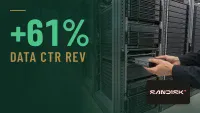
- AI demand: Management forecasts data center bit demand growing about 40%[2] in calendar 2027. Datacenter revenue hit $4.80 billion, up 61% sequentially[1].
- Pricing: Q2 guidance of $12.20 billion to $12.60 billion[1] includes “modest like-for-like price increases.”[2]
- Buybacks: SanDisk returned $5.0 billion[1] last quarter, carries a $15.5 billion[3] authorization and has no debt.
- New products: High-bandwidth flash samples are expected next calendar year[2], and they sit outside the long-term model.
The real test comes if spot prices fall and customers try to renegotiate. Consumer revenue already dropped 29% sequentially[1] as buyers resisted at higher prices. Management said the “vast majority”[2] of commitments are financial guarantees held by third-party institutions. The demand background helps: the same data-center expansion driving NAND orders is lifting a wider set of suppliers in power, cooling, and networking, which we profiled in a free report on seven AI infrastructure stocks that aren’t chipmakers.
SanDisk’s Short History Shows $170 Is Within Range
Getting to $170 would take a 131% gain. SanDisk has traded independently only since separating from Western Digital (NASDAQ:WDC) on February 21, 2025, but its 2026 gain of 148.07% already exceeds that benchmark. Since February 2025, shares are up 1111.69%. Volatility cuts both ways, as the 24.13% drop over the past week shows.
Is $170 Realistic? Here’s My Take
Hitting $170 would require SanDisk to more than double in 2027. Estimates keep rising, the beat streak is intact and the stock trades at a low single-digit multiple. If NBM contracts hold firm through a pricing dip, investors could stop evaluating SanDisk as a cyclical memory supplier. Gains of that size are rare in any given year, but we’ve outlined the design for how SanDisk could see outsized returns in 2027.
Contact [email protected] for any questions or corrections.
Alex Sirois is a financial writer with experience spanning both retail and institutional investing. He has written for InvestorPlace and held roles at BNY Mellon and Bernstein, giving him a perspective that bridges Main Street portfolios and Wall Street analysis.
Alex holds an MBA from George Washington University and has built his career across multiple industries, including e-commerce, education, and translation — a breadth of experience that informs how he breaks down complex financial topics for everyday investors. His writing is conversational, actionable, and grounded in long-term, buy-and-hold investing principles.
At 247 Wall St., Alex focuses on delivering analysis that is both accessible and useful, with a clear emphasis on helping readers make more informed decisions with their money.