Gen X Is Running Out of Time, and the Northwestern Mutual 2025 Study Has the Numbers to Prove It
The oldest members of Gen X are stepping into their early sixties this year, and the youngest are settling into their mid‑forties. That span between 46 and 61 is supposed to be the stretch when peak earnings, fewer household expenses,…

This post may contain links from our sponsors and affiliates, and Flywheel Publishing may receive compensation for actions taken through them.

The oldest members of Gen X are stepping into their early sixties this year, and the youngest are settling into their mid‑forties. That span between 46 and 61 is supposed to be the stretch when peak earnings, fewer household expenses, and years of compounding finally begin to work in the same direction. The new findings from Northwestern Mutual’s 2025 Planning & Progress Study show that many Gen X households are watching that window narrow without the financial footing they expected to have by now.
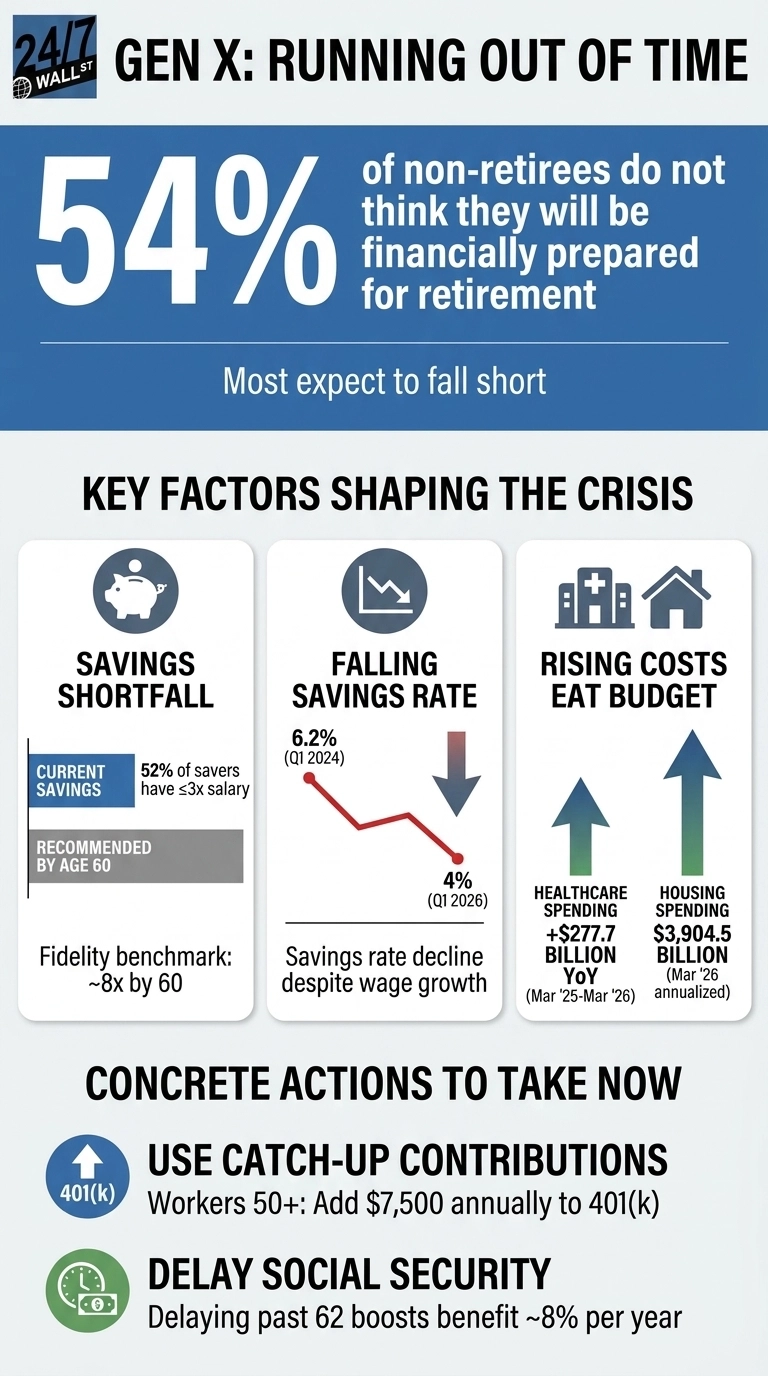
The study’s most telling number sits right at the center of the story. A majority of non‑retirees (54%) say they do not believe they will be financially prepared for retirement when the time comes. That is, working adults across income levels and life stages are telling researchers that they expect to fall short. For Gen X specifically, the concern carries more weight because the first wave of the cohort will reach traditional retirement age in just a few years. The question of readiness is no longer theoretical, but it is arriving on a schedule that does not slow down.
The Savings Math Behind the Anxiety
The numbers behind the worry are not subtle. Among Americans who have saved something for retirement, 52% have set aside three times or less of their current annual income, according to the Northwestern Mutual study. That figure comes straight from the table showing that Gen Xers, Millennials, and Gen Z all cluster heavily in the one‑to‑three‑times‑income range. Fidelity’s benchmark, which is not part of the study but is widely cited, suggests workers should have roughly six times their salary saved by age fifty and eight times by sixty. Half of savers sit at three times or less, with no age filter applied. For a fifty‑five‑year‑old earning $85,000, that translates to roughly $250,000 or less at a moment when standard guidance points closer to $510,000.
The fallback plan is to keep working, and the Northwestern Mutual data shows why that is becoming less of a strategy and more of a necessity. Among those who are working or planning to work in retirement, 48% say they will need the additional income to afford retirement, and Gen X is even higher at 56%. Working longer is being recast from a lifestyle choice into a financial requirement. The labor market is still supportive, with unemployment at 4.3% as of April 2026, but counting on a paycheck in the late sixties assumes a level of health and employer demand the data cannot guarantee. Readers who want to dig deeper into this trend can look at working in retirement or retirement income planning.
The Macro Backdrop: Tightening the Squeeze
The broader economic picture is making the catch‑up years harder. The personal savings rate has fallen from 6.2% in the first quarter of 2024 to 4% in the first quarter of 2026, even as wages have continued to rise. Average hourly earnings climbed from $34.76 in April 2024 to $37.41 in April 2026, yet the share of each paycheck that lasts the month has shrunk. The extra income is being absorbed by something other than retirement accounts.
Most of that “something” is housing and healthcare. Housing spending reached $3.9 trillion at an annualized rate in March 2026, and healthcare spending reached $3.7 trillion. Healthcare alone rose by more than $270 billion year over year, one of the largest increases in any category in the economy. For Gen Xers in their peak earning years, those two line items are consuming the budget room that was supposed to fund the final retirement push. Anyone wanting to explore this further can look at healthcare costs in retirement or housing affordability.
Consumer mood reflects what the spreadsheets show. The University of Michigan Consumer Sentiment Index sits at 48.2 as of May 2026, well inside pessimistic territory and approaching recessionary levels. Inflation has cooled to a 2.1% annual rate, yet the cumulative damage from earlier years has already been done. On top of that, U.S. adults carrying debt held an average of $22,354 dollars, excluding mortgages, as of February 2025, a balance that competes directly with any catch‑up contribution a fifty‑something might try to make.
The Window Gen X Has Left
For Gen Xers who recognize themselves in the 54% who do not feel financially prepared, the next three to four years matter more than any prior stretch of their working lives. Three actions move the needle the most:
- Catch‑up contributions — Workers fifty and older can add 7,500 dollars in catch‑up contributions on top of the standard 23,500 dollar 401(k) limit, and SECURE 2.0 adds an enhanced tier for ages sixty to sixty‑three.
- Delaying Social Security — Each year of delay past sixty‑two increases the monthly benefit by roughly 8% up to age seventy, a guaranteed return no portfolio can reliably match.
- Eliminating non‑mortgage debt — Carrying the average twenty‑two‑thousand‑dollar balance into a fixed‑income retirement turns a manageable monthly bill into a structural drain on every Social Security check.
The Northwestern Mutual numbers show exactly where Gen X stands right now, with the runway shortening every quarter. The cohort that grew up being told to save is arriving at the finish line with the receipts in hand, and for most of them, those receipts come up short.
Contact [email protected] for any questions or corrections.
David Beren has been a Flywheel Publishing contributor since 2022. Writing for 24/7 Wall St. since 2023, David loves to write about topics of all shapes and sizes. As a technology expert, David focuses heavily on consumer electronics brands, automobiles, and general technology. He has previously written for LifeWire, formerly About.com. As a part-time freelance writer, David’s “day job” has been working on and leading social media for multiple Fortune 100 brands. David loves the flexibility of this field and its ability to reach customers exactly where they like to spend their time. Additionally, David previously published his own blog, TmoNews.com, which reached 3 million readers in its first year. In addition to freelance and social media work, David loves to spend time with his family and children and relive the glory days of video game consoles by playing any retro game console he can get his hands on.