61% of Americans Have No Will, According to Northwestern Mutual’s 2025 Planning & Progress Study
Thirty‑one percent of American adults expect to leave an inheritance or charitable gift when they die, yet a large share have done none of the legal work required to make that intention real. Northwestern Mutual’s 2025 Planning & Progress Study,…

This post may contain links from our sponsors and affiliates, and Flywheel Publishing may receive compensation for actions taken through them.

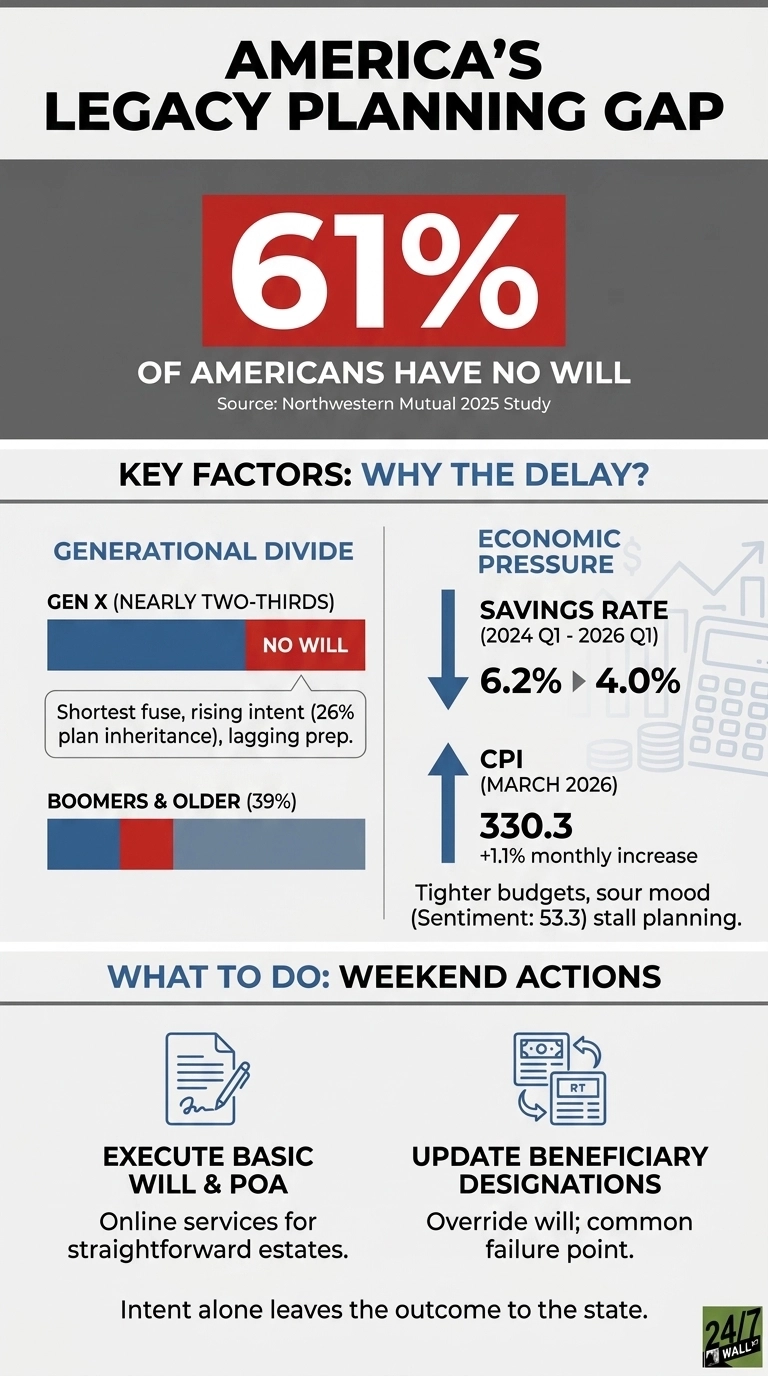
Thirty‑one percent of American adults expect to leave an inheritance or charitable gift when they die, yet a large share have done none of the legal work required to make that intention real. Northwestern Mutual’s 2025 Planning & Progress Study, now in its fifth wave, lays out the gap in clinical terms. People want to pass something on, but many have not signed the document that turns that wish into a legally enforceable instruction. Gen X is the most exposed to this contradiction, with 61% lacking a will, and the runway to correct that gap is getting shorter.
Gen X is the generation with the shortest fuse
Among Gen X adults, 26% now plan to leave an inheritance, up from 22% last year, indicating rising intent even as preparation continues to lag. Nearly two‑thirds of Gen X do not have a will, compared with 39% of Boomers and older Americans, and the oldest members of the cohort are already in their early sixties, entering the stage of life where the actuarial realities that older generations had decades to prepare for begin to come into view, yet without the basic legal document that determines who gets what.
Dying without a will hands the decision to the state’s intestacy laws rather than to the deceased, slowing probate, increasing costs, and routing assets through a default formula that often surprises the very people the family assumed would inherit. For a generation that says it wants to leave something behind, the absence of a will means the state writes the ending.
The people counting on this money do not know how exposed they are
Northwestern Mutual’s data shows that younger Americans are increasingly budgeting for an inheritance. Among those who expect to receive one, 69% of Millennials and 63% of Gen Z say it is critical or highly critical to their long‑term financial security, which means their retirement math, home‑buying math, and debt‑payoff math all lean on a transfer that depends entirely on parents and grandparents completing legal work many of them have not done.
On the giving side, the intent looks just as serious. Sixty‑four percent of people who expect to leave an inheritance describe it as either their single most important financial goal or a very important one, yet the statistics on wills tell a different story. A goal that is significant should not sit behind a missing signature.
Why the document keeps getting deferred
The macro backdrop helps explain the procrastination. The personal saving rate has slipped from 6.2% in the first quarter of 2024 to 4.0% in the first quarter of 2026, even as per capita disposable income climbed to $68,617, leaving households earning more but keeping less. The Consumer Price Index reached 330.3 in March 2026, a 1.1% increase from the prior month, and the University of Michigan consumer sentiment index fell to 49.8, a level that signals broad pessimism. When budgets feel tight and the national mood turns down, paying a few hundred dollars for an estate attorney becomes the kind of task that slides to next month, then next year.
The unemployment picture removes the usual excuse. The jobless rate sits at 4.3% as of April 2026, and average hourly earnings have risen from $34.47 in January 2024 to $37.41 in April 2026. Most working Gen X households are not unable to act, they are simply delaying the work.
What a Gen X household can do in a weekend
The gap in the Northwestern Mutual study is closeable, and none of the steps require a wealth manager.
- Execute a basic will and a durable power of attorney. Online services can handle straightforward estates for a few hundred dollars, while an estate attorney becomes worth the cost once there is a business, a blended family, or property in more than one state.
- Update beneficiary designations on retirement accounts and life insurance as these forms override the will and remain the single most common point of failure when families discover an ex‑spouse still listed.
- Tell the people named in the documents that they are named, and where the documents are stored. A will that no one can find is functionally a will that does not exist.
Without the right documents, the state decides how an estate is divided. That is the position 61% of Americans, including almost two‑thirds of Gen X, find themselves in today. The Northwestern Mutual study shows a country full of people who want to leave a legacy, yet in most homes, the legal mechanism to turn that intention into an enforceable plan simply isn’t in place.
Contact [email protected] for any questions or corrections.
David Beren has been a Flywheel Publishing contributor since 2022. Writing for 24/7 Wall St. since 2023, David loves to write about topics of all shapes and sizes. As a technology expert, David focuses heavily on consumer electronics brands, automobiles, and general technology. He has previously written for LifeWire, formerly About.com. As a part-time freelance writer, David’s “day job” has been working on and leading social media for multiple Fortune 100 brands. David loves the flexibility of this field and its ability to reach customers exactly where they like to spend their time. Additionally, David previously published his own blog, TmoNews.com, which reached 3 million readers in its first year. In addition to freelance and social media work, David loves to spend time with his family and children and relive the glory days of video game consoles by playing any retro game console he can get his hands on.