The Northwestern Mutual 2025 Study Found That 61% of Americans Have No Will, and Boomers Are Not Exempt
The Northwestern Mutual 2025 Planning & Progress Study reveals a significant gap between what Americans want to do with their money after death and what they have arranged legally. Exactly 31% of U.S. adults expect to leave an inheritance or…

This post may contain links from our sponsors and affiliates, and Flywheel Publishing may receive compensation for actions taken through them.

The Northwestern Mutual 2025 Planning & Progress Study reveals a significant gap between what Americans want to do with their money after death and what they have arranged legally. Exactly 31% of U.S. adults expect to leave an inheritance or a charitable gift, yet a clear majority of the general population has not signed the legal documents required to make that wish enforceable.
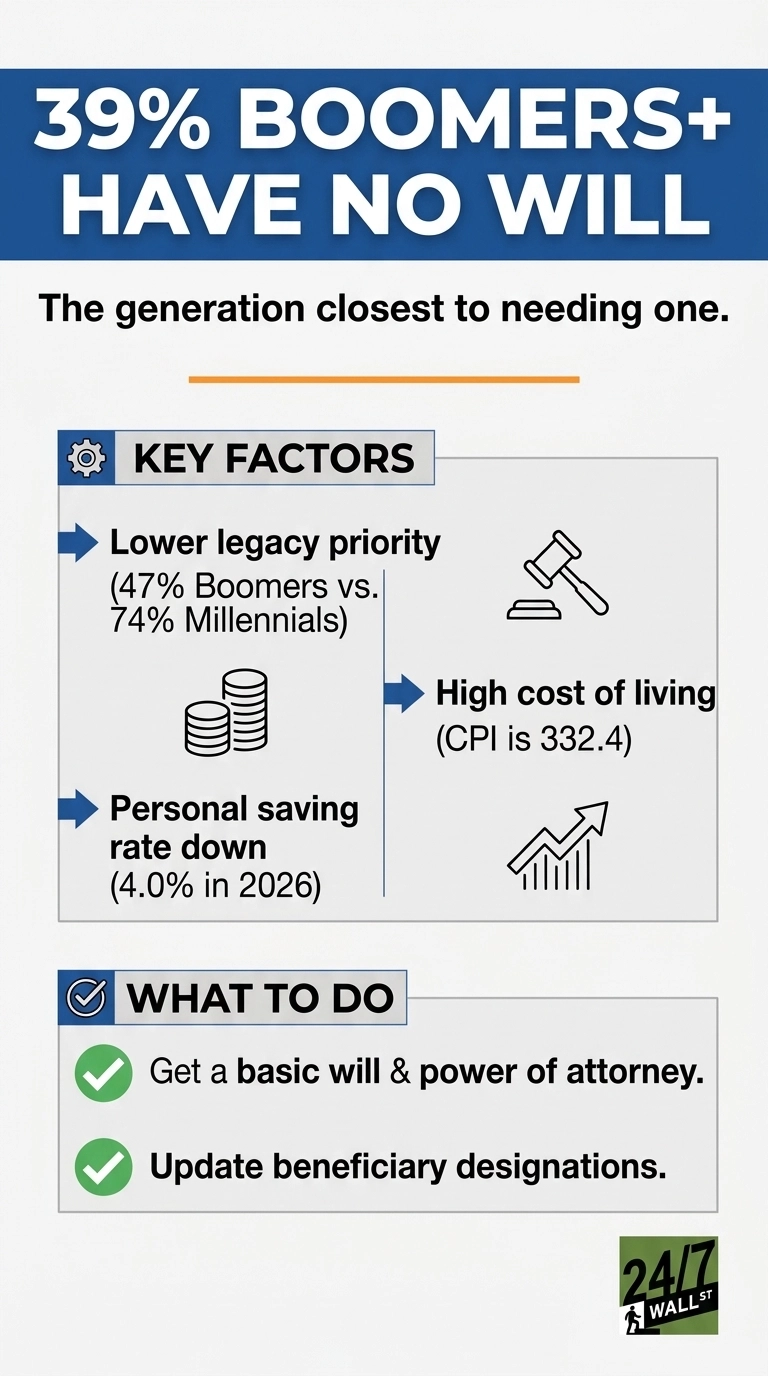
The underlying numbers expose Gen X as an incredibly vulnerable cohort with 61% lacking estate documentation, but the most uncomfortable finding sits one generation up. Fully 39% of Baby Boomers and older Americans admit they do not have a will, meaning a massive portion of the demographic closest to needing immediate estate protection remains completely unprepared.
Boomers have had the most time to prepare
A staggering 61% of Gen X adults are currently operating without a will, a troubling reality for a demographic whose oldest members are officially crossing into their sixties this year. Baby Boomers have already sailed past that milestone, yet roughly four in ten seniors still have absolutely nothing on file. Skipping estate planning forces your estate into intestacy, which strips you of your voice and hands total control over to state bureaucrat calculators. This bureaucratic default drags families through an expensive, sluggish probate court process that often divides assets in ways that shock the surviving heirs.
This widespread lack of preparation stems from a bizarre psychological flip across age groups. While 64% of Americans who plan to leave an inheritance call it a critical or highly important financial milestone, that burning desire cools off as people age. Only 47% of Baby Boomers rank leaving a legacy as a high priority, a sharp contrast to 74% of Millennials and 68% of Gen Z, who do so. Ironically, the very generation standing on the doorstep of transferring their wealth cares the least about planning for it, which explains why the legal paperwork continues to gather dust.
Why the document keeps getting deferred
The economic backdrop helps explain the delay. The personal saving rate has slipped from 6.2% in the first quarter of 2024 to 4% in the first quarter of 2026, even as per capita disposable income climbed to $68,617. Households are earning more and keeping less. The Consumer Price Index reached 331.2 in April 2026, and the University of Michigan consumer sentiment index stood at 48.2 as of May, indicating consumer confidence has plunged into traditional recessionary territory.
For Boomers specifically, federal transfer payments now do much of the heavy lifting. Government Social Security receipts reached an annualized $1.63 trillion in the first quarter of 2026, up from $1.43 trillion two years earlier, as the Medicare and Medicaid programs expanded in parallel. A fixed-income retiree balancing rising healthcare and grocery costs often treats a few hundred dollars for an estate attorney as discretionary. The labor market remains healthy, with unemployment at 4.3% in April 2026, indicating that this planning gridlock is driven by financial psychology rather than a lack of jobs.
How the gap typically gets closed
The will gap is closable, and none of the common remedies require a wealth manager.
- A basic will and a durable power of attorney. Online services handle straightforward estates for a few hundred dollars. An estate attorney is typically engaged when there is a business, a blended family, or property in more than one state.
- Beneficiary designations on retirement accounts and life insurance. These forms override the will and remain the most common failure point when families discover an ex-spouse is still listed.
- Disclosure to the people named in the documents that they are named, and where the originals are stored.
Wanting to leave something behind and arranging the legal mechanism that delivers it are two distinct acts. The Northwestern Mutual study documents a country full of people who have completed the first and skipped the second. For the 39% of Boomers and older Americans without a will, the runway to fix that is no longer hypothetical.
Contact [email protected] for any questions or corrections.
David Beren has been a Flywheel Publishing contributor since 2022. Writing for 24/7 Wall St. since 2023, David loves to write about topics of all shapes and sizes. As a technology expert, David focuses heavily on consumer electronics brands, automobiles, and general technology. He has previously written for LifeWire, formerly About.com. As a part-time freelance writer, David’s “day job” has been working on and leading social media for multiple Fortune 100 brands. David loves the flexibility of this field and its ability to reach customers exactly where they like to spend their time. Additionally, David previously published his own blog, TmoNews.com, which reached 3 million readers in its first year. In addition to freelance and social media work, David loves to spend time with his family and children and relive the glory days of video game consoles by playing any retro game console he can get his hands on.