Trump’s New Fed Chair Kevin Warsh Is Walking Into an Impossible First Meeting
On May 22, Kevin Warsh officially took over from Jerome Powell as head of the Federal Reserve. And his first meeting as Fed Chair is shaping up to be a political and economic minefield. Trump wants rate cuts, but…

This post may contain links from our sponsors and affiliates, and Flywheel Publishing may receive compensation for actions taken through them.
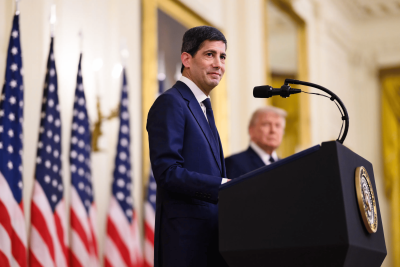
On May 22, Kevin Warsh officially took over from Jerome Powell as head of the Federal Reserve. And his first meeting as Fed Chair is shaping up to be a political and economic minefield.
Trump wants rate cuts, but inflation is moving the other way
Trump has repeatedly argued that the Fed should lower its benchmark interest rate to stimulate economic growth and reduce costs for cash-strapped borrowers — even as inflation has told the opposite story.
In early June, Trump told NBC’s Meet the Press, “There’s no reason to raise interest rates…When they raise interest rates, they try and kill success. I don’t want to kill success.”
Trump wants the Fed’s benchmark rate — currently set at 3.5% to 3.75% — reduced to 1% or lower. Inflation as it stands today makes that virtually impossible.
In May, the Consumer Price Index (CPI) clocked annual inflation at 4.2% — the highest level in three years and more than double the Fed’s official 2% target. Core inflation rose 2.9% year over year, and that’s even more telling.
Core inflation strips out volatile categories like energy and food to better pinpoint true economic trends. Though 2.9% is clearly closer to the Fed’s 2% target, there’s still a notable gap.
Meanwhile, in April, the Personal Consumption Expenditures Price Index (PCE) rose 3.8% on an annual basis.
The Fed says itself that it tends to lean more heavily on the PCE than the CPI because the CPI uses a mostly fixed list of services and products to track, which assumes consumers buy the same things every month. The PCE changes its spending data month to month, so it shows how consumers adjust their purchases when prices change.
For example, if beef gets too expensive, consumers might buy more poultry. The PCE accounts for shifts like this to give a clearer picture of how people are spending and what cost increases look like. And it’s clear that the PCE is well beyond the Fed’s preferred 2% inflation benchmark.
Rate hikes are more likely than cuts
In the near term, the Fed is more likely to raise interest rates rather than cut them. The Fed generally cuts rates when inflation is falling and economic growth is weakening. Today’s environment doesn’t follow that pattern. Not only is inflation rising, but the labor market remains strong.
Still, Warsh faces a lot of political pressure to slash rates. And while he’s unlikely to cut rates at this point in time, in the past, Warsh has actively advocated for lower rates and accused the Fed of suffering from “mission creep.”
Of course, Warsh has to know that his former arguments do not align with current economic realities. But it still puts him in a tough position as he approaches his first meeting as Fed Chair.
Inaction is the most likely action
Most experts believe that the Fed will leave its benchmark interest rate steady at its June meeting. That’s a reasonable approach given that recent increases in inflation are largely attributable to the Middle East conflict. If tensions settle and oil prices retreat, inflation could start to ease over the summer.
But either way, it seems like Warsh really can’t win. If he leans toward cuts, he pleases Trump but risks undermining the Fed’s credibility and his own. If he holds firm on keeping inflation under control at all costs, he risks disappointing the president who put him in the job. Talk about a rock and a hard place.
Contact [email protected] for any questions or corrections.
Maurie Backman has more than a decade of experience writing about financial topics, including retirement, investing, Social Security, and real estate. Her work has appeared on sites that include The Motley Fool, USA Today, U.S. News & World Report, The Washington Post, and Kiplinger.
Prior to becoming a full-time financial writer, Maurie worked in the financial industry trading distressed debt. She then changed course and spent a few years designing electronic toys. After a stint in content marketing and UX, she shifted back into writing and has since covered everything from the housing market to estate planning to Medicare.
When she's not busy writing, Maurie can be found hiking, walking her dogs, driving her kids to their various sports practices and games, and curling up with a good book. She cooks on occasion and bakes way too often.