The Absolute Number 1 Reason to Claim Social Security at 65
Social Security is the backbone of many people’s retirement planning. However, figuring out when to retire is often easier said than done. You can retire anytime after 62, and delaying longer leads to a higher monthly benefit. Delay too long,…


Social Security is the backbone of retirement planning for millions of Americans. Figuring out when to claim, however, is often easier said than done. Benefits are available as early as 62, and delaying produces a higher monthly check. Wait too long, though, and you risk not having the health or energy to enjoy much of your retirement.
Claiming at 65 offers real advantages that deserve careful consideration. Age 65 is no longer the official full retirement age. For many Americans, that threshold has shifted to 67, depending on the year they were born. The SSA’s retirement age calculator can determine your own full retirement age, which is a critical input when planning your claim.
For those with health limitations, claiming Social Security at 65 provides crucial income to manage rising healthcare costs and potentially reduced earning capacity, supporting a more secure and manageable retirement.
Impact of Health on Earning Capacity
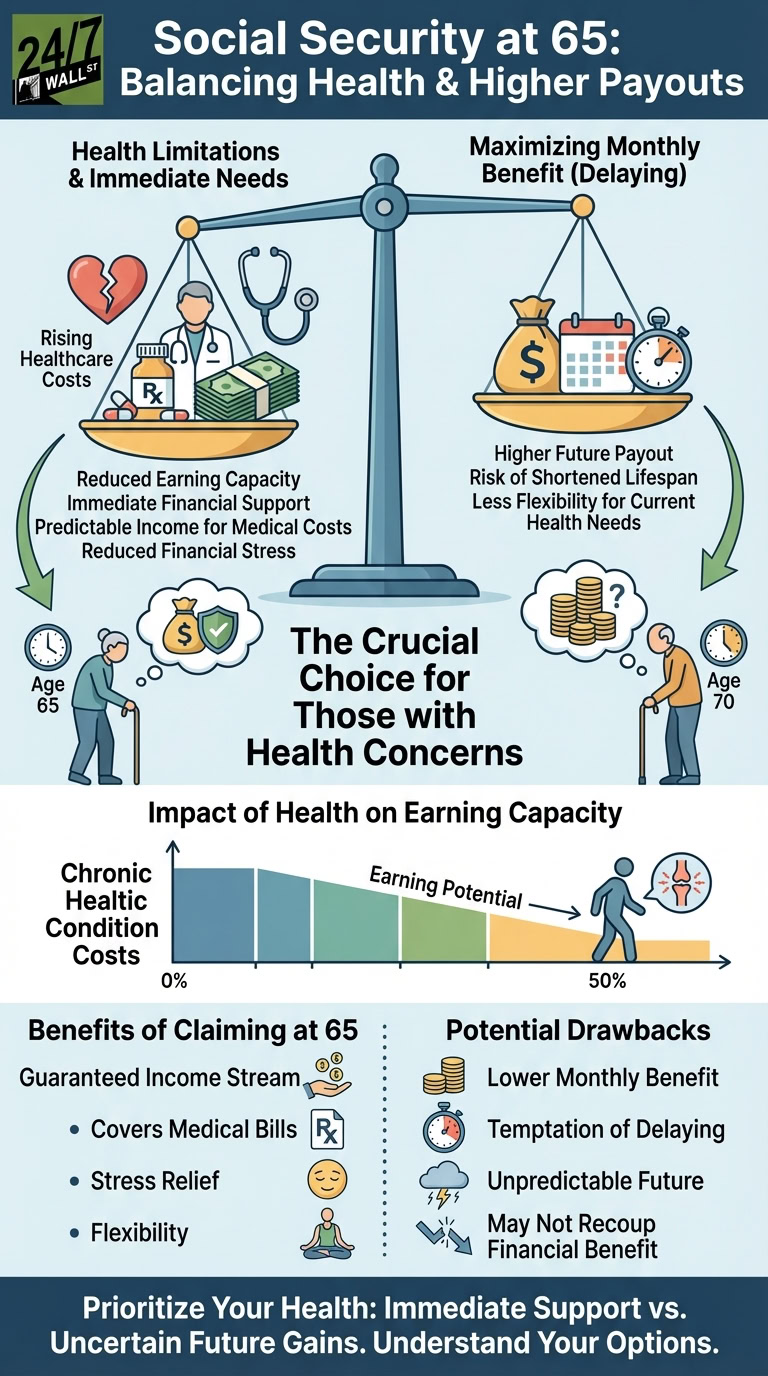
Most people hope to stay healthy well into their senior years, but that is not always what happens. Health problems can surface unexpectedly, sometimes before a person even reaches retirement age. Those facing serious challenges may find their earning capacity cut short or be forced to leave the workforce altogether.
Chronic illnesses such as heart disease, arthritis, or respiratory conditions can significantly limit physical capability and stamina, making it difficult or impossible to keep performing previous job duties. That creates a genuine double bind for retirees with health limitations: rising healthcare costs arrive at the exact moment the ability to generate income is potentially diminished.
In those circumstances, prioritizing your health often becomes the wiser financial move. The guaranteed income from Social Security can be exceptionally helpful even for those who can still work. Dropping to part-time hours and claiming Social Security may provide the relief your body needs while keeping some income flowing.
The Inflation Dimension
Health is the primary driver for many early claimants, but the current economic climate adds another layer to the calculation. The 2026 COLA delivered a 2.8% increase to around 75 million Social Security and Supplemental Security Income beneficiaries, lifting the average retired worker’s monthly benefit to approximately $2,086. Looking ahead, the leading forecasters have converged on 3.5% to 3.6% for the 2027 COLA as of mid-September 2026. The Senior Citizens League pegs the figure at 3.5%, revised down slightly from its earlier 3.6% estimate as inflation moderated, while AARP now independently projects 3.6%. The official figure will be announced by the SSA on October 14, 2026.
For those managing ongoing medical bills, claiming at 65 means locking in these inflation-adjusted increases on a check you are already receiving. A larger base benefit at 67 or 70 cannot replicate the immediate liquidity that early COLA-adjusted payments provide when living costs are elevated.
How Social Security Benefits Help
Social Security acts as a vital safety net for retirees, offering guaranteed monthly income that is not tied to market fluctuations or employment status. For those with health limitations, claiming at 65 can deliver several meaningful advantages:
- Immediate Financial Support: Claiming at 65 opens the income stream right away, which is crucial when facing rising healthcare costs. The guaranteed payment can cover essential medical expenses, prescriptions, and potentially even long-term care costs.
- Predictable Income Source: Chronic conditions can flare unpredictably. Having a steady income stream that does not depend on your ability to work can be a significant stress relief when you are in the middle of a medical battle.
- Reduced Financial Stress: Even if you do not strictly need the income right now, claiming at 65 builds a financial buffer in case your health deteriorates further, removing one major worry from an already difficult situation.
Protecting Your Portfolio
Claiming early also serves as a strategy to protect other retirement assets. By using Social Security at 65 to cover the floor of medical and living expenses, retirees can avoid selling stocks or mutual funds at a loss during market downturns. This supports a more sustainable withdrawal approach for private portfolios, helping savings last as long as they are needed.
Potential Drawbacks
There are real drawbacks to claiming Social Security before full retirement age. Your monthly benefit increases for every month you delay past your earliest eligibility, and that higher base compounds over time for those who live a long life. The temptation to delay is especially strong for retirees without substantial personal savings.
That said, delaying may not be the most prudent path if you have medical limitations or if recent legislative changes affect your situation. The Social Security Fairness Act, signed into law on January 5, 2025, fully repealed the Windfall Elimination Provision (WEP) and Government Pension Offset (GPO), restoring benefits for approximately 2.8 million people who had previously seen their checks reduced because of pensions from jobs not covered by Social Security. Workers such as teachers, firefighters, and police officers in many states were among those affected. By July 7, 2025, the SSA had completed sending over 3.1 million payments totaling $17 billion in retroactive benefits going back to January 2024, finishing five months ahead of schedule.
Separately, the 2026 Social Security trustees report, released June 9, 2026, projected the OASI trust fund could be depleted as soon as the fourth quarter of 2032, one quarter earlier than the prior year’s estimate. The report attributed part of that acceleration to the “One Big Beautiful Bill Act,” which reduced income tax revenues flowing into the program. If Congress does not act, the program would then be able to pay only about 78% of scheduled retirement benefits. That funding uncertainty is itself a reason some retirees prefer to claim earlier rather than counting on the full promised benefit years down the road.
The primary reason to consider claiming at 65 remains the uncertainty surrounding health. While delaying benefits offers a higher future payout, that calculation hinges on your ability to enjoy those benefits over an extended period. A larger monthly check provides little comfort if health problems cut that window short.
When deciding when to claim Social Security, reviewing our Social Security guide is a worthwhile first step. Understanding exactly how the program works and how your claiming age affects it is vital to making the best decision for your retirement.
Editor’s note: This update revises the 2027 COLA forecasts to reflect September 2026 data, with the Senior Citizens League now projecting 3.5% (revised down from 3.6%) and AARP projecting 3.6%; updates the average retired worker monthly benefit to $2,086, per the SSA’s July 2026 Monthly Statistical Snapshot; revises the beneficiary count to around 75 million per CNBC’s September 2026 reporting on SSA data; and names the “One Big Beautiful Bill Act” as the 2025 legislation the trustees cited in connection with the accelerated OASI depletion timeline.
Contact [email protected] for any questions or corrections.
Kristin Hitchcock is a financial expert who has been writing on topics related to retirement for over eight years. Her knowledge spans a wide range of areas, including navigating the complexities of Social Security, developing sustainable investment strategies, and helping individuals achieve their retirement goals.
Throughout her career, she has written for various platforms, including several retirement communities, to ensure that seniors have access to clear and actionable financial advice.
Kristin is also an active investor with more than ten years of experience in a diverse range of investment strategies, including short-term trades, dividend stocks, and options. She enjoys simplifying complex trading concepts by writing easy-to-follow guides that help readers meet their investment goals.