The Mag 7 Just Lost $2.3 Trillion in a Single Month. Here’s the AI Fear Behind It
The Magnificent 7 erased $2.3 trillion in market cap in June alone, the largest monthly loss ever for the group, even as the Nasdaq heads for its best quarter since 2020. CNBC’s MacKenzie Sigalos framed the split neatly on June…

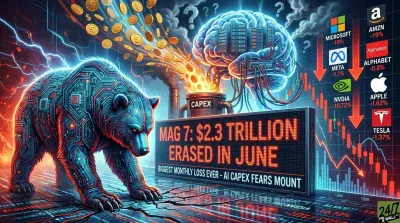
The Magnificent 7 erased $2.3 trillion in market cap in June alone, the largest monthly loss ever for the group, even as the Nasdaq heads for its best quarter since 2020. CNBC’s MacKenzie Sigalos framed the split neatly on June 30: “the mag-7 erased 2.3 trillion in June alone, the largest monthly market cap loss ever for the group.” The tape is telling you something specific about who is paying for AI, and who is getting paid.
The selloff was concentrated in the hyperscalers writing the biggest checks. Microsoft (NASDAQ:MSFT | MSFT Price Prediction) fell -19% in June, its worst month in years. Amazon (NASDAQ:AMZN) dropped -8.77%, Meta Platforms (NASDAQ:META) shed -6.11%, and Alphabet (NASDAQ:GOOGL) gave back -4.99%. Even NVIDIA (NASDAQ:NVDA), the supplier everyone else is feeding, slipped -10.72%. Apple (NASDAQ:AAPL) was down -5.53%. Yet the Nasdaq-100, via Invesco QQQ Trust (NASDAQ:QQQ), was essentially flat for the month at -0.85%. Money moved. It just did not leave tech.
Capex is eating cash flow
Sigalos pointed to the number that has been quietly reshaping the AI trade: “Hyperscaler capex is up 84% from a year ago. It now amounts to 98% of cash flow from operations.”
Almost every dollar these businesses generate is being recycled into chips, memory, and power. The receipts are in the filings. Microsoft’s most recent quarter carried $30.88 billion in CapEx, up 84% year-over-year. Amazon spent $43.2 billion in Q1. Alphabet ran $35.7 billion and now guides $180 to $190 billion for the full year, with 2027 “expected to significantly increase” on top of that.
Furthermore, Meta raised its full-year range to $125 to $145 billion, up from a prior $115 to $135 billion. Meta’s CFO told analysts the company has “continued to underestimate our compute needs even as we have been ramping capacity significantly.”
Bulls hear that as demand. Bears hear it as a company that cannot budget for its own core input.
Circular AI money and the dilution ghost
The other thing rattling investors is what happens to the checks once they leave the hyperscalers. “Google committing up to 43 billion to Anthropic, Amazon as much as 50 billion into OpenAI. But it is unclear they get paid back,” Sigalos said.
The money loops: cloud providers invest in labs, labs buy compute back from the cloud providers, and everyone points at the revenue as validation. On the Amazon call, Andy Jassy said the AWS backlog reached $364 billion, and that figure does not include the recent deal with Anthropic for over $100 billion. Microsoft’s OpenAI arrangement now covers an incremental $250 billion of Azure services.
With OpenAI’s IPO pushed and payback timelines fuzzy, retail is doing the math. On r/wallstreetbets, the post “Satya and Zuckerberg are incinerating capital” drew 1,024 upvotes and 415 comments. Meta’s Reddit sentiment score cratered to 12 (very bearish) on June 21. Then there is the dilution ghost. If cash flow is already fully committed and debt markets tighten, hyperscalers may issue equity, and Alphabet’s recent raise has become the reference point.
The rotation nobody is quite naming
NVIDIA’s June drawdown was real, but its year-to-date is still +4.6% and one-year is +29%, while Microsoft is -22% YTD. Jensen Huang keeps repeating that “the buildout of AI factories is the largest infrastructure expansion in human history.” The market seems to agree with him about the buildout. It just is not sure it agrees about who profits from it. For now, the suppliers, memory makers, power operators, and networking vendors are getting the benefit of the doubt. The buyers are being asked to show their work.
Contact [email protected] for any questions or corrections.
Omor Ibne Ehsan is a writer at 24/7 Wall St. He is a self-taught investor with a focus on growth, cyclical, and dividend equities that have strong fundamentals, value, and long-term potential. He also has an interest in high-risk, high-reward investments such as penny stocks.