One Wall Street Analyst Thinks SoFi Stock Could Jump 20%. Here’s Why.
SoFi has been punished hard in 2026, but a fresh Wall Street initiation and back-to-back earnings beats are rewriting the story. Whether the bull case or the rate-hike risk wins out depends on factors that make this call genuinely close.


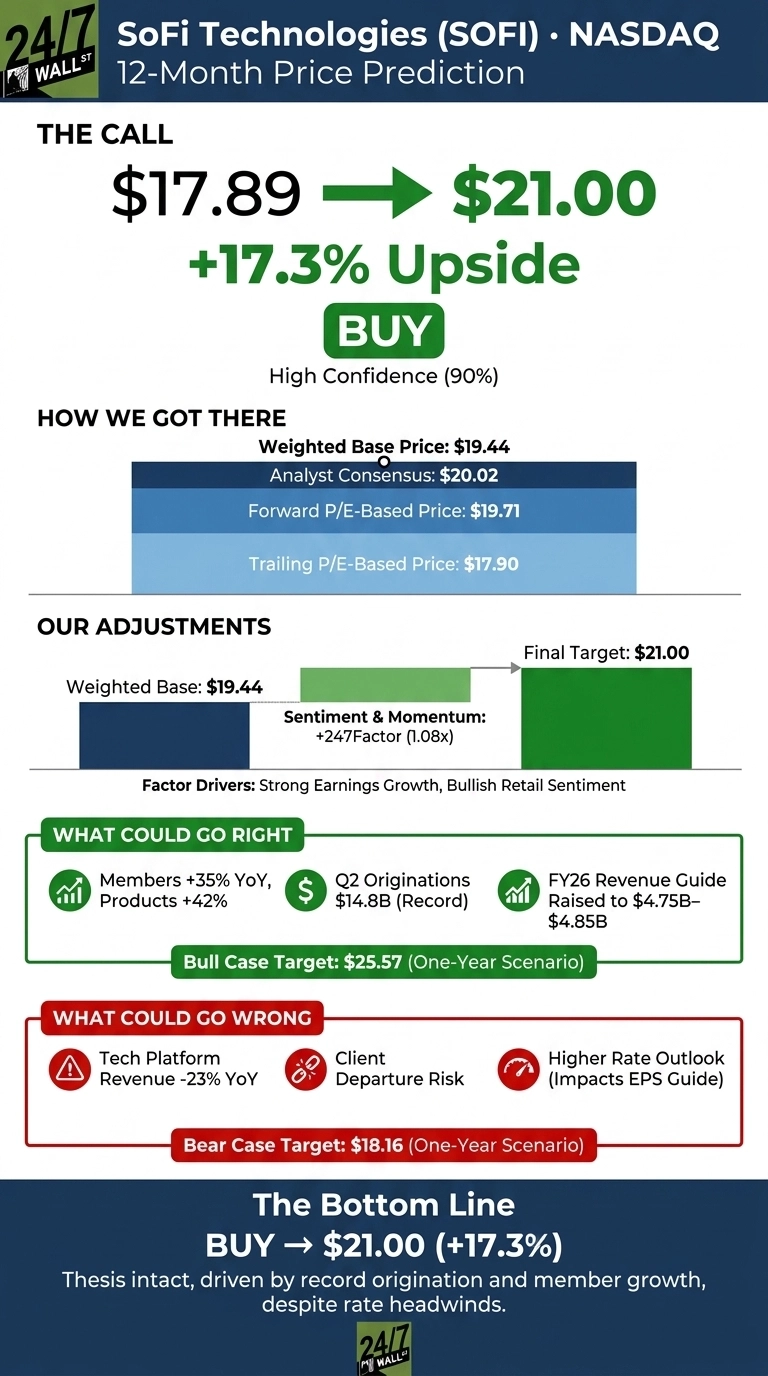
SoFi Technologies (NASDAQ:SOFI | SOFI Price Prediction) has set up attractively after a brutal first half of 2026. Our 24/7 Wall St. price target is $21, roughly a 17.3% move from the current price of $17.89. That aligns with the 20% gain some bull analysts see: this is a buy, with high model confidence.
24/7 Wall St. Price Target Summary
| Metric | Value |
|---|---|
| Current Price | $17.89 |
| 24/7 Wall St. Price Target | $21.00 |
| Implied Upside | 17.3% |
| Recommendation | BUY |
| Confidence Level | 90% |
A Rough YTD, but the Trend Is Turning
SoFi shares are down 29.64% year to date and 19.03% over the last year, still 39% off the 52-week high of $32.73. The recent trend is friendlier: up 8.29% in the past month, with Piper Sandler initiating coverage this week at Overweight.
Q2 results support the turn. SoFi delivered EPS of $0.12 versus $0.1092 expected, extended its beat streak to five consecutive quarters, and posted record loan originations of $14.8 billion. Management raised full-year adjusted revenue guidance to $4.75 billion to $4.85 billion.

Why Bulls See a Breakout Ahead
The bull case rests on the “everything app” flywheel. Members grew 35% YoY to 15.8 million, products grew 42%, and 51% of new products came from existing members, up from 35% a year ago. SoFi Plus crossed 200,000 paid subscribers, and CEO Anthony Noto said he would be disappointed if it were not at 1 million members generating $120 million in annual revenue within a year.
The Loan Platform Business offers real optionality: a $1 billion agreement with Sixth Street and a $3 billion deal with Basepoint Capital extend capital-light revenue into small business and home equity. If bulls are right, the bull-case path implies a one-year price of $25.57, roughly 43% upside.

What Could Go Wrong
The Technology Platform segment saw revenue fall 23% YoY after a large client departure. The segment grew 13% sequentially, and the Peach Finance acquisition broadens SoFi Tech Solutions into cards and BNPL, but client concentration risk is real.
Rates pose a second concern: management now expects one to two hikes in 2026 versus two cuts baked into original guidance, which dragged full-year EPS guidance to $0.60 from an implied $0.65. The bear-case path takes SoFi to $18.16, essentially flat.

How SoFi Compares to Robinhood and LendingClub
Robinhood Markets (NASDAQ:HOOD) posted Q2 EPS of $0.62 on 32% revenue growth and carries a market cap of $75.3 billion, more than 3x SoFi’s $23.1 billion. HOOD’s richer multiple on comparable growth suggests SoFi looks reasonably valued at 30x forward earnings.
LendingClub (NYSE:LC) guides FY2026 EPS to $1.80 to $1.90 with originations of $12.2 to $12.6 billion. That is below SoFi’s single quarter of $14.8 billion, and LC trades at a much thinner $2.14 billion market cap. The peer set makes our $21 target reasonable, not aggressive.
SoFi Price Prediction 2026-2030
The 24/7 Wall St. price target of $21 and buy recommendation stand, with 90% model confidence. The scale tips on origination momentum plus a re-rating catalyst from the Piper Sandler initiation.
The thesis strengthens if the Technology Platform segment shows sequential growth next quarter and net interest margin holds above 5%. The thesis weakens if benchmark rates keep grinding higher and personal-loan charge-offs push above 3%.
| Year | 24/7 Wall St. Price Target |
|---|---|
| 2026 | $19.22 |
| 2027 | $22.50 |
| 2028 | $25.00 |
| 2029 | $27.50 |
| 2030 | $29.65 |
These projections assume SoFi hits its medium-term guide of a 30%+ adjusted revenue CAGR and 38% to 42% adjusted EPS CAGR through 2028. Meaningful upside or downside could come from Loan Platform Business scaling or a sharp shift in the rate cycle.
Contact [email protected] for any questions or corrections.
Vandita Jadeja is a financial publisher with over a decade of experience writing about financial topics, including investment, savings, retirement, insurance and banking. Vandita is a Chartered Accountant who loves to debunk financial concepts for readers.
Her work has appeared on sites that include The Motley Fool, InvestorPlace, and Benzinga. She covers investing and focuses on stock picks and price prediction for 24/7 Wall St.
When not looking for the next stock investment opportunity, she can be found traveling, reading, chasing sunsets and enjoying her iced latte.