Prediction: Eli Lilly Could Be One of the Biggest Winners of the Next Decade. Here’s Why.
Eli Lilly just delivered one of the most staggering quarters in Big Pharma history, yet Wall Street is barely reacting. Three catalysts in the next 18 months could either push shares to levels few analysts dare to print or expose…

Eli Lilly (NYSE:LLY | LLY Price Prediction) just posted one of the most impressive quarters in Big Pharma history. Revenue jumped 47.67% to $22.974 billion, Mounjaro alone did $9.943 billion, and management raised full-year guidance again.
Shares are up 77.52% over the past year and 16.36% YTD. Trading near $1,263.92, the question is simple: can Lilly hit $1,750 by the end of 2027?

Why Lilly Is Trading Like a Steady Compounder Right Now
Despite the blowout earnings report, the stock is oddly digestible in the short run. LLY is up just 3.08% over the past week and 6.02% over the past month.
The reason is straightforward: realized prices are shrinking even as volume explodes. Q2 realized prices fell 13%, and Mounjaro’s addition to China’s National Reimbursement Drug List will lift volumes while pressuring price.
Add $2.78 billion in acquired IPR&D charges and a jump in the effective tax rate to 23.3%, and reported earnings are noisier than the underlying business. With a beta of 0.506, LLY tends to move in measured steps rather than sharp single-day gaps. The compounding here is grinding.
Wall Street Sees 4% Upside. Our Model Says 16%
The Street consensus target sits at $1,310.90, barely above where LLY trades today. The ratings breakdown: 5 strong buys, 17 buys, 4 holds, 1 sell, and 1 strong sell. Bullish sentiment is 79%.
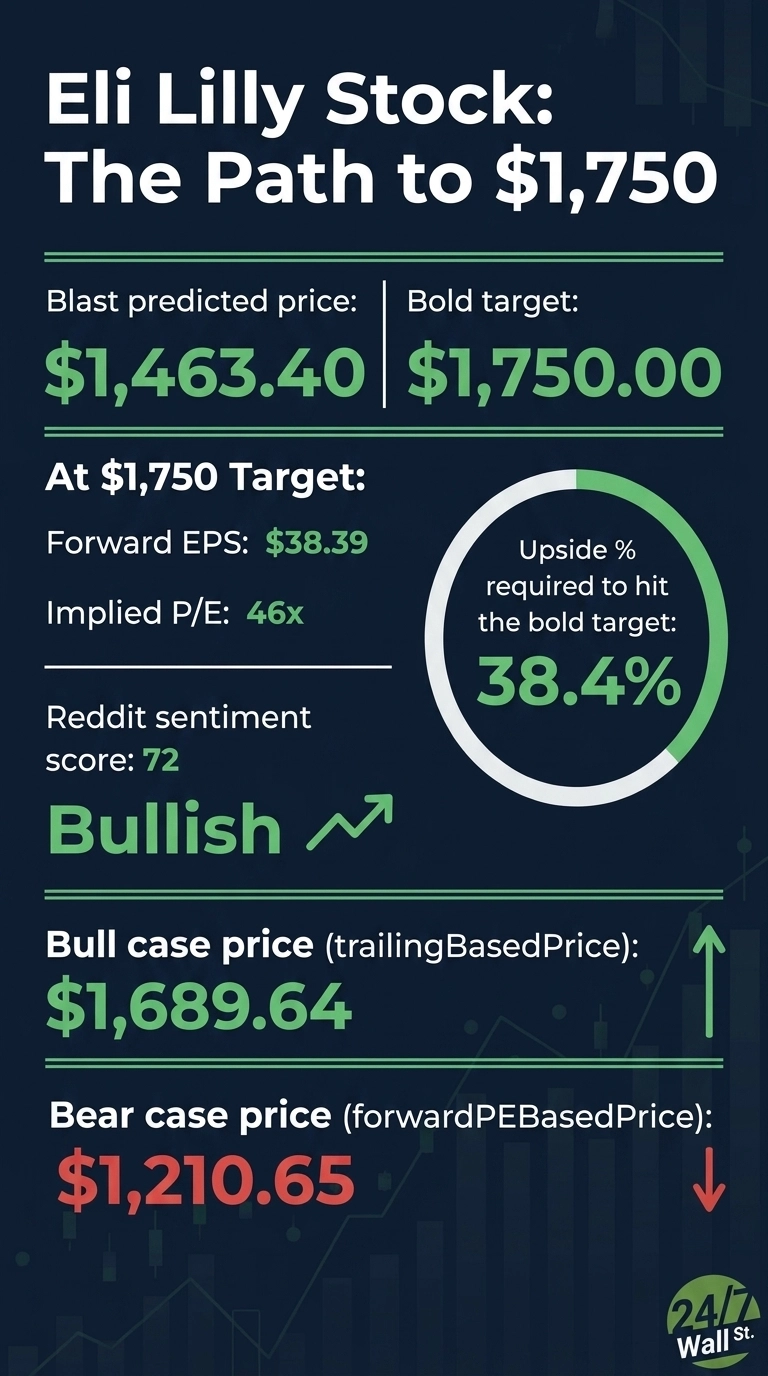
Our base-case model prints a one-year target of $1,463.40, an upside of 15.5%, with a bull case of $1,689.64 and a bear case of $1,210.65. Confidence is high (0.9). YoY earnings growth is 26.2%, and analysts have been chasing every quarter higher for a year straight.

Path to $1,750 Per Share
Reaching $1,750 from today’s price of $1,263.92 would require a gain of 38.4%. With forward EPS of $38.39, a price of $1,750 implies a forward P/E of 46x. Our base case of $1,463.40 already implies 40x, meaning the bold target requires roughly 6x of additional multiple expansion on top of continued EPS growth.
Is that achievable? Three catalysts matter. First, retatrutide’s BLA is set for Q1 2027, with Phase 3 data showing weight loss “approaching bariatric surgery levels.”
Second, Foundayo, the oral GLP-1, is under review in more than 40 additional countries with a global rollout in 2027.
Third, CEO David Ricks said “Lilly’s future, after 150 years, has never been brighter.” The risk: any retatrutide safety hiccup would compress the multiple fast.

Where LLY Trades Today vs Its Earnings Power
Today’s forward P/E works out to roughly 33x on forward EPS of $38.39. That is not cheap in absolute terms, but with FY2026 guidance now at $85 to $87 billion in revenue and non-GAAP EPS of $35.50 to $36.50, the growth rate justifies a premium.
Shares sit close to their 52-week high of $1,292.65 and well above the 52-week low of $689.88. Over ten years, LLY has returned 1,735.24%.
Is $1,750 Realistic?
Reaching $1,750 requires a 38.4% gain and a forward P/E of 46x. That is a stretch.
Three things need to go right: retatrutide’s Q1 2027 filing has to land clean, Foundayo’s international launches need to accelerate meaningfully, and price erosion in the US incretin market has to stay controlled by volume growth.
What derails it is a Novo Nordisk (NYSE:NVO) data readout that closes Lilly’s efficacy lead. We’ve outlined the blueprint for how Eli Lilly could reach $1,750 in 2027.
Contact [email protected] for any questions or corrections.
Vandita Jadeja is a financial copywriter who loves to read and write about stocks. She believes in buying and holding for long term gains. Her knowledge of words and numbers helps her write clear stock analysis. She has contributed to several publications, including the Joy Wallet, Benzinga, The Motley Fool and InvestorPlace.