Amazon Stock Could Surprise Investors Over the Next 12 Months
AWS just posted its fastest growth in 18 quarters while Amazon burns through billions in capex, and that tension is exactly what makes the next 12 months so pivotal for shareholders.


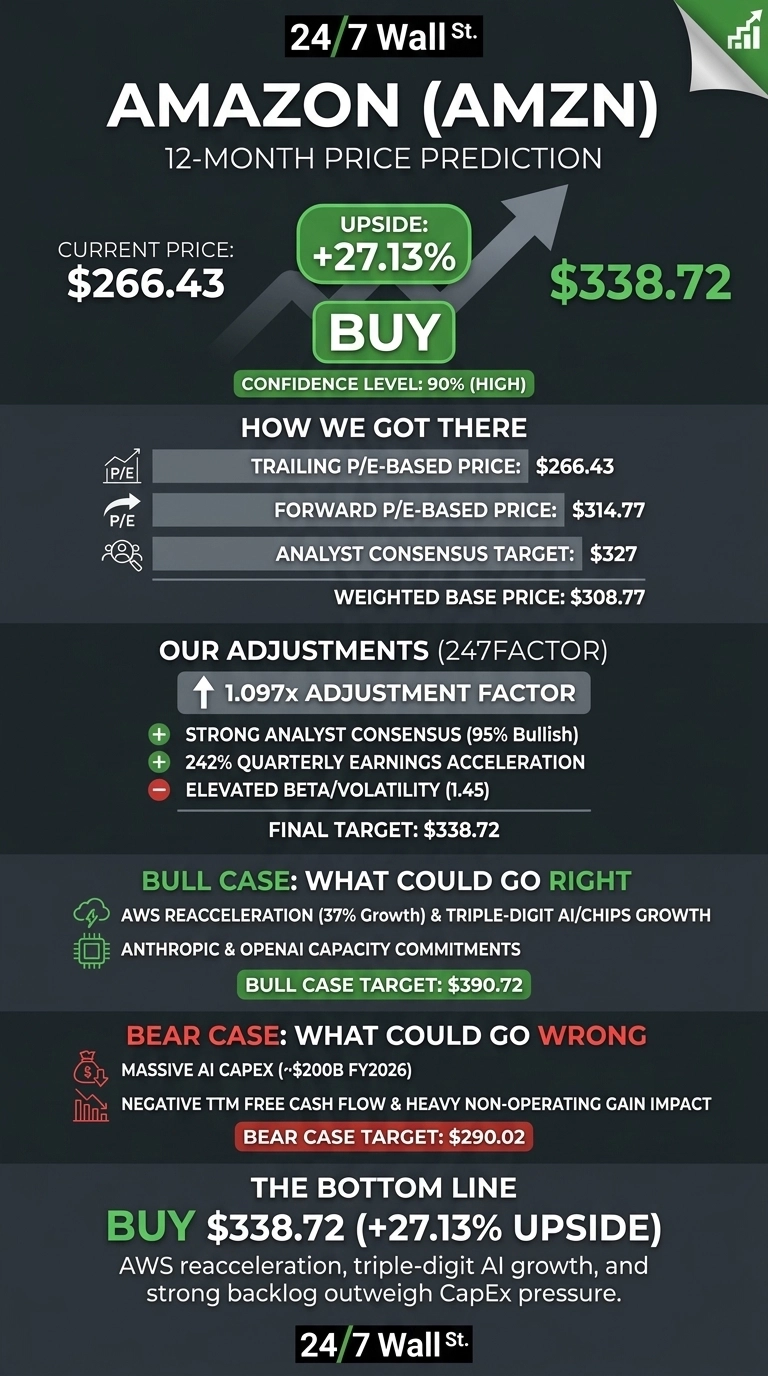
Amazon (NASDAQ:AMZN | AMZN Price Prediction) is trading at $266.43 after a 17.55% one-month rally that took the shares through what had been resistance around the prior 52-week high.
Our 24/7 Wall St. price target for Amazon is $338.72 over the next 12 months, implying 27.13% upside from current levels. Our recommendation is buy, and our model registers a high 90% confidence reading behind that call.

24/7 Wall St. Price Target Summary
| Metric | Value |
|---|---|
| Current Price | $266.43 |
| 24/7 Wall St. Price Target | $338.72 |
| Upside | 27.13% |
| Recommendation | BUY |
| Confidence Level | 90% |
An AWS Reacceleration That Changes the Story
Amazon reported Q2 FY2026 revenue of $200.61 billion, up 19.62% year over year, with operating income of $27.46 billion. AWS grew 37% to $42.23 billion at a 39.4% operating margin, the fastest AWS growth in 18 quarters.
CEO Andy Jassy said “AWS is booming, growing 36.7% year-over-year in Q2, our fastest growth in 18 quarters, and our AI and Chips businesses each eclipsed run rates of more than $25 billion.” The stock is up 15.43% year to date and 15.04% over the past year, with the AWS backlog now at $496 billion.

Why Bulls See a Path to $390
Our bull case pins Amazon at $390.72, a 46.65% return. The setup is straightforward: AWS AI and custom-silicon run rates are each above $25 billion and growing triple digits, Anthropic and OpenAI have committed to multi-year, multi-gigawatt Trainium capacity, and Jassy floated the possibility that AWS could become “a trillion dollar annual revenue business for us in time.”
Advertising grew 26% to $19.81 billion, and analyst sentiment skews sharply positive with 16 strong buy and 43 buy ratings.

What Could Go Wrong
Our bear case lands at $290.02, still 8.86% above spot. The biggest risk is capital intensity. FY2026 capex is guided to roughly $200 billion, Q2 capex alone hit $54.21 billion, and trailing free cash flow has swung to negative $7.6 billion.
Bulls will note this reflects data-center investments that management says take less than three years to break even and then earn for 30-plus years. GAAP EPS is also flattered by a $53.4 billion Anthropic gain, so headline P/E of 37 understates the underlying multiple.
How Amazon Compares to Microsoft and Alphabet
The cleanest comparisons are the other hyperscalers. Microsoft (NASDAQ:MSFT) trades at a P/E of roughly 29 with Azure growing 43% in fiscal Q4 and a $678 billion commercial RPO backlog, richer than AMZN on multiples but with a comparable AI growth story.
Alphabet (NASDAQ:GOOGL) is the value counterweight, at a P/E near 15 with Google Cloud growing 82% last quarter. Against MSFT, our AMZN target looks conservative on growth; against GOOGL, it looks fair given AMZN’s superior segment mix. On balance, the peer set makes $338.72 look reasonable.
Why the Setup Looks Constructive Here
The 24/7 Wall St. price target of $338.72 with a buy rating and 90% confidence reflects a clear thesis: AWS reacceleration to 37%, triple-digit AI and chip growth, and a $496 billion backlog outweigh capex-driven free cash flow pressure.
The setup looks constructive if AWS holds above 35% growth into Q4. The thesis weakens if capex creeps materially above $200 billion without matching revenue traction.
| Year | 24/7 Wall St. Price Target |
|---|---|
| 2026 | $291 |
| 2027 | $341 |
| 2028 | $406 |
| 2029 | $452 |
| 2030 | $505 |
These projections assume Amazon continues executing on AWS capacity buildouts and monetizing AI workloads.
All of that capacity has to be powered, cooled, and networked by somebody, and we profiled seven of those suppliers in a free report on the AI infrastructure names that aren’t chipmakers. Meaningful upside or downside could come from Trainium adoption beyond Anthropic and OpenAI, or from a demand air pocket that leaves reserved capacity underutilized.
Contact [email protected] for any questions or corrections.
Vandita Jadeja is a financial publisher with over a decade of experience writing about financial topics, including investment, savings, retirement, insurance and banking. Vandita is a Chartered Accountant who loves to debunk financial concepts for readers.
Her work has appeared on sites that include The Motley Fool, InvestorPlace, and Benzinga. She covers investing and focuses on stock picks and price prediction for 24/7 Wall St.
When not looking for the next stock investment opportunity, she can be found traveling, reading, chasing sunsets and enjoying her iced latte.