The Oracle Stock Question Wall Street Will Be Asking for Years
Oracle's AI backlog is exploding while its stock has been cut nearly in half, and that contradiction is forcing a fundamental question about whether Wall Street has this completely backwards.


Few large-cap stocks have flipped the AI infrastructure narrative like Oracle (NYSE:ORCL | ORCL Price Prediction). A year ago, ORCL traded above $298. Today it sits near $140.35, down 53.02% over 12 months even as its AI backlog exploded. That gap between operating reality and stock price is the Oracle question Wall Street will be arguing about for years.
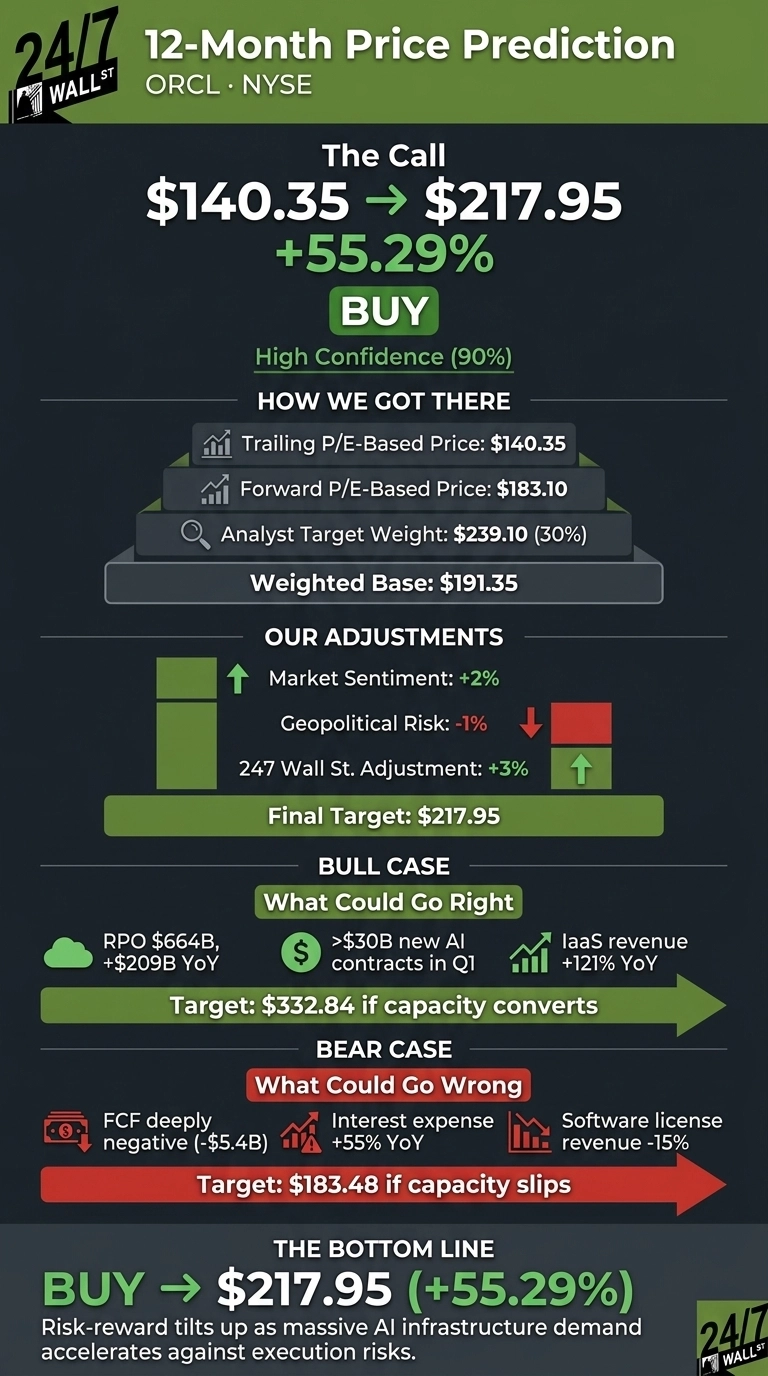
Our 24/7 Wall St. price target for Oracle is $217.95 over the next 12 months, implying 55.29% upside. Our recommendation is buy, with high confidence at 90%.
| Metric | Value |
|---|---|
| Current Price | $140.35 |
| 24/7 Wall St. Price Target | $217.95 |
| Upside | 55.29% |
| Recommendation | BUY |
| Confidence Level | 90% |

A Brutal Year Meets a Blowout Quarter
Oracle has been punished in 2026, down 27.29% year to date and 13.64% in the last week alone, sitting well below the 200-day moving average of $167.64.
Yet the Q1 FY2027 report on September 10, 2026 was a genuine standout: revenue of $19.345 billion (+29.61% YoY), non-GAAP EPS of $1.92 beating by 10.4%, and IaaS revenue up 121%. Days later, Larry Ellison cancelled a planned $7.5 billion sale of Oracle stock, a notable insider-alignment signal.
Why Bulls See a Breakout Ahead
The bull case starts with the backlog. Remaining performance obligations hit $664 billion, up $209 billion YoY, and management now expects roughly half of RPO to convert to sales over the next 36 months.
Oracle booked more than $30 billion in new AI contracts in Q1 alone, delivered 850 megawatts of capacity and over 300,000 GPUs, and ran GPU utilization at 97.9%.
Multicloud database revenue grew 353%. FY2027 guidance was raised to at least $90 billion in revenue. Our bull scenario points to $332.84, in line with the analyst high, if capacity converts on schedule.

What Could Go Wrong
The bear case centers on cash. Free cash flow was -$5.396 billion in Q1 on capex of $28.499 billion, and full-year capex is guided at $90 to $95 billion.
Interest expense rose 55% to $1.4 billion, and Oracle plans to raise roughly $40 billion through debt and equity in FY2027. Software license revenue fell 15%.
Bulls would counter that CFO Hilary Maxson said each project delivers roughly 100% free-cash-flow conversion to post-tax EBITDA after ramp-up, and that the majority of new contracts use prepay or bring-your-own-hardware structures. Still, our bear scenario clocks in at $183.48 if capacity slips.

How Oracle Compares to Microsoft and IBM
Microsoft (NASDAQ:MSFT) is the natural hyperscaler comp, given Azure sits directly opposite OCI in AI infrastructure. MSFT trades at a forward P/E of 25 with only 17.7% revenue growth, versus Oracle’s forward P/E of 19 on 29.6% growth. On growth-adjusted multiples, ORCL screens cheaper.
IBM (NYSE:IBM) is the legacy enterprise counterweight, sharing on-prem software exposure. IBM trades at a forward P/E of 18 but posted just 1.1% revenue growth last quarter. Oracle earns a similar multiple with growth an order of magnitude higher, which makes our $217.95 target look conservative against this peer set.
| Company | Forward P/E | Revenue Growth YoY |
|---|---|---|
| Oracle | 19 | 29.6% |
| Microsoft | 25 | 17.7% |
| IBM | 18 | 1.1% |
Oracle Price Prediction 2026-2030
The 24/7 Wall St. price target of $217.95 with a buy rating and 90% confidence reflects a stock that has been punished ahead of the actual revenue conversion.
The setup looks constructive if RPO continues converting at management’s stated pace and Vera Rubin deliveries scale in Q2. The thesis breaks if capex overshoots the $95 billion ceiling or major sites like New Mexico slip. On the numbers we have, the risk-reward tilts up.
| Year | 24/7 Wall St. Price Target |
|---|---|
| 2026 | $160.69 |
| 2027 | $217.95 |
| 2028 | $290.21 |
| 2029 | $353.28 |
| 2030 | $410.70 |
These projections assume Oracle continues converting its AI backlog on schedule and reaches positive free cash flow after the current capex peak.
Significant upside or downside could come from capacity execution, GPU sourcing, and the pace of on-prem software attrition. Oracle is only one piece of the AI infrastructure trade (we profiled seven suppliers powering the buildout, from power to cooling, in a free report you can grab here).
Contact [email protected] for any questions or corrections.
Vandita Jadeja is a financial publisher with over a decade of experience writing about financial topics, including investment, savings, retirement, insurance and banking. Vandita is a Chartered Accountant who loves to debunk financial concepts for readers.
Her work has appeared on sites that include The Motley Fool, InvestorPlace, and Benzinga. She covers investing and focuses on stock picks and price prediction for 24/7 Wall St.
When not looking for the next stock investment opportunity, she can be found traveling, reading, chasing sunsets and enjoying her iced latte.