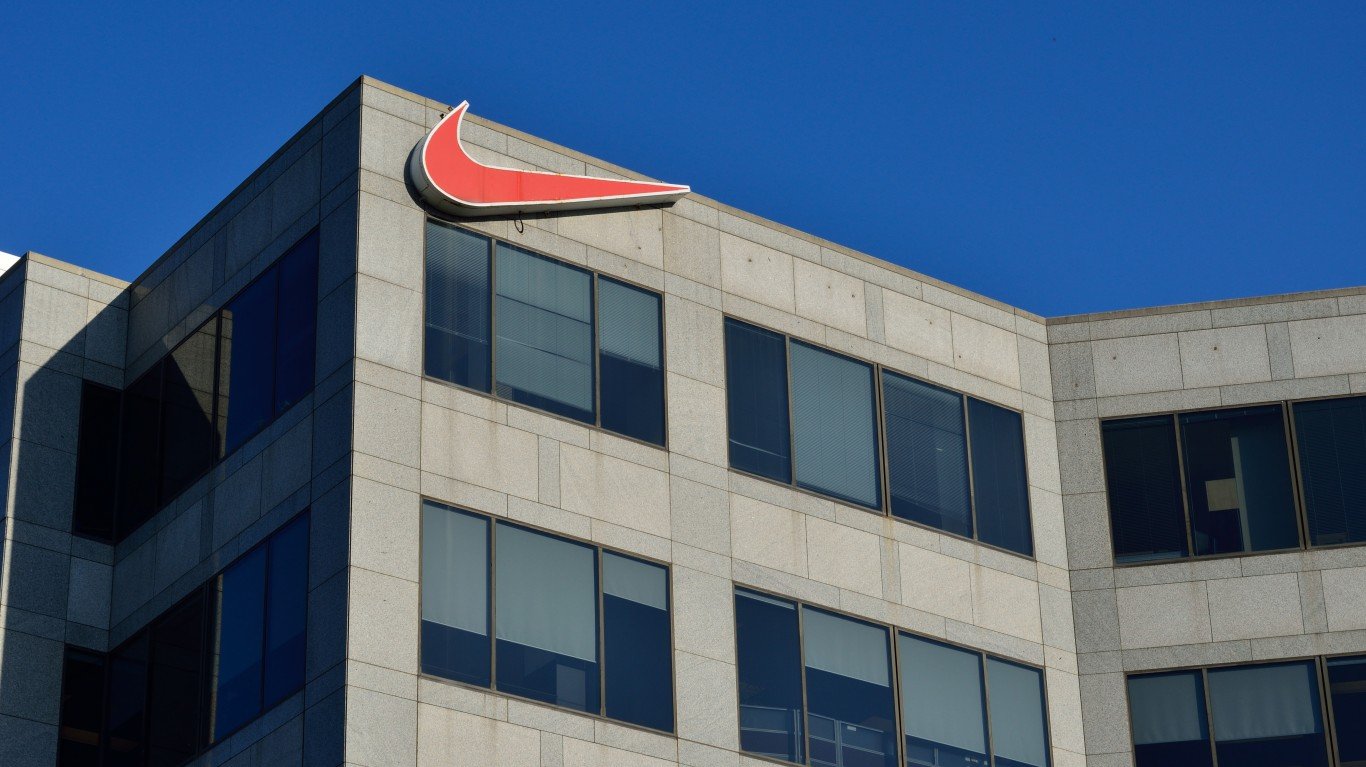
Nike Is Down About 80% From Its Peak and Just Told Investors Sales Will Fall Again
Nike's stock has collapsed from its highs, analysts still show a 30% upside gap, and management just guided earnings far below what Wall Street expected. The math behind those price targets tells a very different story.


Right now, Nike (NYSE:NKE | NKE Price Prediction) trades at $35.10, while the average Wall Street price target is $45.63. That leaves about 30% between the share price and where analysts think it should be.
The stock topped out at $179 in 2021. Management told investors that revenue will fall again across fiscal 2027, and it set an earnings range far below what analysts had modeled.
The guidance matters most because the earnings base has been reset lower, and much of the gap to the target likely reflects outdated analyst estimates.
An Earnings Beat That Points to Cost Control Over Demand

Revenue came in at $11.2 billion, missing the $11.3 billion consensus. Earnings per share of $0.48 beat the $0.44 estimate and came in close to the $0.49 Nike earned a year earlier.
Most of the beat came from 60 basis points of gross margin expansion from cheaper logistics and a 3% drop in SG&A. Nike managed costs well even as customers bought less.
Regionally, North America grew 2%, but Greater China fell 22%, and Converse fell 28%.
Management expects China to decline for the rest of the year.
Guidance Cut the Earnings Base Under Every Target
Nike guided fiscal 2027 adjusted earnings per share to a range of $1.15 to $1.35. Analysts had modeled $1.67, so the midpoint sits about 25% below consensus.
A price target is a multiple applied to forward earnings. Switching the guidance midpoint for consensus, the average target falls to roughly $34.15, which is below the current price.
At that midpoint, the stock trades at roughly 28 times guided earnings. That is a growth multiple for a company expecting revenue to fall by a high single-digit percentage.
Shares are down 43.36% this year and 51.06% over twelve months, and the stock sits about 80% below its peak.
Pace Lowers Costs While Demand Stays Unsolved
The restructuring, called Pace, targets $2.5 billion in savings through fiscal 2031 and will cost about $1 billion in charges. Most savings land in fiscal 2029 and 2030, so the program should lift margins later, although cost cuts alone do little to rebuild demand.
Chief Executive Elliott Hill said, “Our Nike performance business is not yet large enough to offset the pressure we’re seeing in Nike Sportswear, Jordan Brand, and Greater China.” Performance is a $16 billion business while Sportswear contracts at a low double-digit rate.
Running is also a category where specialists compete directly with Nike. On Holding (NYSE:ONON) is down 35.03% this year and Hoka owner Deckers Outdoor (NYSE:DECK) is down 23.25%. Both fell less than Nike.
Wall Street’s Average Target Has Gone Stale
The current ratings mix is 1 highly bullish, 10 bullish, 25 neutral, 1 bearish, and 2 highly bearish. Most calls came before the guidance, so targets are outdated.

The most bearish major bank downgraded the stock to Underperform with a $30 target, which is below the current price. Most of the 30% gap reflects targets set before the guidance.

Investors can track whether Greater China revenue steadies, inventory runs clean, gross margin turns higher, and where first post-guidance target updates land. The November investor day should show Nike’s long-term financial targets.
What Would Change the Outlook for Nike Stock
The outlook would likely improve if China steadies and Pace clearly cuts the cost base, because margins would recover once costs fall. It would decline if revenue keeps falling into fiscal 2028.
Bears could prove wrong, because a restructuring that actually cuts costs changes what any given level of revenue earns, so recovering earnings could make today’s multiple look cheap in hindsight.
The stock trades at roughly 28 times reduced earnings, with targets that haven’t caught up. The risks currently look larger than the upside implied by outdated targets.
Deckers offers a useful comparison. It trades at $79.62 against an average target of $120.41, implying about 51% upside, and its quarterly revenue grew 5.7%. Its forward multiple is about 11 times earnings. Hoka competes directly in the running category Nike is trying to win back. Deckers’ forecasts rest on a growing business.
Contact [email protected] for any questions or corrections.
Omor Ibne Ehsan is a writer at 24/7 Wall St. He is a self-taught investor with a focus on growth, cyclical, and dividend equities that have strong fundamentals, value, and long-term potential. He also has an interest in high-risk, high-reward investments such as penny stocks.