Oracle Rises 5% as Google TPUs Come to Oracle Cloud and NVIDIA Deal Expands; Amazon Nudges Higher, Microsoft Treads Water
Oracle just pulled off something no other hyperscale cloud outside Google has managed, and the market responded with a sharp single-day surge even as the company burns through cash at an alarming rate. Whether this bet on rival chip architectures…

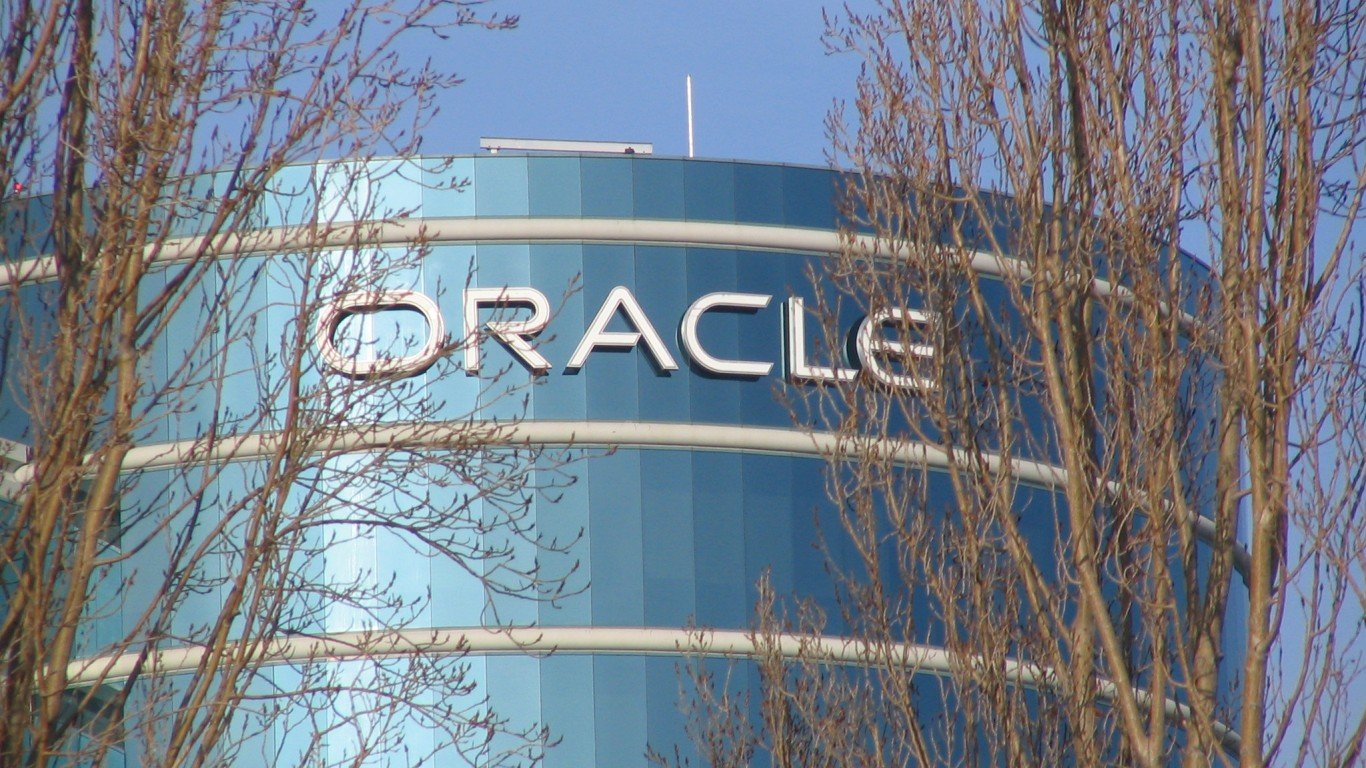
Rival AI chip architectures are headed for one shared cloud at Oracle (NYSE:ORCL | ORCL Price Prediction), and Wall Street is adopting the plan. Oracle stock is at $132.28, up 5% in afternoon trading, a move that rewards the company’s push to host more than one supplier’s silicon. Oracle shares remain down 31% year to date despite the jump.
Meanwhile, Amazon (NASDAQ:AMZN) stock is at $253.71, up 2%, a healthy gain that still trails the advance in Oracle stock. Microsoft (NASDAQ:MSFT) stock is at $532.76, essentially unmoved and lagging both cloud rivals. Amazon and Microsoft each run a giant cloud that competes head-on with Oracle for AI workloads, so the performance gap between the three stands out.
Broader tech benchmarks are climbing at a slower clip than Oracle stock. The Technology Select Sector SPDR ETF (NYSEARCA:XLK) is up 2%, while the Invesco QQQ Trust (NASDAQ:QQQ) is up 1.3%.
TPUs and Vera Rubin Superclusters Head to OCI
Oracle made the announcement at its Oracle AI World event. The company said that Alphabet‘s (NASDAQ:GOOGL) Google will make its Tensor Processing Units (TPUs) available through Oracle Cloud Infrastructure (OCI), the company’s fast-growing AI rental business. It’s the first time Google will offer the chips on a hyperscale cloud platform outside its own walls, with availability starting next year and ramping over several years. Mahesh Thiagarajan, president of OCI, framed the deal around customer choice, stating, “Bringing Google TPUs to OCI gives customers access to multiple leading AI compute architectures in one cloud.”
Separately, Oracle and NVIDIA (NASDAQ:NVDA) announced plans to expand OCI’s NVIDIA Vera Rubin superclusters to multi-gigawatt scale. Both companies also made NVIDIA’s Vera Rubin systems and Vera CPUs generally available on Oracle’s cloud, giving customers immediate access to the newest NVIDIA hardware. That pairing puts NVIDIA GPUs and Google TPUs under one roof for OCI customers, a combination no other hyperscale cloud outside Google has offered.
Oracle Plays Neutral Host as Rivals Build In-House Chips
Trainium chips anchor Amazon’s custom silicon effort, while Microsoft has built its Maia 200 accelerator for Azure. Each company still offers NVIDIA hardware as well, leaving Oracle to stand out on range of choice, which now includes Google’s chips, and such range gives OCI a pitch to customers who want to test workloads on different architectures without switching providers.
Results from Oracle’s Q1 FY2027 showed both sides of that approach. Cloud infrastructure revenue at Oracle soared 121% and remaining performance obligations reached $664 billion, yet capital expenditures hit $28.5 billion and free cash flow landed at negative $5.4 billion. Clay Magouyrk, speaking as CEO on the quarter’s earnings call, stated that NVIDIA Vera Rubin systems were “performing better than expected across hardware quality, manufacturing yield and performance.”
Skeptics see timing problems. Google’s chips don’t arrive until next year and ramp slowly, while Oracle’s multi-gigawatt build-out demands heavy spending (we covered seven of the power, cooling, and networking suppliers behind that buildout in a free report here). Funding that expansion could keep pressure on Oracle’s cash flow and balance sheet for several more quarters, and delays at any single data center campus could also push revenue further out.
Oracle’s Multi-Chip Cloud Strategy Faces Its Proving Ground
Oracle must now show whether Google TPU capacity arrives on schedule next year with early customers committing to it at scale. Execution on the multi-gigawatt Vera Rubin expansion carries equal weight, since it ties up power, construction workers and financing on a massive scale. A key signal will be whether OCI names customers for the TPU capacity before the chips go live.
One strong rally in Oracle stock can’t erase a long slide, and the company’s capital needs stay large while TPU revenue remains a future event. Shareholders should size their positions modestly until Oracle’s Google TPU rollout resolves.
Contact [email protected] for any questions or corrections.
David Moadel is financial writer specializing in stocks, ETFs, options, precious metals, and Bitcoin. David has written well over 1,000 articles for leading online publications, helping investors understand markets, income strategies, and risk.His work has appeared in The Motley Fool, InvestorPlace, U.S. News & World Report, TipRanks, ValueWalk, Benzinga, Market Realist, TalkMarkets, Finmasters, 24/7 Wall St., and others.With a master’s degree in education, David has taught at the elementary, high school, and college levels. That teaching background shapes his writing style: clear, educational, and practical. David has also built a loyal social-media audience by providing trustworthy financial content on YouTube, X/Twitter, and StockTwits.